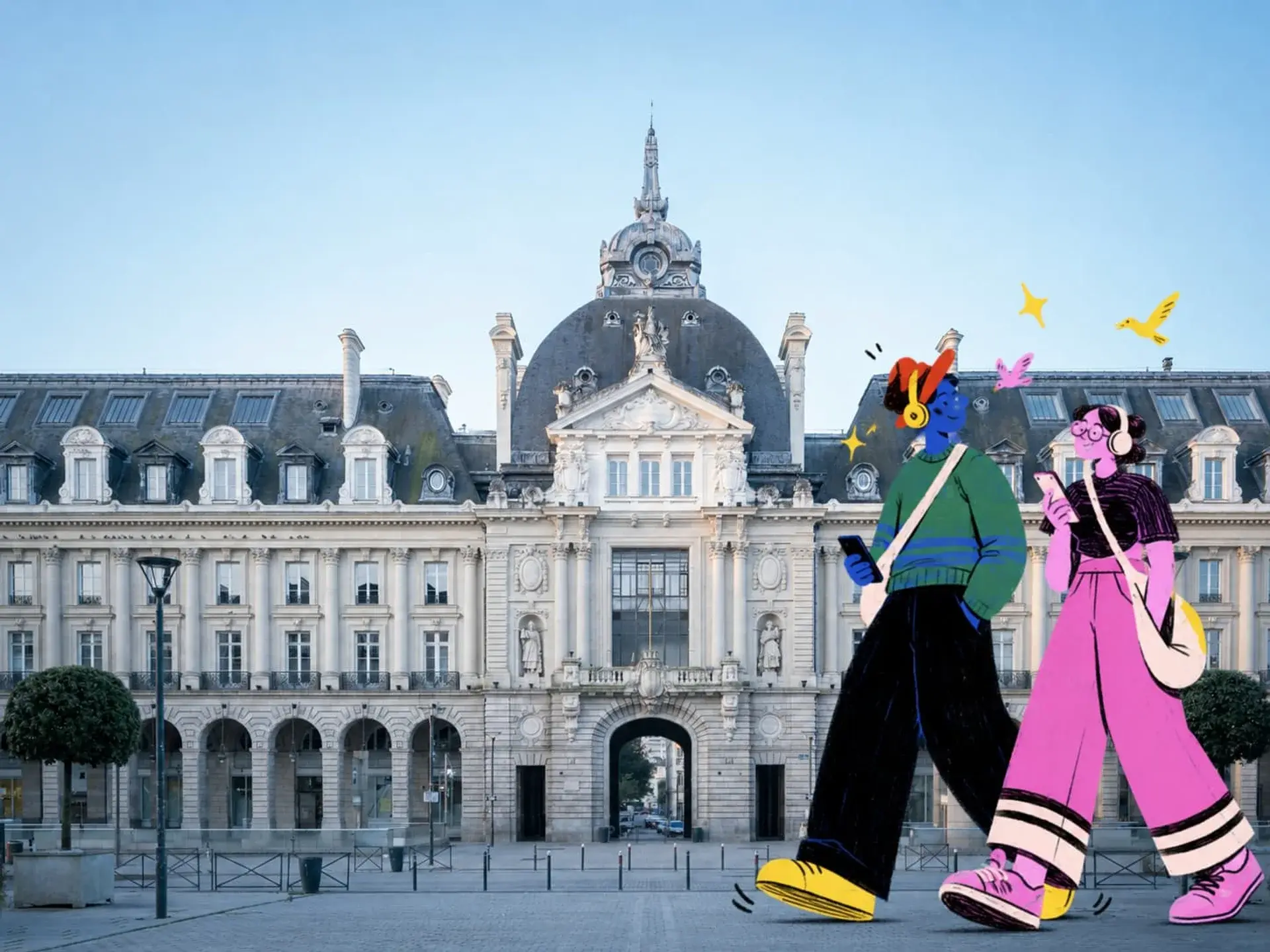
Rennes City Hall: History and Architecture
Architecture and Post-Fire Reconstruction
Rennes City Hall (Hôtel de Ville de Rennes) is the civic focal point of Place de la Mairie. Following the devastating Great Fire of 1720, which leveled much of the city, royal architect Jacques Gabriel (premier architecte du Roi) was commissioned to redesign the municipal center. Construction began with the laying of the cornerstone in 1734 and concluded in 1743. Built from ashlar stone, the building combines classical and Baroque elements, serving as a transitional anchor between the surviving medieval timber-framed core to the north and the planned 18th-century stone grid.
Gabriel’s masterplan brought three vital civic functions under a single cohesive facade. The south wing housed the municipal administration, the north wing contained the judicial courts (Présidial), and the center featured a recessed clock and belfry tower (Tour de l’Horloge). The structure is characterized by two symmetrical, forward-curving pavilions framing the central tower, creating an inviting concave profile along the square.
The Empty Niche and Breton Politics
Directly beneath the central clock tower sits a prominent classical arched niche that has stood vacant for nearly a century. In 1754, a bronze sculpture group by Jean-Baptiste Lemoyne depicting Louis XV over an allegorical representation of Brittany was placed in the alcove to honor royal rebuilding funds. That sculpture was dismantled and melted down during the French Revolution.
In 1911, the alcove received a new monument by sculptor Jean Boucher commemorating the 1532 union between Brittany and France. The artwork depicted Duchess Anne of Brittany kneeling before France, which drew sharp public criticism locally as "La Bretagne à genoux" (Brittany on her knees). On the morning of August 7, 1932—the 400th anniversary of the union—the militant Breton nationalist group Gwenn ha Du destroyed the statue with an explosive device. Rather than replace the monument and risk further regional political conflict, city authorities chose to leave the stone niche permanently empty.
Modern Civic Roles and the Panthéon Rennais
Today, Rennes City Hall continues to operate as the functional heart of the local government. It accommodates the mayor's office, the city council chambers, and municipal registry services such as weddings.
The ground floor of the north pavilion is home to the Panthéon Rennais. Designed after World War I by municipal architect Emmanuel Le Ray, this public hall serves as a civic war memorial honoring residents of Rennes who lost their lives in service.
Architectural Harmony and Local Wildlife
The placement of Rennes City Hall creates an architectural dialogue across Place de la Mairie. Directly opposite the building stands the Rennes Opera House, constructed with a convex rounded facade intentionally designed to mirror the concave, inward curve of Gabriel's municipal complex.
The belfry also maintains a long civic tradition. It replaced the timekeeping role of the lost medieval clock tower that once held a famous massive bell known as La Grosse Françoise. Today, the building's historical stone craftsmanship supports urban wildlife, as the ornate classical mouldings and friezes beneath Gabriel’s rooflines host a documented nesting colony of house martins (hirondelles de fenêtre).
FAQ
Why is the niche beneath the clock tower empty?
The niche has remained empty since August 7, 1932, when a controversial 1911 statue depicting Anne of Brittany kneeling before France was destroyed by the Breton nationalist group Gwenn ha Du. Municipal authorities chose not to replace it to avoid political friction.
Who designed Rennes City Hall?
Rennes City Hall was designed by Jacques Gabriel, premier architecte du Roi, as part of the reconstruction plan following the Great Fire of 1720. Construction took place between 1734 and 1743.
What is the Panthéon Rennais inside City Hall?
The Panthéon Rennais is a public municipal war memorial hall situated on the ground floor of the north pavilion. It was created after World War I by architect Emmanuel Le Ray.
How does Rennes City Hall connect with the Rennes Opera House?
The Rennes Opera House sits directly opposite the City Hall on Place de la Mairie and was built with a convex facade specifically designed to complement the concave curve of Gabriel's building.