The Ionian Parliament: Corfu's Independence Landmark
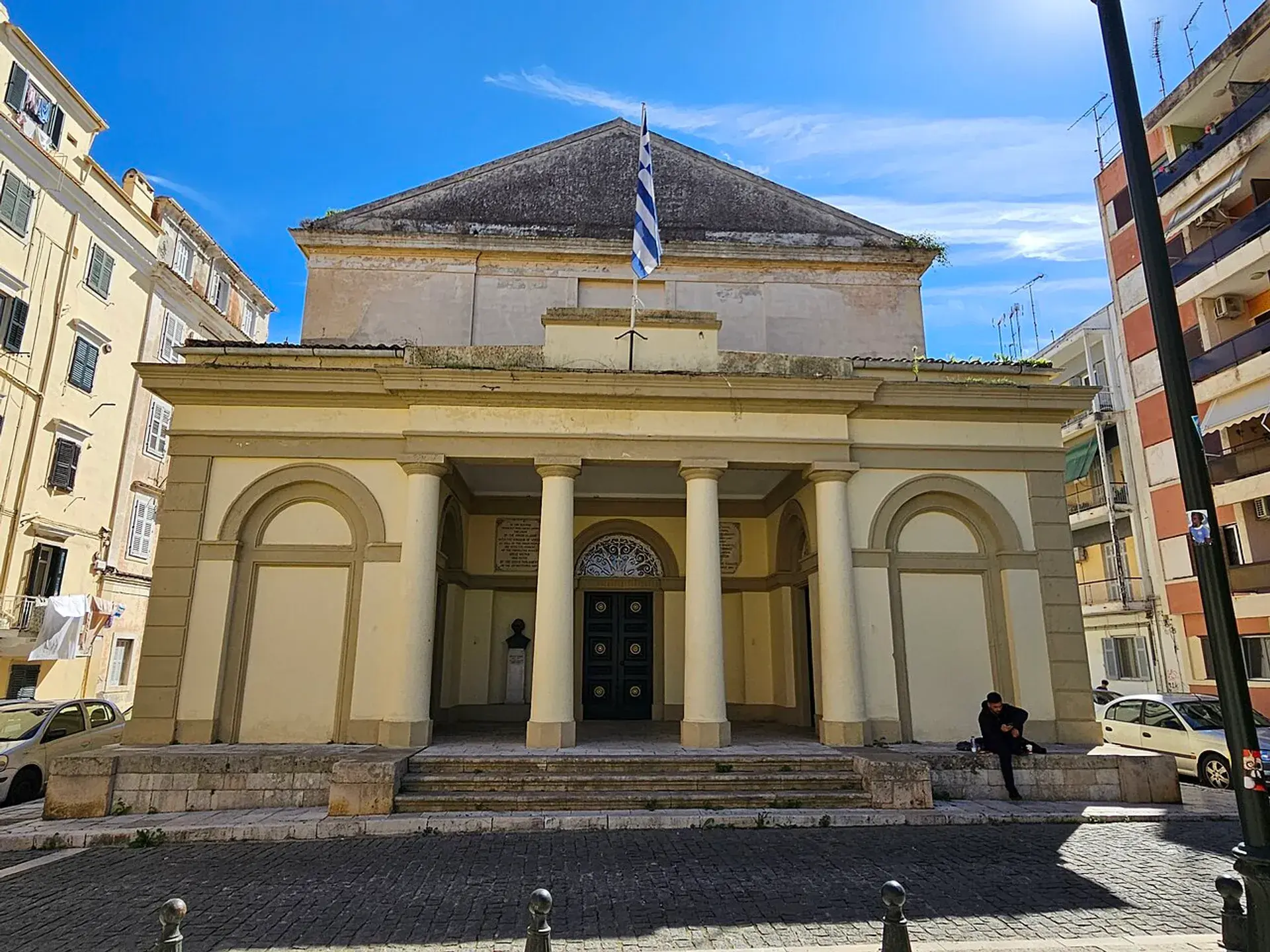
The Ionian Parliament stands as a monumental landmark of political heritage in the heart of Corfu's UNESCO-listed Old Town. Located at an intersection traditionally known as Plati Kantouni, or "Wide Alley," the building is just steps from the historic Town Hall and Spianada Square. It physically marks the definitive political transition of the Ionian Islands out of a half-century of British administration and into the modern Greek state.
A Vote for Unification
Following the 1815 Treaty of Paris, a British protectorate was established over the Ionian Islands. Driven by the local Ionian Radical movement, deputies gathered in this hall on September 23, 1863. During a historic session of the 13th Parliament of the United States of the Ionian Islands, they voted to dissolve the protectorate and unite with the Kingdom of Greece. Sovereignty was officially ceded to Greece the following year, in May 1864.
Neoclassical Architecture
Built between 1854 and 1855, the parliament was designed by prominent Corfiote architect Ioannis Chronis. The severe, classical stone pediment and prominent Doric columned portico present a stark architectural contrast to the tall, pastel-washed Venetian residential facades flanking the surrounding narrow lanes. Carved marble plaques flank the entrance portico, featuring bilingual inscriptions in English and Greek that commemorate the establishment of the democratic parliament. Inside, Chronis designed the space with a second tier of columns supporting a semi-circular gallery, allowing ordinary citizens to sit above and watch parliamentary debates.
A Surprising Transition and Restoration
Once legislative power was centralized in Athens after the unification, the dedicated parliament building became obsolete. In a surprising historical twist, the Greek Parliament handed the building back to the local British community in 1869—just six years after the vote to end British rule. It was consecrated as the Holy Trinity Anglican Church in 1870, serving the congregation for over seven decades.
The structure suffered severe damage on September 14, 1943, when German incendiary bombs largely destroyed it during World War II air raids. The Greek state eventually reclaimed and restored the building in 1962 under the direction of architect Ioannis Kollas.
The Ionian Parliament Today
Reopened in its present form in 1978, the building now functions as a municipal museum. The exhibits are dedicated to the struggles and historical freedom movements of the Ionian Islands. The space also operates as a public exhibition hall, a gallery annex, and a distinguished venue for lectures and official civic events.
FAQ
When was the Ionian Parliament built?
The Ionian Parliament was built between 1854 and 1855 by the prominent Corfiote architect Ioannis Chronis.
What historic event took place at the Ionian Parliament?
On September 23, 1863, local deputies in the Ionian Parliament voted to dissolve the British protectorate and formally unite the Ionian Islands with the Kingdom of Greece.
Did the Ionian Parliament ever serve as a church?
Yes. After the unification with Greece rendered the building politically obsolete, it was handed back to the British community in 1869 and served as the Holy Trinity Anglican Church for over 70 years.
What is the Ionian Parliament building used for today?
Today, it operates as a municipal museum dedicated to the historical freedom movements of the Ionian Islands, as well as an exhibition hall and venue for official civic events.