The Liston Corfu: History, Architecture & Cafés
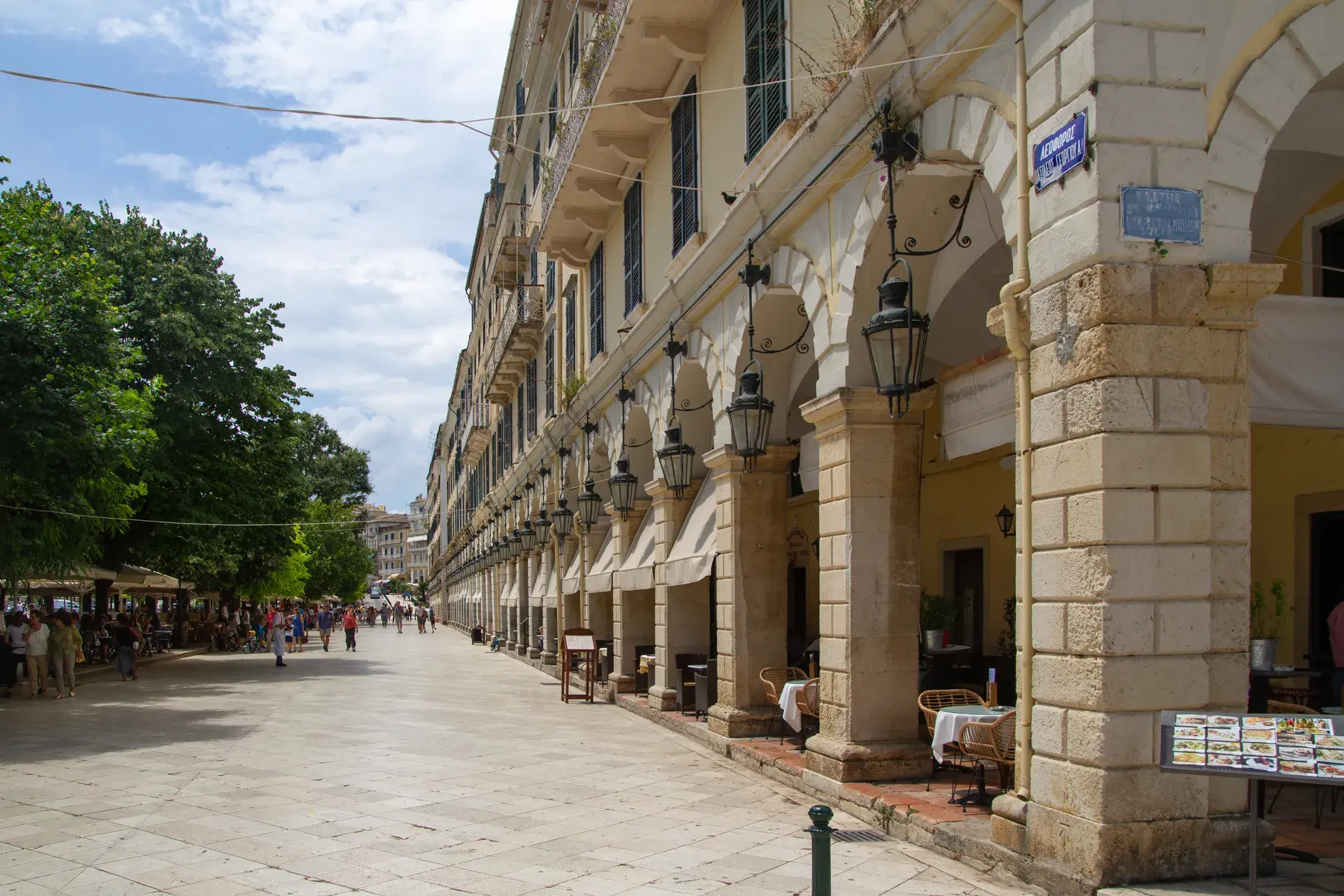
Modelled after the neoclassical arcades of the Rue de Rivoli in Paris, the Liston is a monumental pedestrian promenade and residential row situated on the western edge of the Spianada square in Corfu Town. Acting as a transition zone between the dense Venetian alleyways of the Old Town and the vast open greenery of the Spianada, this elegant colonnade stands as the city's classic gathering hub.
A Legacy of Empires
Following the Treaty of Tilsit in 1807, Corfu came under French rule, initiating a wave of Parisian-style urban modernization. French Imperial Commissioner Mathieu de Lesseps, alongside Greek engineer Ioannis Parmezan, designed the gallery along the border of the Spianada. This area had previously been kept clear of buildings as an open Venetian military defensive field to ensure a line-of-sight artillery defense. Interestingly, project director Mathieu de Lesseps was the father of Ferdinand de Lesseps, the prominent developer who later oversaw the construction of the Suez Canal.
Architectural Evolution
While the initial ground-floor structure was established under the French administration between 1807 and 1814, the building continued to evolve. During the subsequent British protectorate (1815–1864), the upper residential and commercial office floors were gradually added above the arcades. The British completed the facade and integrated Venetian-style lanterns into the high stone archways. Today, the upper stories still function as private apartments and commercial spaces.
The Social Center of Corfu Town
The ground-floor colonnade serves as Corfu Town's central social promenade. High stone archways cast deep shade across the marble walkway, sheltering outdoor café terraces, pastry shops, and restaurants. Ambient background noise often drifts in from cricket matches and band music taking place on the open lawns of the adjacent Spianada. Establishments under the arcades traditionally serve local ginger beer, known as tsitsibira, and kumquat liqueur, both legacies of British rule and late 19th-century agricultural trade.
The paved strip immediately in front of the Liston acts as the primary viewing concourse for major civic and religious processions. These include the famous Holy Saturday pot-throwing tradition and the Palm Sunday marches.
The Origin of the Name
A persistent local legend claims that the name "Liston" derives from the Libro d'Oro, the golden book of nobility. According to the myth, only aristocrats whose names appeared on this registry list were permitted to walk along the promenade. In reality, architectural historians note that "liston" is a standard Venetian dialect term referring to a wide, straight promenade paved with marble slabs, identical to listons found across former Venetian territories.
FAQ
Why is it called the Liston in Corfu?
While a local legend claims the name comes from the 'Libro d'Oro' nobility list, 'liston' is actually a standard Venetian dialect word for a wide, straight promenade paved with marble slabs.
What is the architectural style of the Liston?
The Liston features a neoclassical design modelled after the arcades of the Rue de Rivoli in Paris, complete with arched bays and Venetian-style lanterns added by the British.
Who built the Liston in Corfu?
Construction began under French Imperial Commissioner Mathieu de Lesseps and Greek engineer Ioannis Parmezan between 1807 and 1814. The British later added the upper floors during their protectorate (1815–1864).