St. George Cathedral Nafplion: History & Architecture
Visible from the square outside, the historic stone architecture of St. George Holy Orthodox Metropolitan Church physically embodies Nafplion's multi-layered transitions between Venetian, Ottoman, and Greek control. The building shifted from a Venetian church to an Ottoman mosque before becoming the first modern political and religious center of the newly formed Greek state.
A History of Shifting Rulers
Constructed in the early 16th century during the first period of Venetian rule over Nafplion, the Metropolitan Church of Saint George (Agios Georgios) reflects the changing hands of the city. Following the Ottoman conquest in 1540, the building was converted into a mosque. It returned to Christian worship in 1686 when Venetian commander Francesco Morosini recaptured the city, hosting a grand victory service of thanksgiving. Under the second Ottoman rule in 1715, it became a mosque once again. The site permanently returned to Orthodox Christian hands upon the Greek liberation of Nafplion in 1822.
Center of the Revolutionary State
During Nafplion's tenure as the capital of modern Greece, Saint George became the ceremonial heart of the nation. Following the assassination of Ioannis Kapodistrias, the first Governor of Greece, in October 1831, his solemn state funeral was held inside the church. His embalmed body was kept in the vestry for roughly six months before being transported to Corfu. The church also hosted the funerals of prominent Greek War of Independence figures, including Bishop Germanos of Old Patras and General Dimitrios Ypsilantis, who was buried in the church's narthex following his death in 1832.
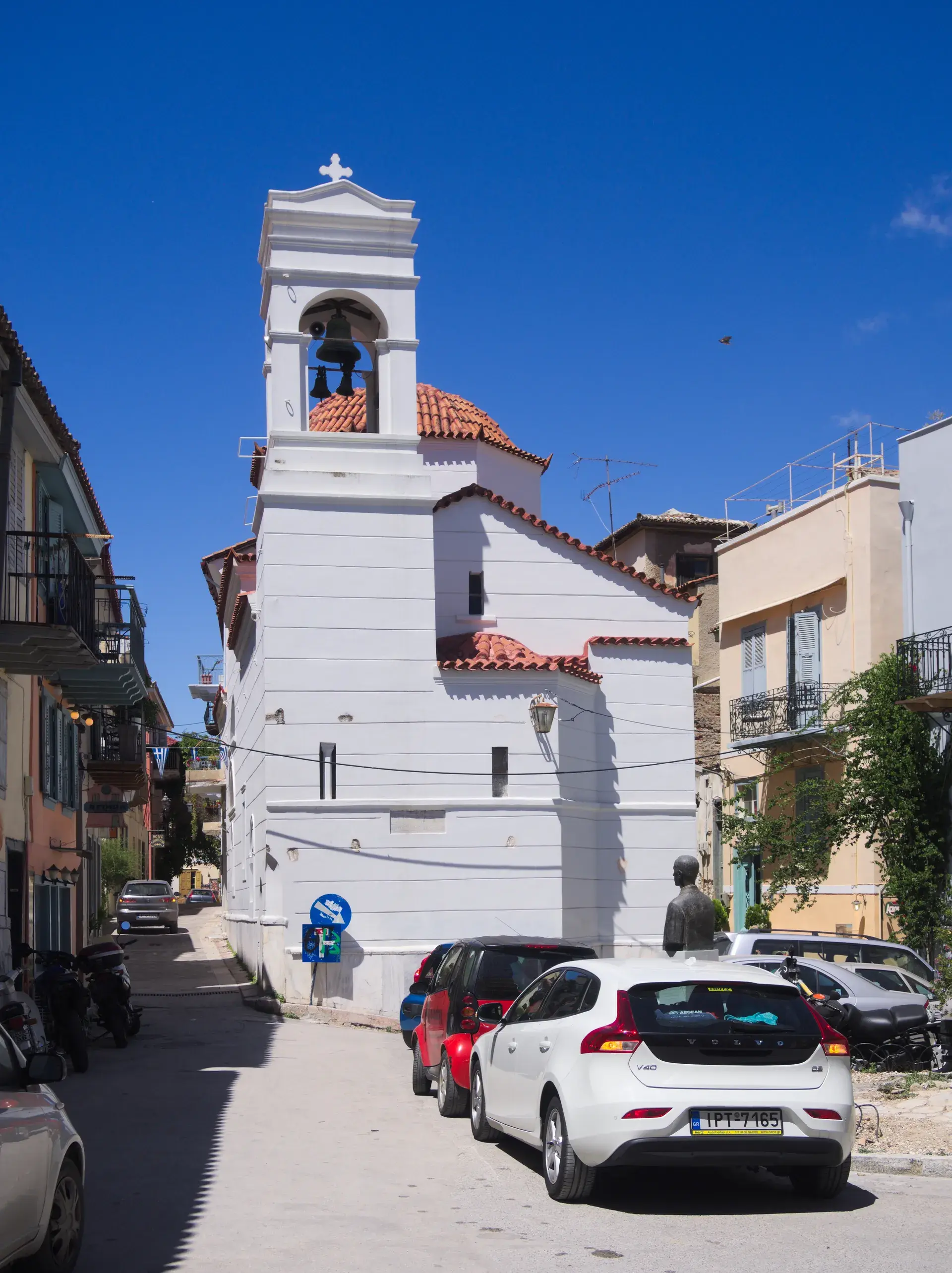
On January 25, 1833, the young Bavarian Prince Otto attended a doxology service at Saint George immediately upon landing in Nafplion to become the first King of Greece. A carved wooden royal throne built specifically for the teenage king still stands inside the church nave. To commemorate his arrival, the Regency council added the narthex and the distinct neoclassical and Venetian-influenced bell tower in 1834, officially elevating the building to the city's Metropolitan Cathedral.
Unique Architecture and Western-Style Art
The cathedral is designed as a domed basilica, but its interior stands out from standard Eastern Orthodox iconography. Instead, the church features Western-style Italianate murals, most notably a direct copy of Leonardo da Vinci’s The Last Supper. These wall paintings were restored and repainted in 1823 by Dimitrios Vyzantios, who later authored Babylonia, one of modern Greece’s most famous theatrical comedies.
An Active Cathedral Today
Situated in the Old Town of Nafplion, Argolis, just off the main pedestrian paths behind Syntagma Square and the Old Town Hall, Saint George serves as a primary anchor on the historic walking route of the city. Today, it operates as an active Greek Orthodox metropolitan cathedral. It regularly holds liturgies, liturgical feasts, weddings, and baptisms, and remains open to visitors daily throughout the year during daytime operating hours.
FAQ
Is St. George Cathedral in Nafplion open to the public?
Yes, the cathedral is open to visitors daily throughout the year during daytime operating hours and continues to operate as an active Greek Orthodox church.
Who is buried at St. George Cathedral in Nafplion?
General Dimitrios Ypsilantis, a prominent commander of the revolutionary forces in the Greek War of Independence, was buried in the church's narthex in 1832.
What famous artwork is featured inside the church?
The interior features Western-style Italianate murals, including a direct copy of Leonardo da Vinci’s The Last Supper. These were restored in 1823 by Dimitrios Vyzantios.