The Land Gate: Nafplion's Historic Venetian Entrance
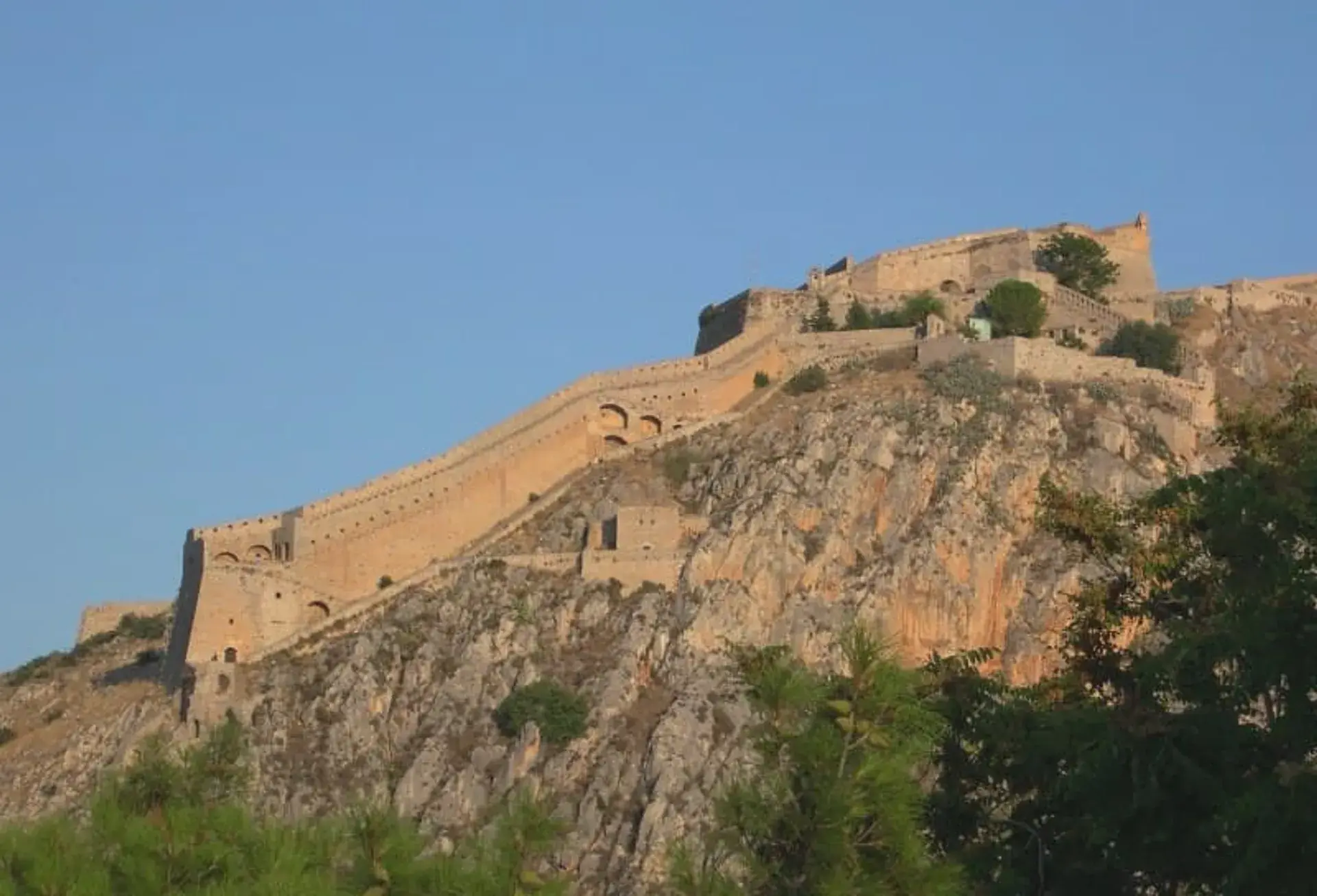
Until the late 19th century, The Land Gate (also known as Pýli tis Xirás or Porta di Terraferma) was the only way into Nafplion by land. Situated at the eastern edge of the Old Town beneath the cliffs of Akronafplia, this stone archway served as the physical bottleneck that defined urban life in the heavily fortified city for centuries.
Venetian Architecture and Fortifications
Constructed in 1708 during the Second Venetian rule, the gate was designed by French military engineer Lassalle. It was part of an extensive modernization of the city's defenses following General Francesco Morosini’s capture of Nafplion in 1687. A plaque set near the left pillar commemorates Morosini’s victory.
The structure functioned as the sole terrestrial entry point into the fortified city. It originally featured a defensive seawater moat that ran along the eastern ramparts. This moat was wide enough to act as an inlet canal extending toward the harbor shipyard, allowing small boats to moor directly outside the gate. Access across the water was restricted entirely to a wooden drawbridge.
The stone archway is flanked by two pilasters and topped with a relief carving of the Venetian Lion of Saint Mark, alongside the family crest of the Venetian governor, Grimani. Today, the surviving lion relief is heavily weathered and fragmented, missing its head, wings, and tail.
Nightly Curfews and Royal Arrivals
During its operational years, the Land Gate enforced a strict nightly curfew. At sundown, the wooden drawbridge was raised and the gate was locked. Travelers, farmers, and merchants arriving after dark were barred from entering and were forced to sleep outside the city walls in the extramural suburb of Pronoia.
The gate also served as a site of high ceremony. In January 1833, when Nafplion was the capital of Greece, the Land Gate acted as the formal checkpoint where the newly crowned 17-year-old King Otto arrived. City authorities met the young king at this threshold to present him with the keys to the city. Adjacent to the gate stands a marble monument honoring Staikos Staikopoulos, the Greek revolutionary leader who captured the nearby Palamidi fortress in 1822.
Demolition and Reconstruction
As Nafplion expanded beyond its medieval confines in the late 19th century, defensive restrictions were dismantled. Between 1894 and 1897, the Land Gate was gradually pulled down and its seawater moat was filled with earth.
The monument was lost until 1973, when excavations unearthed the buried foundations and fragmented architectural elements. In the late 1990s, the façade was meticulously reconstructed based on detailed archival studies of Lassalle's original 1708 plans.
The Land Gate Today
Today, the Land Gate stands as a free-access public monument opposite the Judicial Palace. It forms an orienting landmark and major pedestrian node, connecting the Kapodistrias and Kolokotronis parks to the Old Town. The gate also sits near the base of the stairway leading to the 999 steps of the Palamidi Fortress. The physical archway creates a distinct spatial transition from the open, traffic-lined municipal avenues into the historic pedestrian corridors shadowed by Akronafplia's sheer stone ramparts.
FAQ
When was the Land Gate in Nafplion built?
The Land Gate was built in 1708 by French military engineer Lassalle during the Second Venetian rule of Nafplion.
What happened if travelers arrived at the Land Gate after dark?
The wooden drawbridge was raised at sundown. Anyone arriving after dark was locked out and forced to sleep outside the city walls in the suburb of Pronoia.
Is the current Land Gate the original structure?
The original gate was demolished in the late 19th century. The current structure is a reconstruction completed in the late 1990s, built upon the excavated 1708 foundations using original architectural plans.