Basilica of St. Nicholas in Bari: Relics & History
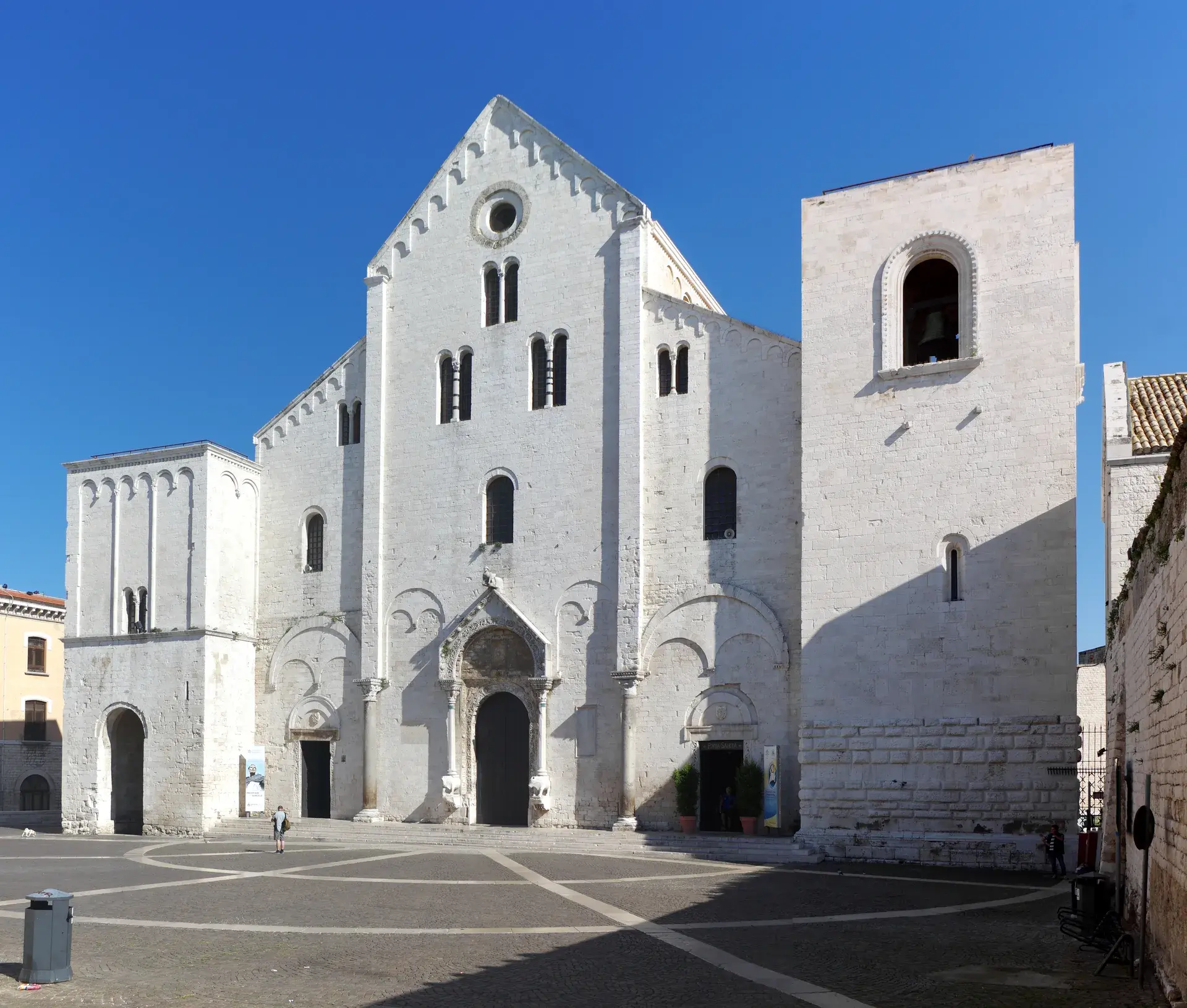
Gaze up at the grand, ancient facade of the Basilica of St. Nicholas, a powerful Romanesque fortress of faith that has drawn pilgrims from across the globe for nearly a millennium. Located in Bari, Italy, this basilica is not only an architectural masterpiece but also the final resting place of Saint Nicholas, the 4th-century bishop whose legendary generosity inspired the figure of Santa Claus.
A Foundation Built on Relics
The basilica's origins trace back to a daring act in 1087. Sailors from Bari traveled to Myra (in modern-day Turkey) and brought the relics of Saint Nicholas to their city, seeking to protect them from the Seljuk Turks and elevate Bari's prestige. Construction of a new church to house these sacred remains began almost immediately.
The project spanned over a century, from 1087 to 1197, during the Italo-Norman rule of Apulia. Key milestones include the consecration of the crypt by Pope Urban II in 1089, under the direction of Abbot Elias, who became the first archbishop. The entire basilica was officially consecrated in 1197 with the patronage of Emperor Henry VI. The church even survived a city-wide razing during a rebellion in 1156, standing as a testament to its protected status.
Architectural Grandeur and Artistry
A quintessential example of the Apulian Romanesque style, the Basilica di San Nicola features a heavy, solid construction with prominent rounded arches. Its influential design served as a model for other churches throughout the region.
Inside, visitors find significant works of art spanning centuries. The gilded wooden ceiling, a 10-year project begun in 1661 by painter Carlo De Rosa, captivates from above. The church also contains the cathedra, or bishop's throne, of Abbot Elias, a masterpiece of 11th-century Romanesque sculpture. In contrast, the elaborate marble Renaissance tomb of Bona Sforza, the 16th-century Queen of Poland and Duchess of Bari, adds another layer to the basilica's rich history.
A Bridge Between Faiths
The Basilica di San Nicola stands as a profound symbol of Christian unity. It is a rare sacred space where both Roman Catholic and Orthodox Christian traditions are actively practiced. Since 1966, an Orthodox chapel has been established in the crypt, allowing for separate liturgies. This ecumenical spirit was highlighted in 2018 when Pope Francis convened religious leaders from the Middle East at the basilica to pray for peace, reinforcing its role as a bridge between Eastern and Western Christianity.
The Crypt and Its Mysteries
Beneath the main church, the crypt holds the tomb of Saint Nicholas and several curiosities. A unique liquid known as the "Manna of Saint Nicholas" is said to exude from the saint's relics. This substance is collected annually and distributed to pilgrims, who believe it possesses miraculous healing properties.
The crypt also contains the "Miraculous Column," which legend claims Saint Nicholas himself transported across the sea. For centuries, a tradition held that unmarried women who circled the column three times would find a husband within a year. Nearby, the 1684 Altar of Patronage features an engraved cryptogram of 624 Latin characters that remains undeciphered to this day.
Cultural and Civic Heart of Bari
The basilica is deeply woven into the identity of Bari. It is a major pilgrimage destination, drawing faithful from around the world, and a center of local devotion. Residents often invoke the saint for protection, and his image adorns homes and cars. The city's football stadium is even named in his honor.
The feast days of Saint Nicholas, on December 6 and May 9, are major civic celebrations. The streets fill with residents for dawn Masses, processions, music, and traditional foods like sgagliozze (fried polenta), demonstrating the enduring connection between the saint, the basilica, and the city.
FAQ
Why is the Basilica of St. Nicholas in Bari so important?
The basilica is important because it houses the relics of Saint Nicholas of Myra, the 4th-century bishop who is the historical basis for Santa Claus. It is a major pilgrimage destination for both Catholic and Orthodox Christians and a masterpiece of Apulian Romanesque architecture.
Can both Catholics and Orthodox Christians worship at the basilica?
Yes, the Basilica di San Nicola is a unique symbol of Christian unity. It hosts liturgies for both traditions and features a dedicated Orthodox chapel in its crypt, which was established in 1966.
What is the 'Manna of Saint Nicholas'?
The 'Manna of Saint Nicholas' is a liquid that is said to exude from the saint's relics, which are housed in the basilica's crypt. This substance is collected once a year and distributed to the faithful, who believe it has miraculous healing and protective powers.