Castello Svevo di Bari: A Fortress of Emperors and Kings
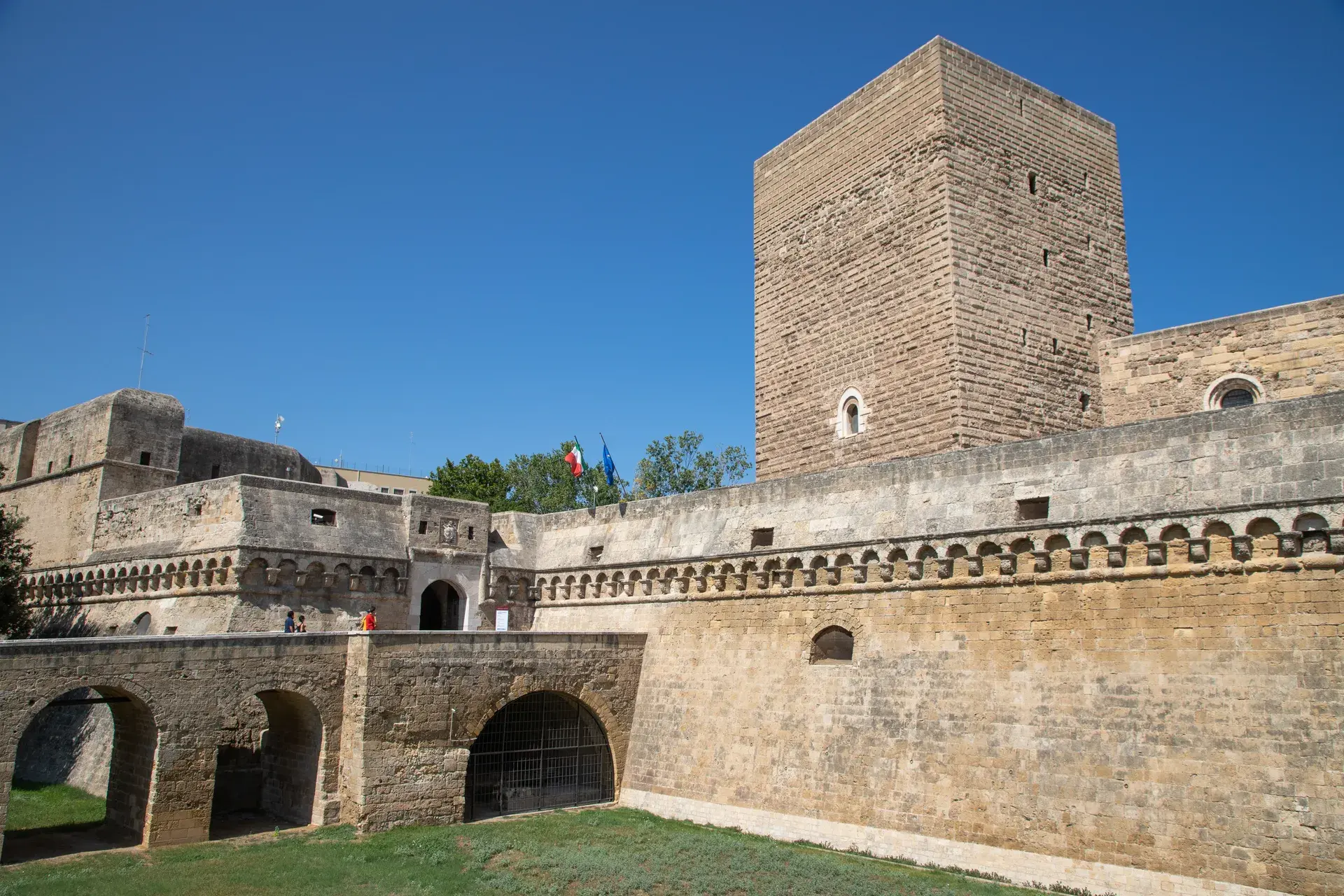
Encounter the formidable stone walls of Castello Svevo di Bari, a 13th-century fortress whose robust Norman foundations and Swabian redesign tell tales of power and defense. Positioned strategically near the port and the entrance to Bari Vecchia (the old city), the castle stands as a monument to the city's long history as a Mediterranean crossroads.
A History of Destruction and Rebirth
The castle's origins trace back to a Norman commission by King Roger II around 1131-1132, who established a defensive stronghold on pre-existing Byzantine foundations. This initial structure was short-lived, as it was destroyed in 1156 by William I of Sicily, known as 'the Wicked', following a rebellion in Bari.
A new era for the fortress began between 1233 and 1240 under the direction of Holy Roman Emperor Frederick II, often called 'Stupor Mundi' (Wonder of the World). He rebuilt and reinforced the castle, giving it the formidable Swabian character it retains today. This reconstruction integrated Romanesque and early Gothic principles, with contributions from local artisans and Saracen workers, whose Islamic artistic influences are visible in the architectural details.
Renaissance Court and Military Evolution
In the 16th century, the castle underwent significant transformations under the Duchess of Bari, Isabella of Aragon, and her daughter, Bona Sforza, Queen of Poland. Responding to the evolution of warfare, they added massive outer bastions designed to withstand artillery fire. The outer walls still bear the marks of cannon fire from various sieges.
Beyond military upgrades, the castle was also adapted into an elegant Renaissance palace. The addition of refined living spaces, a monumental staircase, and a chapel dedicated to Saint Stanislaw of Kraków marked its transition from a purely defensive structure to a noble residence.
From Prison to Cultural Center
After its time as a ducal residence, the castle's role shifted. During the Bourbon period, it was repurposed to serve as a prison and military barracks, a function it held for a considerable time. It wasn't until 1957 that the Castello Svevo opened to the public as a museum.
Today, following extensive renovations completed in 2017, the castle is a vibrant cultural hub. The ground floor features archaeological excavation areas that reveal the site's deeper history, including Byzantine-era structures. It hosts permanent exhibitions, most notably the Gipsoteca, a collection of plaster casts of Apulian Romanesque architectural elements made in 1911. The castle also serves as a venue for temporary art exhibitions and cultural events, with its former dry moat sometimes used as an outdoor stage.
Legends Within the Walls
A persistent, though unconfirmed, tradition associated with the castle involves two of history's most famous figures. The story recounts a meeting in 1221 between Emperor Frederick II and Saint Francis of Assisi. To test the friar's piety, Frederick allegedly sent a courtesan to his room. When Francis sent her away, the emperor, who was said to be watching through a peephole, was deeply impressed by his principles.
FAQ
Who built the Castello Svevo di Bari?
The original fortress was built around 1132 by the Norman King Roger II. After its destruction, it was rebuilt and significantly reinforced by Emperor Frederick II between 1233 and 1240.
What is inside the Castello Svevo di Bari today?
The castle now functions as a museum and cultural venue. It contains archaeological areas showing Byzantine ruins, the Gipsoteca (a collection of plaster casts), and spaces for temporary art exhibitions and cultural events.
What is the Gipsoteca in Bari's castle?
The Gipsoteca is a collection of plaster casts created in 1911 by sculptors Pasquale Duretti and Mario Sabatelli. These casts reproduce sculptural and architectural elements from important monuments throughout the Apulia region.
What architectural styles are present in the castle?
The castle features a blend of architectural styles, reflecting its long history. These include Norman, Romanesque, early Gothic, and Renaissance elements, visible in its trapezoidal plan, massive towers, and outer bastions.