Castle Maretsch: Bolzano's Renaissance Vineyard Estate
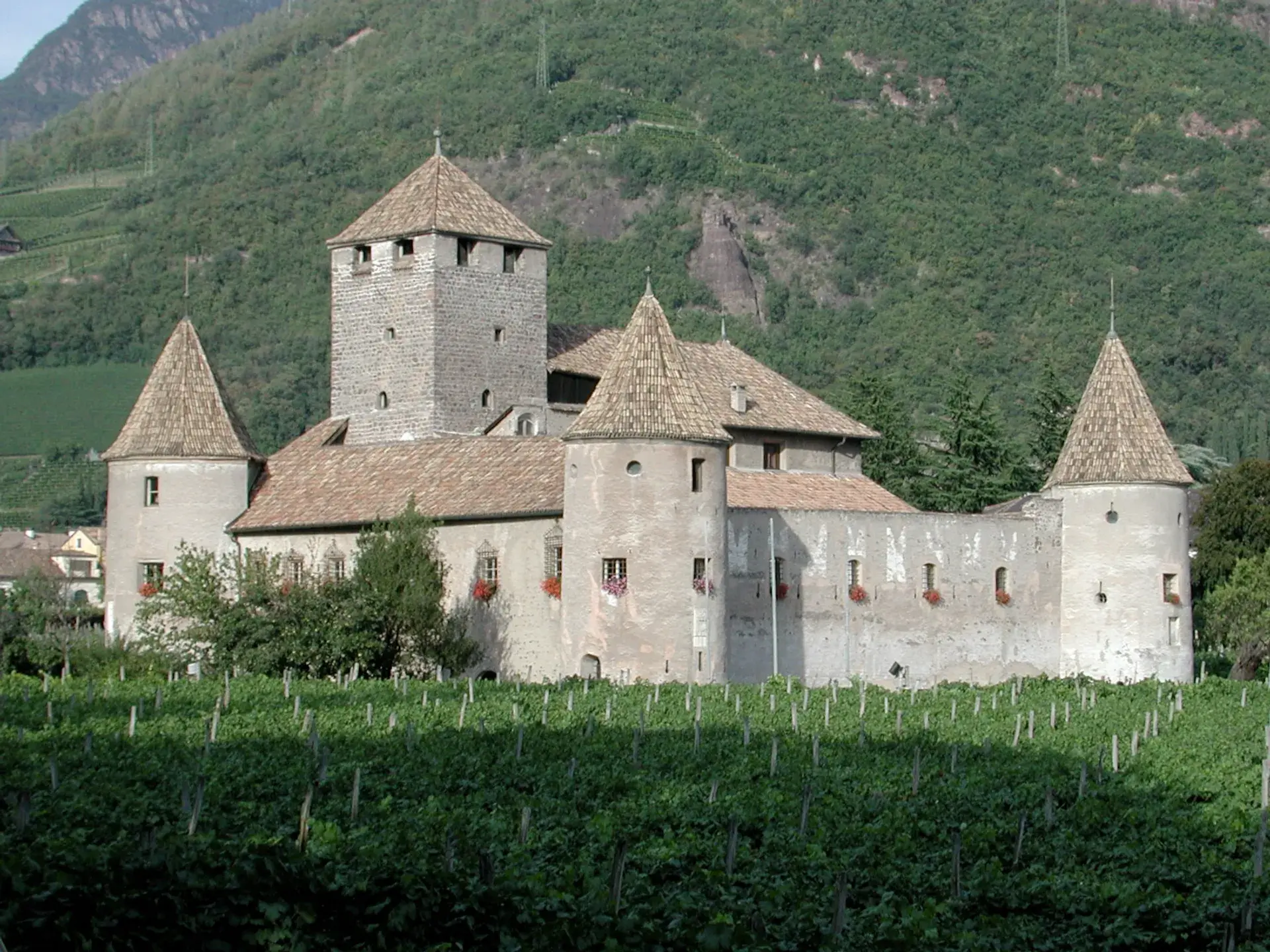
Gaze across the surrounding grounds at the impressive 13th-century stone walls and Renaissance-era round-corner towers of Castle Maretsch. Also known as Castel Mareccio or Schloss Maretsch, this elegant manor house is situated just north of Bolzano's historic center along the Lungotalvera promenade. Unlike typical South Tyrolean defensive fortresses built on inaccessible crags, Castle Maretsch was constructed on flat, arable land as a riverbank estate. Today, it acts as a stepping stone connecting Bolzano's dense medieval center to the open green corridor of the Talvera River Meadows.
Medieval Origins and Renaissance Transformations
The oldest surviving component of the estate is its massive stone keep, constructed around 1194 by Berthold von Bozen, a judge and plenipotentiary of the Counts of Tyrol. During the 13th and 14th centuries, subsequent owners expanded the complex by adding perimeter walls and swallowtail, or Ghibelline, crenellations.
A major architectural shift occurred after Sigmund Römer acquired the property in 1477. Between 1560 and 1570, the structure was transformed into an elegant Renaissance residential palace. This renovation introduced the castle's defining features, including its four round corner towers and an ornate loggia. Over the following centuries, the building passed through various noble families and served several utilitarian functions, eventually housing the Bolzano State Archives from 1921 to 1978.
Art and Humanist Frescoes
The interior of Castle Maretsch features impressive Renaissance halls decorated with extensive 16th-century frescoes. The Römer Hall showcases detailed humanist fresco cycles that depict classical philosophers, the Seven Sages, and allegorical representations of Christian virtues such as Faith, Hope, and Charity.
The upper floor of the castle contains a particularly mysterious historical artifact: a 16th-century Sator Square. This ancient Latin palindrome reads "SATOR AREPO TENET OPERA ROTAS" and is uniquely designed to read identically forward, backward, upward, and downward.
Vineyards and Modern Use
The castle's setting provides a striking visual contrast. The centuries-old stone walls are framed by working Lagrein grapevines, all set against the dramatic backdrop of the jagged Rosengarten, or Catinaccio, mountain massif.
Following periods of decay, Castle Maretsch was acquired and restored by local authorities in the 1980s. Today, it operates primarily as a venue for events, seminars, weddings, and conferences. The estate is highly celebrated in regional viticulture, serving as the host venue for the annual Bolzano Wine Tasting (Bozner Weinkost). When private events or conferences are not taking place, the castle is open to independent visitors and guided tour groups for a nominal admission fee.
FAQ
Why is Castle Maretsch located on flat land instead of a mountain?
Unlike typical South Tyrolean defensive fortresses built atop inaccessible crags, Castle Maretsch was designed primarily as a riverbank manor estate on flat, arable land.
What is the Sator Square at Castle Maretsch?
The upper floor of the castle features a 16th-century inscription of the Sator Square, an ancient Latin word palindrome (SATOR AREPO TENET OPERA ROTAS) that reads identically forward, backward, upward, and downward.
Can the public visit Castle Maretsch?
Yes, the castle is open to independent visitors and guided tour groups for a nominal admission fee on days when private events, weddings, or conferences are not taking place.