Chiesa dei Domenicani: Bolzano's Gothic Gem & Frescoes
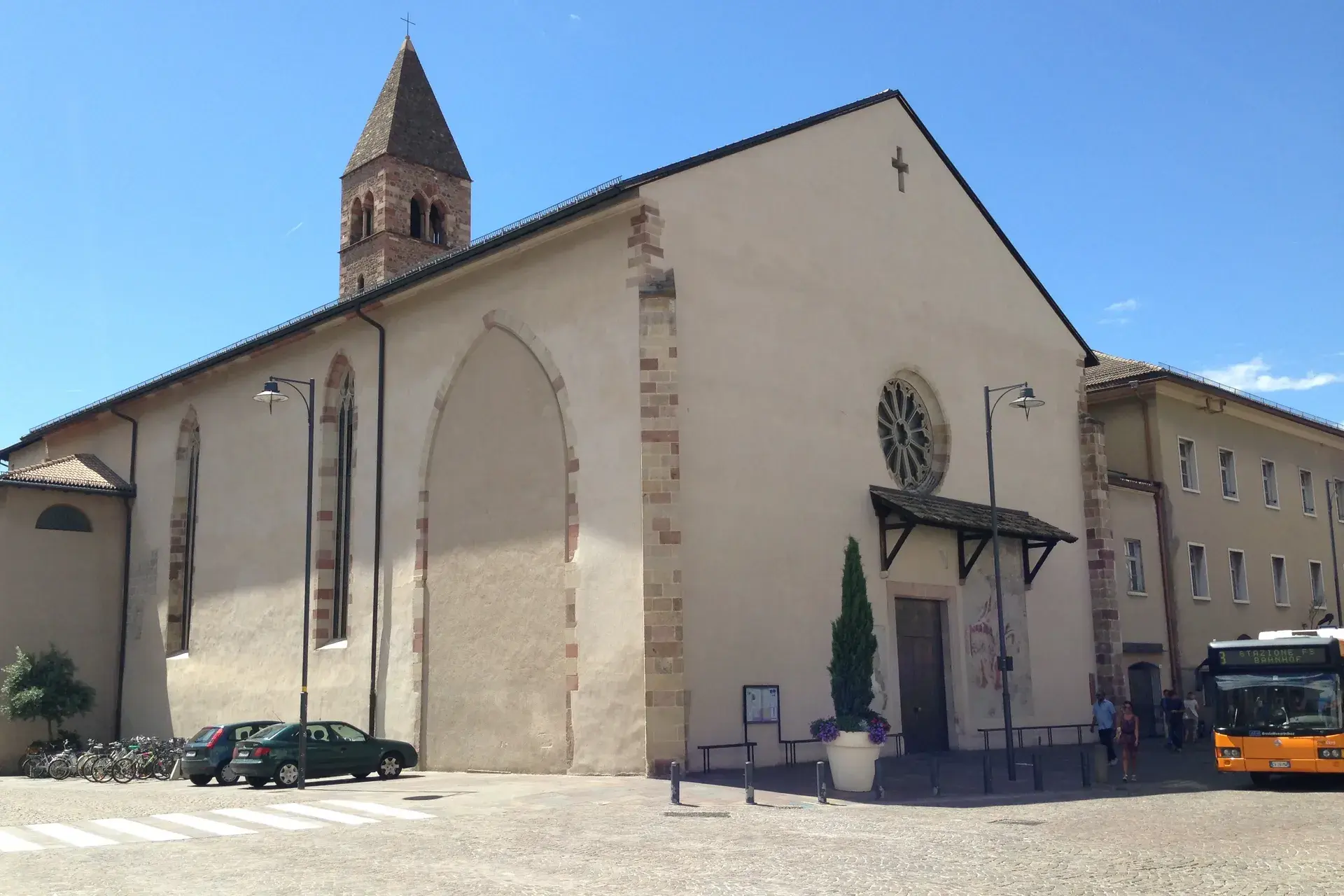
Located roughly 100 meters west of Bolzano Cathedral, the Chiesa dei Domenicani is a historic 13th-century Gothic complex. Founded by the Dominican Order in 1272, the three-nave hall church stands as physical proof of Bolzano's historic identity as a cultural crossroads bridging Italian and Germanic traditions.
A Medieval Foundation
Dominican friars originally settled outside Bolzano's medieval walls, establishing a church and convent that spurred the development of a surrounding "New Town" neighborhood. Over the centuries, the complex faced significant institutional and physical challenges. Holy Roman Emperor Joseph II secularised the monastery in 1785. During the Napoleonic era, the church was stripped of interior furnishings and repurposed as a military depot. While World War II bombing raids destroyed parts of the wider convent complex, the site's most significant artistic treasures survived the destruction.
The Chapel of Saint John
The church's most celebrated feature is the narrow, dimly lit Chapel of Saint John. The space is covered in 14th-century frescoes executed between 1330 and 1340 by a Paduan-Venetian workshop of Giotto's school. Paduan and Venetian painters brought Giotto's revolutionary sense of spatial depth and emotional realism northward, introducing a major Italian Trecento style to the Alpine borderland.
The vivid works display rich ultramarine blues and earthy ochres across the chapel's intricate vaulting. The decorative cycle includes scenes from the lives of Saint John the Baptist, Saint John the Evangelist, Saint Nicholas, and the Virgin Mary. It also features dramatic apocalyptic compositions, most notably the Triumph of Death and the Horsemen of the Apocalypse.
Florentine Patronage and Blended Heritage
The chapel's celebrated frescoes were commissioned by the de' Rossi family, Florentine merchant-bankers who relocated to Bolzano. They brought high Tuscan-Paduan artistic prestige north of the Alps to demonstrate their financial standing to the local Tyrolean nobility, later Germanizing their surname to von Botsch.
This artistic blend continues in the adjoining 14th-century cloister, which displays both Italianate paintings and late Gothic Tyrolean frescoes painted in 1496 by Friedrich Pacher. Inside the main church, the presbytery houses a prominent Baroque altarpiece from 1655 titled The Vision of Soriano. Painted by Guercino, it was purchased and donated by Bolzano's wealthy merchant guild.
Modern Role
Today, the Chiesa dei Domenicani remains an active Roman Catholic place of worship. The surviving secularised sections of the medieval convent have been repurposed to serve the city's modern cultural life. The Bolzano City Gallery and the Claudio Monteverdi Music Conservatory now occupy these historic spaces, maintaining the site's legacy in the heart of Bolzano.
FAQ
Who painted the frescoes in the Chiesa dei Domenicani?
The frescoes in the Chapel of Saint John were painted between 1330 and 1340 by masters from a Paduan-Venetian workshop belonging to Giotto's school.
What do the 14th-century frescoes depict?
The murals feature scenes from the lives of Saint John the Baptist, Saint John the Evangelist, Saint Nicholas, and the Virgin Mary, alongside dramatic apocalyptic scenes like the Triumph of Death.
What else is housed within the Chiesa dei Domenicani complex?
Beyond the active church, the surviving secularised sections of the medieval convent now house the Bolzano City Gallery and the Claudio Monteverdi Music Conservatory.