Bolzano Victory Monument & Underground Museum
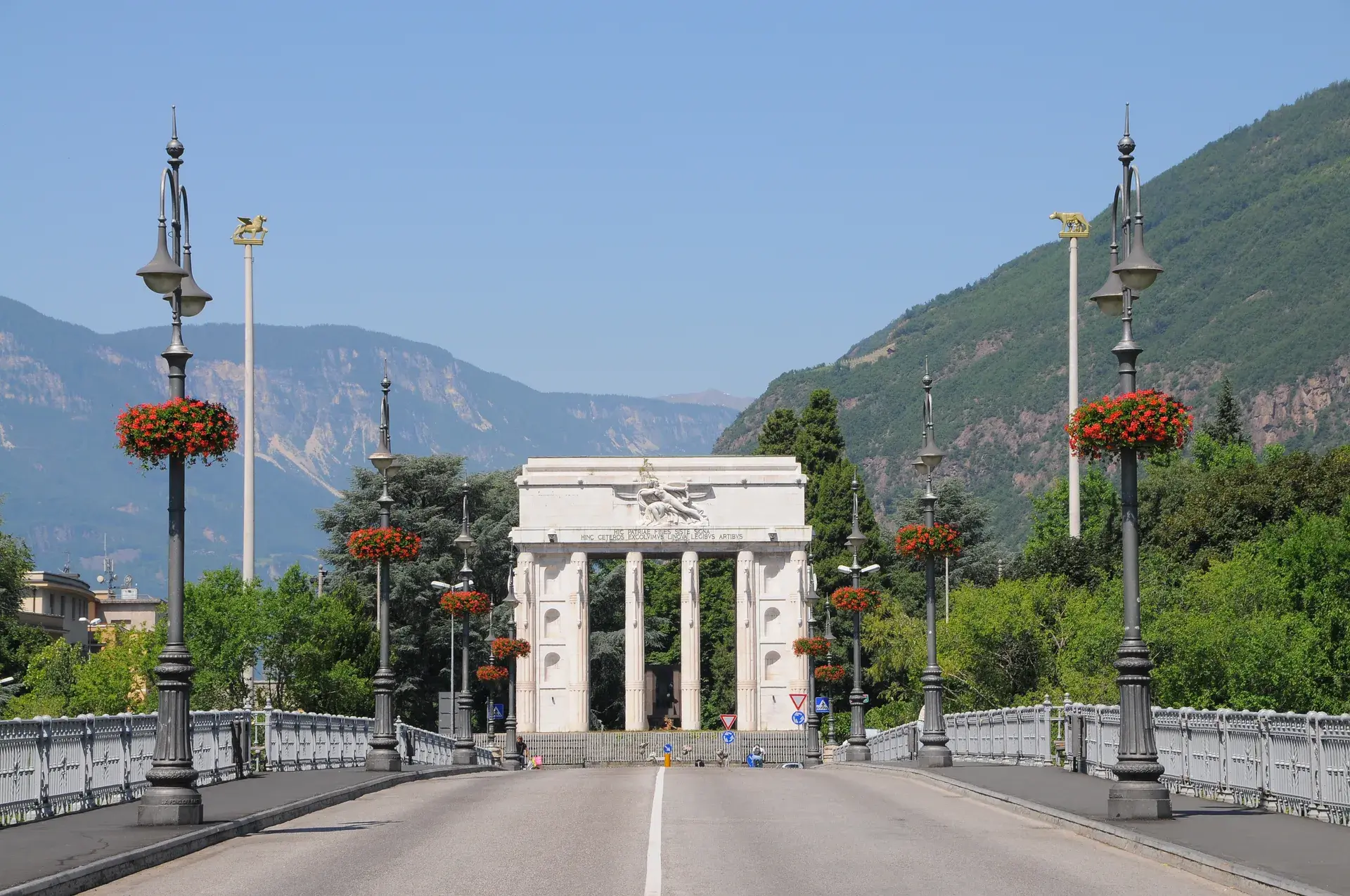
The Victory Monument (Monumento alla Vittoria or Siegesdenkmal) showcases an imposing architectural scale, standing as a circa-1928 marble arch that now houses a subterranean museum. Situated just across the Talvera River, connected by the Talvera Bridge, the monument serves as a stark architectural boundary in Bolzano. It separates the city's historic medieval and Austrian core from the 1920s and 1930s Italian rationalist expansion into the Gries district.
Fascist Architecture and Origins
Commissioned directly by Benito Mussolini in 1926, the triumphal arch was designed by prominent Fascist-era architect Marcello Piacentini and inaugurated on July 12, 1928, by King Victor Emmanuel III. The structure is roughly 19 meters wide and 20.5 meters high, constructed primarily of stark white marble. Its classical lictorial pillars are shaped like Roman fasces, and its attic façade bears a Latin inscription declaring the intent to "educate the others" with Italian language, laws, and arts.
The arch was erected to assert Italian sovereignty over South Tyrol following its annexation from the Austro-Hungarian Empire after World War I. Controversially, it was built on the exact footprint of an unfinished Austrian Kaiserjäger war memorial, which was demolished in 1926 and 1927 to make way for the project.
Decades of Division
The monument and its inscription sparked immediate outrage, including a 10,000-person counter-demonstration in Innsbruck on its opening day. For decades, it remained a flashpoint of ethnic and political tension between German- and Italian-speaking communities. Following a 1978 bomb attack by separatists, the structure was surrounded by a security fence. The surrounding square briefly bore the name Piazza della Pace (Peace Square) in 2001 and 2002 before reverting to its official name, Piazza della Vittoria.
A Symbolic Intervention
Rather than demolishing the fascist monument or leaving it unaltered, the city of Bolzano chose to defuse its ideological power through a symbolic architectural intervention, which successfully deterred far-right rallies at the site. An electronic LED collar now wraps around one of the front columns, contrasting sharply with the classical stone. The dynamic ring emits a red glow, continually scrolling text in Italian, German, and English.
The Subterranean Museum
In July 2014, the monument's subterranean crypt and surrounding basement were opened to the public as a permanent documentation exhibition titled BZ '18–'45: One monument, one city, two dictatorships. Spanning 13 to 15 underground rooms, the museum contextualizes the monument's history alongside Italian Fascism, Nazi occupation, and South Tyrol’s divided twentieth-century past.
Inside the crypt, projection lights superimpose quotes from thinkers such as Hannah Arendt, Bertolt Brecht, and Thomas Paine directly over the original fascist Latin friezes in Italian, German, and Ladin. In 2016, the exhibition received a Special Commendation from the European Museum of the Year Award for transforming a divisive structure into a space for humanism, tolerance, and democracy.
FAQ
When was the Victory Monument in Bolzano built?
The monument was commissioned by Benito Mussolini in 1926, designed by architect Marcello Piacentini, and inaugurated on July 12, 1928.
What is inside the Victory Monument?
The monument's underground crypt and basement house a permanent exhibition titled "BZ '18–'45: One monument, one city, two dictatorships," featuring 13 to 15 rooms that explore South Tyrol's divided history and Italian Fascism.
Why does one of the columns have an LED ring?
The dynamic LED ring scrolling text in Italian, German, and English was added as a symbolic intervention to defuse the fascist monument's ideological power and deter far-right political rallies.