Piazza del Duomo, Syracuse: Ancient Temple to Baroque Gem
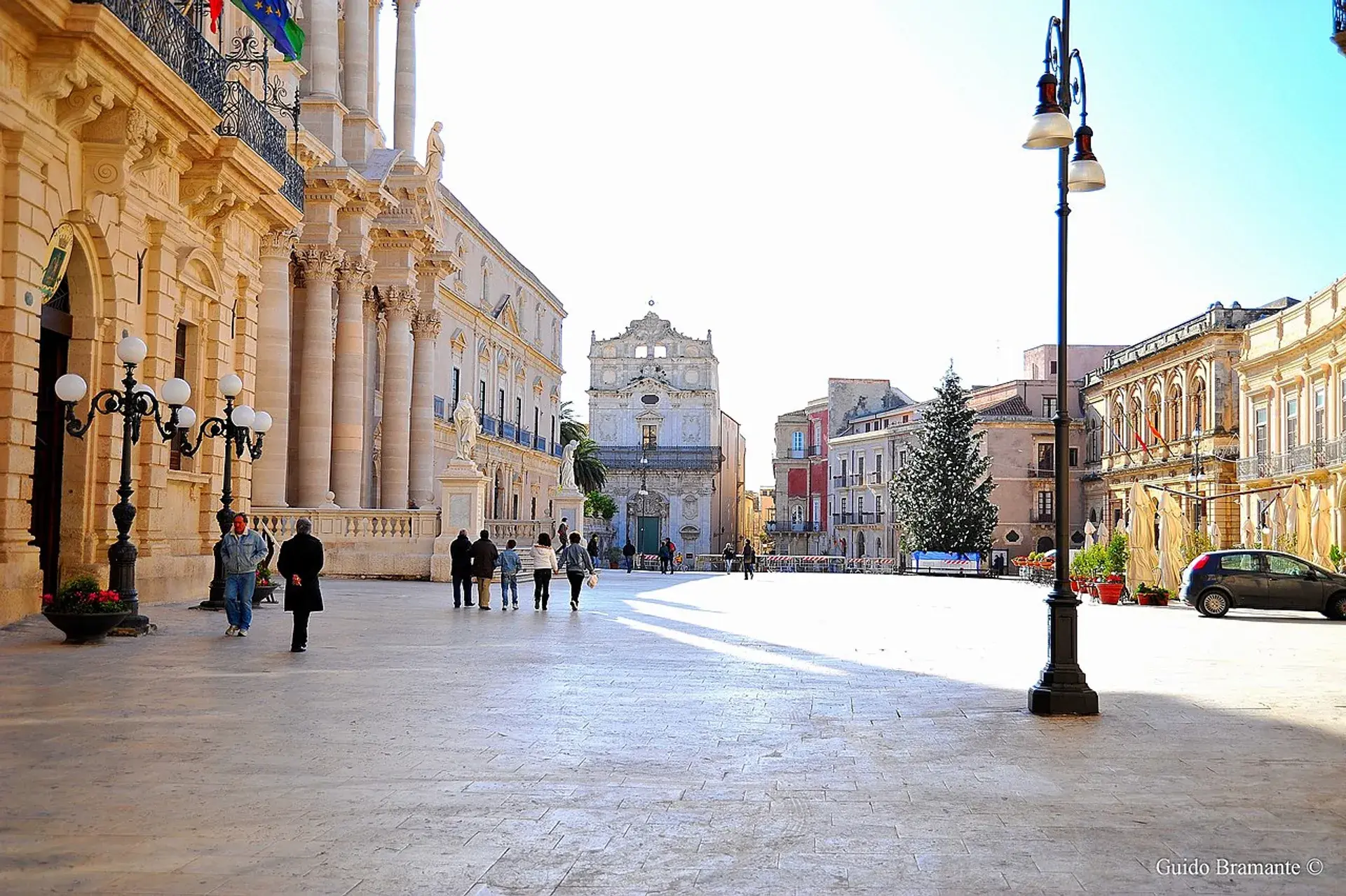
Piazza del Duomo is an elegant, oval-shaped square on the island of Ortigia, serving as the ceremonial and social heart of Syracuse. Framed by magnificent Baroque palaces, this pedestrian-only piazza is dominated by the soaring facade of the Cathedral of Syracuse. The entire area is part of the 'Syracuse and the Rocky Necropolis of Pantalica' UNESCO World Heritage Site, recognized in 2005 for its profound historical significance.
A Cathedral Built on Ancient Bones
The most remarkable feature of the piazza's cathedral is its unique construction. It was not simply built on the ruins of an ancient temple, but ingeniously incorporates the original structure within its walls. The massive Doric columns of the 5th-century BC Temple of Athena are still visible, forming an integral part of the cathedral's interior and exterior structure. This physical fusion of a pagan temple and a Christian church offers a tangible glimpse into the city's layered past.
A Tapestry of Faith and Empire
The site has been a place of worship since prehistoric times. Around 480 BC, the tyrant Gelon constructed the monumental Temple of Athena to celebrate a victory over the Carthaginians. In 70 BC, the Roman orator Cicero documented the looting of its rich ornaments by Governor Verres. The building's purpose shifted dramatically in the 7th century AD when Bishop Zosimo converted the pagan temple into a Christian basilica by walling the spaces between the Doric columns.
Following the Arab conquest in 878 AD, the building served as a mosque for two centuries. It was reconsecrated as a Christian cathedral in 1086 AD by the Norman Count Roger I, who added a new roof and mosaics. This continuous adaptation reflects the successive waves of Greek, Roman, Byzantine, Arab, and Norman influence that shaped Syracuse.
The Baroque Masterpiece
A devastating earthquake in 1693 destroyed the cathedral's Norman facade and bell tower, necessitating a major reconstruction. Between 1725 and 1753, architect Andrea Palma designed the current facade in the opulent High Sicilian Baroque style. The exterior is adorned with impressive statues created by sculptor Ignazio Marabitti, giving the piazza its present grand appearance.
The Heart of Modern Ortigia
Today, Piazza del Duomo is a vibrant gathering place for locals and tourists. The square is lined with cafes and restaurants offering outdoor seating, creating a lively atmosphere, especially when illuminated in the evenings. The Cathedral of Syracuse remains an active Catholic church and the seat of the Archdiocese of Siracusa, holding daily masses. The piazza also frequently hosts cultural events, art exhibitions, and outdoor performances.
Hidden Details of the Piazza
Beyond the main facade, the piazza holds subtle curiosities. On the Palazzo Municipale, located north of the Duomo, a small lizard is carved into the cornice. This is the signature of the 17th-century architect Juan Vermexio, who was nicknamed 'Il Lucertolone' (the Lizard). Beneath the square lies the Hypogeum of Piazza Duomo, an extensive network of tunnels first discovered in 1869. These passages were later enlarged and used as air-raid shelters during World War II, notably to protect the precious silver statue of Saint Lucy, the city's patron saint.
FAQ
Why is the Cathedral of Syracuse so unique?
Its uniqueness lies in its structure, which incorporates the original Doric columns of a 5th-century BC Greek Temple of Athena directly into its walls, visibly blending ancient pagan and Christian architecture.
What is the history of the building at the center of Piazza del Duomo?
The site has evolved over millennia. It began as a Greek Temple of Athena (c. 480 BC), was converted into a Byzantine basilica, then a mosque, a Norman cathedral, and was finally rebuilt with its current Baroque facade after the 1693 earthquake.
Is Piazza del Duomo in Syracuse a UNESCO World Heritage Site?
Yes, the piazza and its cathedral are part of the 'Syracuse and the Rocky Necropolis of Pantalica' UNESCO World Heritage Site, designated in 2005 for its testimony to Mediterranean history.
What is hidden beneath the Piazza del Duomo?
Beneath the piazza lies the Hypogeum, a network of underground tunnels. Originally discovered in 1869, they were expanded and used as air-raid shelters during World War II to protect citizens and treasures like the silver statue of Saint Lucy.