Syracuse Cathedral: Greek Temple to Baroque Masterpiece
Gaze up at the magnificent Baroque facade of Syracuse Cathedral, where intricate statuary guards a sacred space built upon ancient Greek foundations. Formally known as the Cattedrale metropolitana della Natività di Maria Santissima, this architectural marvel is a central component of Syracuse's UNESCO World Heritage site, embodying over two and a half millennia of history.
From Pagan Temple to Christian Church
The site's history of worship is ancient, with archaeological findings suggesting continuous use since at least 1100 BC. The structure's story begins around 480 BC when Tyrant Gelon commissioned the Doric Temple of Athena to celebrate a victory over the Carthaginians. This grand temple featured 14 columns on its long sides and six on its short sides, with a golden shield on its pediment that acted as a beacon for sailors. In 70 BC, Roman orator Cicero documented the looting of its gold and ivory treasures by the corrupt governor Verres.
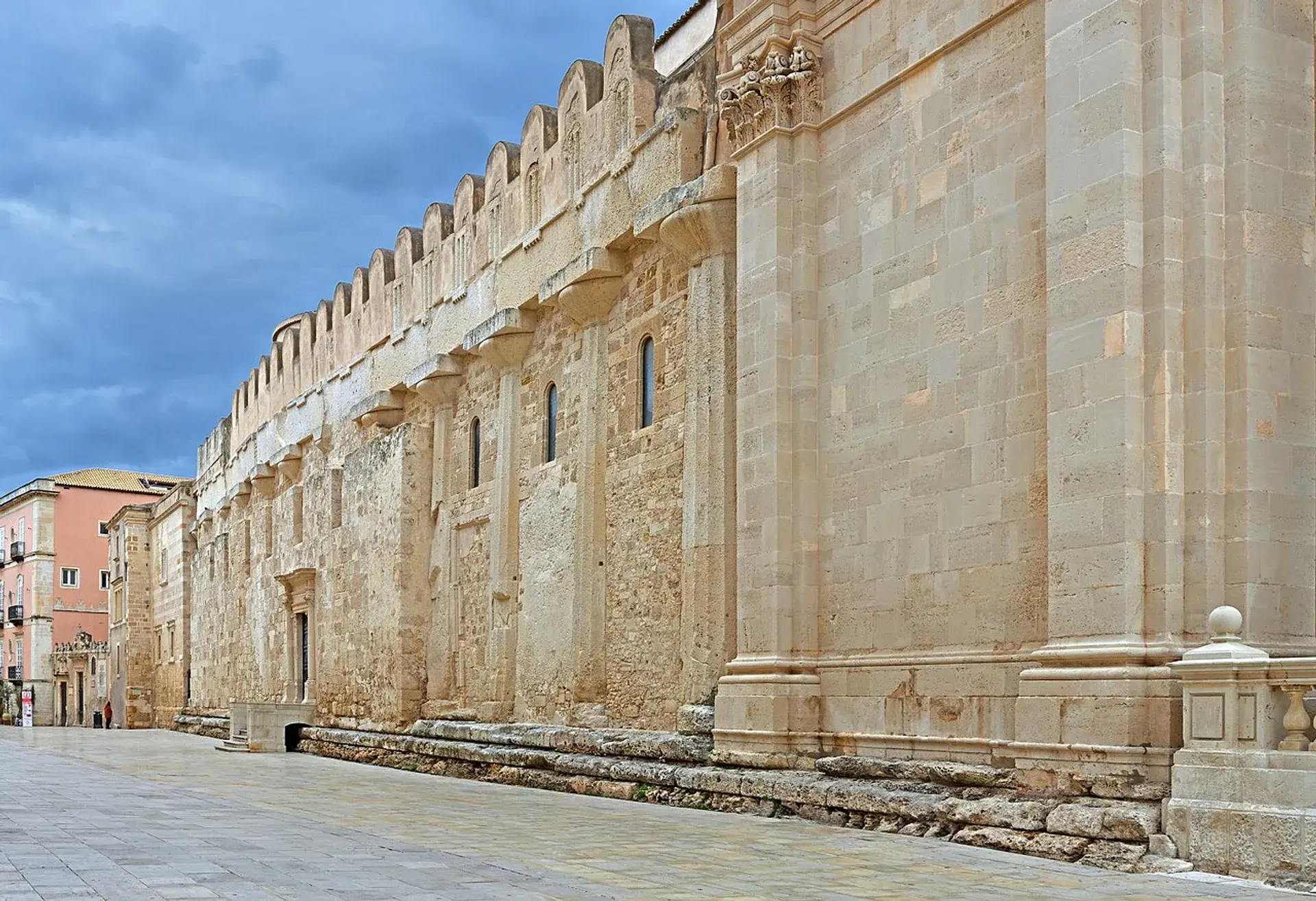
In the 7th century AD, Saint Bishop Zosimo ingeniously converted the pagan temple into a Christian basilica. Rather than demolishing the temple, he walled up the spaces between the massive Doric columns, preserving the ancient Greek structure within the church's very walls. This unique feature led to the local name "Santa Maria delle Colonne" (Saint Mary of the Columns).
A History of Transformation
The cathedral's evolution reflects the successive cultural shifts in Sicily. After its time as a Byzantine basilica, it was converted into a mosque in 878 AD during two centuries of Arab rule. In 1086 AD, the Normans, led by Roger I of Sicily, reconquered the city and reconverted the building into a Catholic church. The Normans made their own additions, including the nave's roof and mosaics in the apse.
The Baroque Reconstruction
A catastrophic earthquake in 1693 devastated much of Sicily, including the cathedral's facade. The subsequent rebuilding effort resulted in the magnificent exterior seen today. Between 1725 and 1753, architect Andrea Palma designed and constructed the new facade in the opulent High Sicilian Baroque style. The full-length statues adorning the facade were created by sculptor Ignazio Marabitti.
Art, Relics, and Modern Use
The interior of the cathedral houses significant artistic and religious treasures. Among them are a 1512 statue of the "Madonna della Neve" by Antonello Gagini and a ciborium by Luigi Vanvitelli. The cathedral is deeply connected to Saint Lucy, the patron saint of Syracuse. It contains a silver statue of the saint crafted by Pietro Rizzo in 1599, which holds fragments of her ribs.
Today, the Syracuse Cathedral is an active Catholic church and the seat of the Archdiocese of Siracusa. It remains a focal point for the community, especially during the biannual festivals for Saint Lucy in May and December, when her silver statue is paraded through the city. As a key part of a UNESCO World Heritage site, it continues to draw visitors from around the world to witness its layered history. As of mid-2025, the facade is undergoing restoration work.
FAQ
What is unique about the Syracuse Cathedral's architecture?
Its structure uniquely incorporates the massive Doric columns of the 5th-century BC Greek Temple of Athena directly into its walls. These ancient columns are visible from both the inside and outside of the cathedral.
Why was the facade of the Syracuse Cathedral rebuilt?
The original facade was destroyed in the devastating 1693 Sicily earthquake. It was rebuilt between 1725 and 1753 in the High Sicilian Baroque style by architect Andrea Palma.
What is the cathedral's connection to Saint Lucy?
The cathedral is the home of important relics of Saint Lucy, the patron saint of Syracuse. A silver statue of the saint, made in 1599, contains fragments of her ribs and is central to biannual festivals held in her honor.
What was the building before it became a cathedral?
The building was originally the Greek Temple of Athena, built around 480 BC. It was later converted into a Byzantine church, then an Islamic mosque, and a Norman church before becoming the cathedral seen today.