Temple of Apollo: Sicily's Oldest Doric Temple
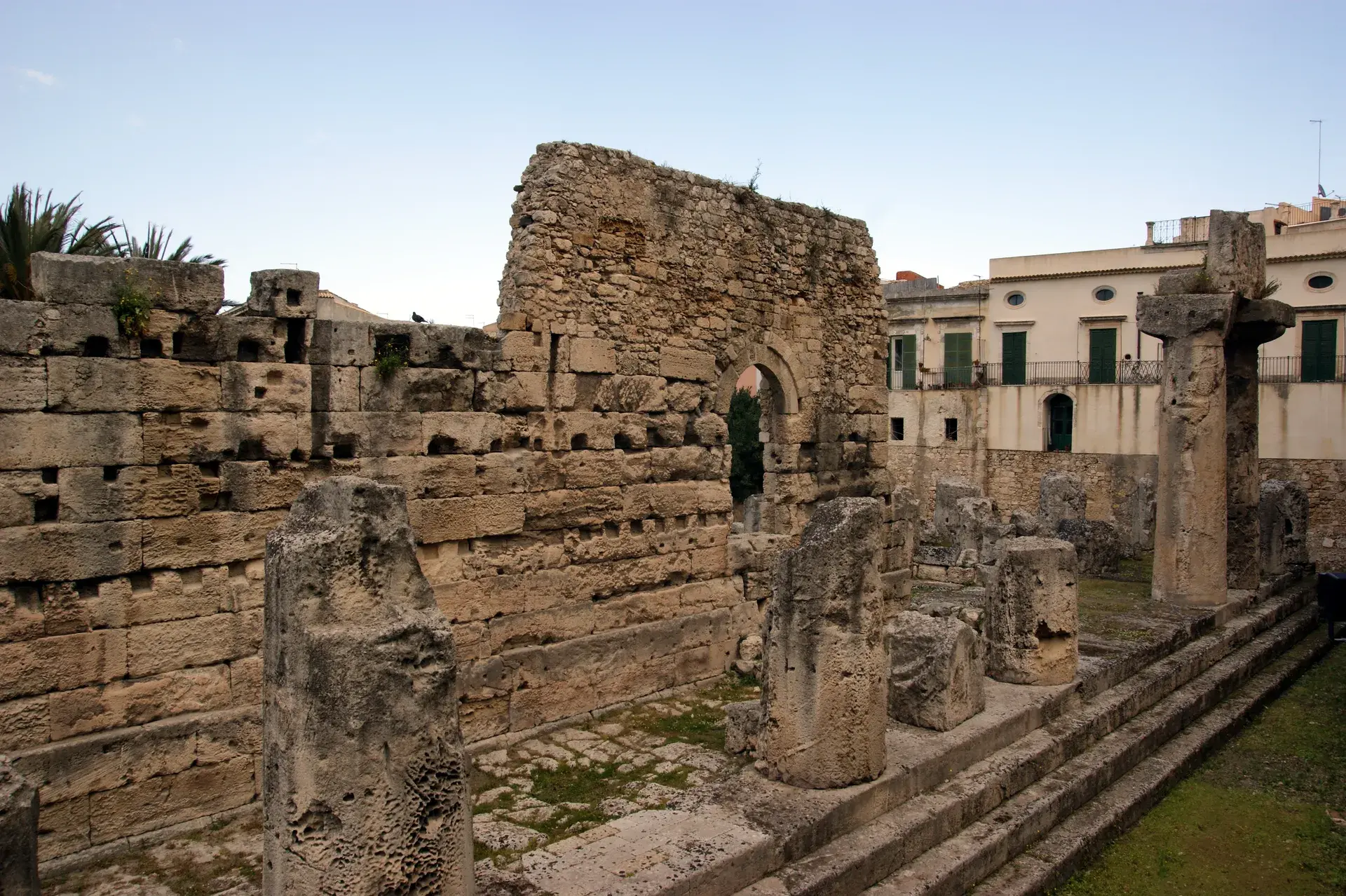
The Temple of Apollo stands in Ortigia, Syracuse, as a monumental testament to ancient Greek architecture. Constructed in the early 6th century BCE, it is recognized as the first major peripteral temple built entirely of stone in the Western Greek world and the earliest Doric temple in Sicily. Its ruins, integrated into the bustling Piazza Pancali, offer a direct link to the city's ancient past.
Architectural Significance and Construction
Built between approximately 590 and 575 BCE, the temple was a pioneering feat of engineering. The structure was made from a local yellowish limestone known as "giurgiulena." Its design follows an archaic Doric style with a hexastyle facade, featuring six columns on the short sides and seventeen on the long sides. The stylobate, or temple platform, measures about 55.36 by 21.47 meters.
A unique archaic Greek inscription on the eastern stylobate, one of the earliest of its kind, credits individuals for the temple's creation. It names Kleomenes, son of Knidieides, as the 'maker' and Epicles as the one who made the columns. Interestingly, the original architrave had an L-shaped cross-section designed to hide a wooden core, suggesting the builders' early hesitation regarding the full structural capacity of stone for such a large-scale project.
A Palimpsest of History
The temple's long history is marked by a series of dramatic transformations. Its continuous use across millennia reflects the diverse civilizations that have shaped Sicily. During the Byzantine period in the 6th century CE, it was converted into a Christian church. Under Arab rule in the 9th century CE, it became a mosque, only to be converted back into a Christian basilica during the Norman era.
In the 16th century, under Spanish rule, Charles V ordered the structure to be repurposed as military barracks, known as the Quartiere Vecchio, and used it as a quarry for city fortifications. The ancient ruins became so integrated into later buildings that in 1778, French artist Dominique Vivant Denon found two intact capitals and column drums from the temple built into the wall of a private residence.
Rediscovery and Modern Day
The temple's ancient form remained largely obscured until it was rediscovered and systematically excavated in the late 19th and early 20th centuries. The work of archaeologist Paolo Orsi between 1938 and 1942 was particularly crucial in uncovering the ruins from beneath the later constructions.
Today, the Temple of Apollo is an open-air archaeological site, freely accessible to the public at all times. While direct entry into the structure is not allowed, visitors can view the remaining columns and stylobate from the perimeter. The site is a prominent feature of Ortigia's urban landscape, surrounded by shops and cafes, with a local market operating nearby on weekday mornings. Many artifacts recovered from the temple are housed in the Museo Archeologico Regionale Paolo Orsi in Syracuse.
FAQ
When was the Temple of Apollo in Syracuse built?
The Temple of Apollo was constructed in the early 6th century BCE, with estimates ranging from 590 BCE to 575 BCE. It is the oldest known Doric temple in Sicily.
Can you go inside the Temple of Apollo?
No, direct entry into the temple ruins is not permitted. However, the site is an open-air ruin in a public square, and visitors can observe the structure from close proximity around its perimeter.
Who was the Temple of Apollo dedicated to?
A dedicatory inscription found on the temple's stylobate explicitly names the god Apollo. This discovery corrected earlier scholarly speculation that the temple might have been dedicated to Artemis.
What happened to the Temple of Apollo over the centuries?
After its time as a Greek temple, it was transformed into a Byzantine church, an Arab mosque, a Norman basilica, and finally Spanish military barracks and a quarry, before being excavated in the 20th century.