Temple of Athena: Syracuse Cathedral's Ancient Core
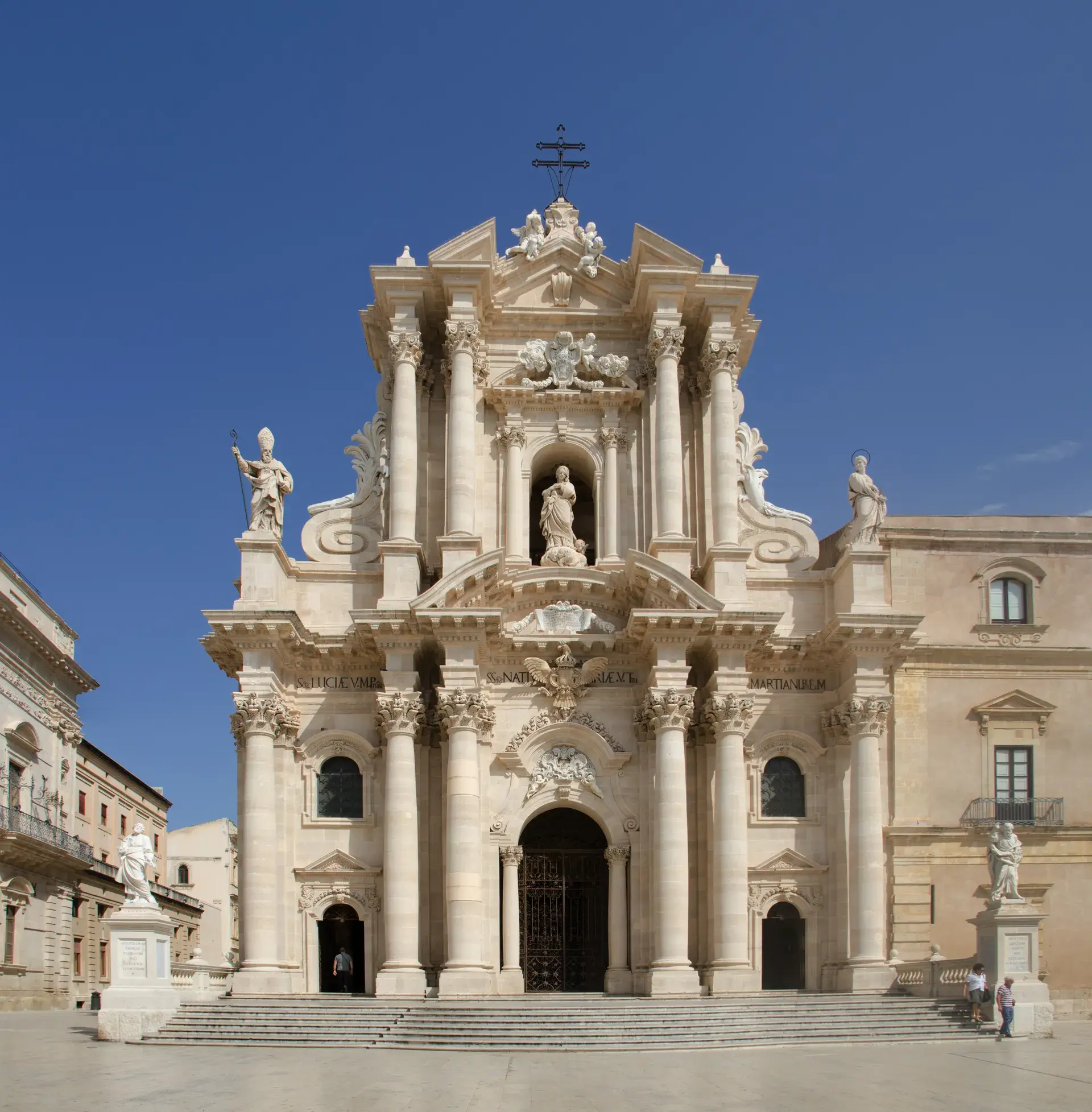
The Syracuse Cathedral in Ortigia presents a stunning Baroque facade, yet it holds an ancient secret within its walls: the remarkably preserved structure of a 5th-century BC Greek Temple of Athena. This architectural palimpsest offers a visible timeline of over 2,500 years of history, where successive civilizations built upon, rather than erased, the past.
A Monument of Greek Victory
The Temple of Athena was constructed around 480 BC under the rule of the tyrant Gelo. This grand project celebrated the significant Syracusan victory over the Carthaginians at the Battle of Himera. As a hexastyle peripteral Doric temple, it was an impressive sight, measuring approximately 22 by 55 meters. Its design featured six columns on the short sides and fourteen along the long sides. Archaeological excavations have revealed that this temple was itself built upon even older sacred ground, including a cult site from the 8th century BC and an earlier Doric temple from the mid-6th century BC.
In 70 BC, the Roman orator Cicero described the temple's opulent decorations, including a gilded bronze shield on its pediment that reportedly served as a navigational beacon for sailors. He also documented the looting of its treasures by the praetor Verres.
From Temple to Cathedral
The building's most significant transformation occurred in the 7th century AD when Bishop Zosimus of Syracuse converted the pagan temple into a Christian basilica. In an ingenious act of adaptive reuse, the structure was not demolished. Instead, walls were constructed between the outer Doric columns, which were incorporated directly into the church. The ancient temple's cella became the nave of the new church.
Over the centuries, the building continued to evolve. It briefly served as a mosque during the Arab conquest in the 9th century before being reclaimed and expanded by the Normans. After a devastating earthquake in 1693, the cathedral was given its current Baroque facade, designed by architect Andrea Palma between 1725 and 1753.
The Cathedral Today
Today, the former Temple of Athena is the Cattedrale metropolitana della Natività di Maria Santissima, or Syracuse Cathedral. It is an active Roman Catholic church and the seat of the Archbishop of Syracuse. The ancient Doric columns remain clearly visible both inside and along one of the exterior walls, bearing silent witness to the city's layered past. The cathedral is a central point for religious and cultural life in Ortigia, housing relics of Saint Lucy, the patron saint of Syracuse, and serving as a key monument within the city's UNESCO World Heritage site.
FAQ
What is the Temple of Athena in Syracuse today?
The Temple of Athena is now the Syracuse Cathedral (Cattedrale metropolitana della Natività di Maria Santissima). The ancient Greek temple structure is almost entirely integrated within the walls of the active Roman Catholic church.
When was the Temple of Athena built?
The temple was constructed around 480 BC by the tyrant Gelo of Syracuse to commemorate his victory over the Carthaginians at the Battle of Himera.
Why are there Greek columns inside the Syracuse Cathedral?
In the 7th century AD, Bishop Zosimus converted the pagan temple into a Christian church. Instead of demolishing it, he ingeniously built walls between the original Doric columns, incorporating them into the new structure where they remain visible today.
Who designed the Baroque facade of the Syracuse Cathedral?
The Baroque facade was designed by architect Andrea Palma between 1725 and 1753, as part of the reconstruction efforts following the major Sicily earthquake of 1693.