House of the Blackheads: Riga's Hanseatic Hall
Origins of the New House and the Brotherhood
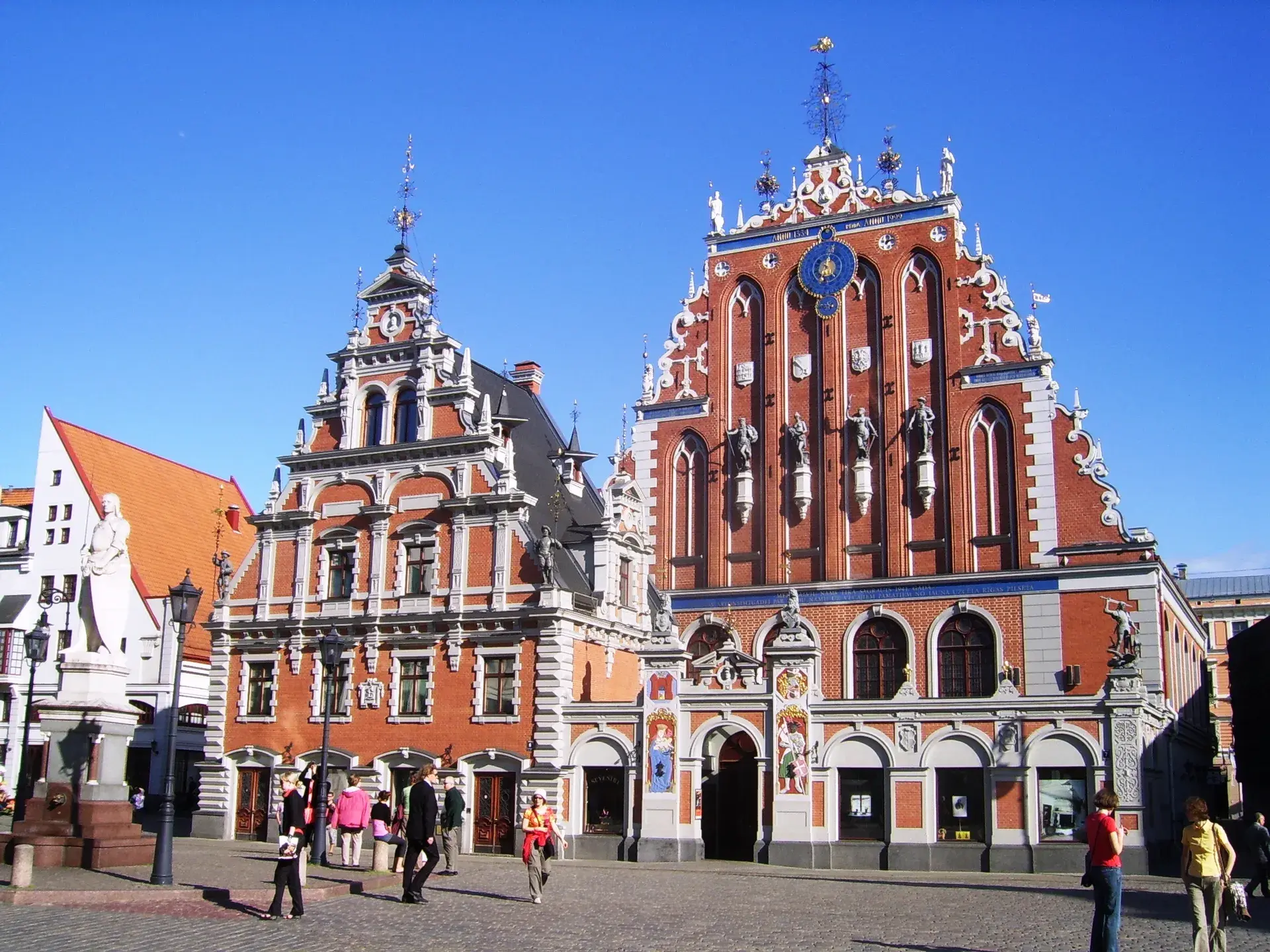
First constructed in 1334 on Town Hall Square in Riga, the building was initially known as the New House (Neues Haus). Designed as an assembly venue and storage warehouse for the city's merchants and civic guilds, it became closely tied to international commerce along the Baltic trade routes.
During the 15th century, the premises were leased by the Brotherhood of Blackheads, who later acquired the property outright in 1713. The brotherhood was an association of unmarried German and foreign merchants and ship captains who were excluded from Riga's patrician Great Guild. They chose Saint Maurice—an early Christian Roman legionary traditionally depicted in European heraldry as an African Moor—as their patron saint and emblem. The fraternity transformed the building into a center for trade meetings, civic assemblies, and lavish banquets.
Around 1619–1620, the building received a major reconstruction in a Dutch Renaissance and Mannerist style. Over subsequent centuries, the distinctive stepped gable facade was embellished with Hanseatic coats of arms, an astronomical clock, and allegorical statues representing civic virtues and international commerce.
Riga self guided walking tour with Ciceru
2 hours9 stopsAudio guideStart any day, at your own paceTicket on your phone · 30-day refundWartime Destruction and Soviet Demolition
On June 29, 1941, the House of the Blackheads was reduced to ruins by artillery shelling during World War II clashes between German and Soviet forces. Although substantial portions of the facade and walls remained standing after the bombardment, Soviet authorities cleared and demolished the surviving masonry on May 23, 1948.
For nearly half a century, the site remained an empty lot under the Soviet administration. This absence erased one of the primary historical focal points of Town Hall Square and severed a key physical link to Riga's pre-Soviet, Hanseatic urban heritage.
The Civic Reconstruction of 1999
An inscription that once adorned the historic entrance stated: "Should I ever crumble to dust, rebuild my walls you must." Following Latvia's restoration of independence, this motto became the catalyst for a national preservation campaign ahead of Riga's 800th anniversary.
Under the public initiative titled "I Build the House of the Black Heads," more than 5,000 citizens contributed funds to symbolically sponsor individual bricks. Relying on original architectural blueprints, pre-war structural surveys, and historical photographs, builders meticulously reconstructed the complex between 1996 and 1999. The completed hall was officially unveiled in December 1999.
The Authentic Medieval Cellars
While the above-ground brickwork, ornate gables, and staterooms are late-20th-century reconstructions, the foundation beneath the building is authentic. The medieval vaulted cellars survived underneath war debris until they were systematically excavated in 1992.
Visitors descending from the gilded ballrooms into the subterranean levels encounter a marked drop in temperature and the rough masonry of original 14th-century brickwork, floor tiles, and preserved wooden stair fragments. These subterranean vaults represent the only original architectural components of the medieval New House remaining in place.
Modern Museum and Civic Functions
Today, the House of the Blackheads operates as a public museum dedicated to the Brotherhood's history and Riga's trading heritage. The building houses Latvia's largest collection of historical guild silver and features restored period staterooms. The upper Grand Ballroom (Celebration Hall) and Lübeck Hall continue their historical tradition of hosting state receptions, banquets, and classical concerts. Between 2012 and 2016, the complex served as the temporary working chancellery and residence for the President of Latvia while Riga Castle underwent renovations.
Directly outside in Town Hall Square, the facade faces a replica of the 1897 statue of Knight Roland, a traditional Hanseatic symbol of justice and civic autonomy. Nearby in the cobblestones, a marker commemorates a guild tradition claiming the Blackheads decorated one of the earliest recorded public Christmas trees on the square in 1510.
FAQ
Why was the House of the Blackheads rebuilt in 1999?
The building was reconstructed between 1996 and 1999 to mark the upcoming 800th anniversary of Riga. Over 5,000 citizens contributed funds to sponsor bricks through the public campaign 'I Build the House of the Black Heads', working from pre-war surveys and blueprints.
Is any part of the House of the Blackheads original?
Yes. While the above-ground structure is a reconstruction, the vaulted basement cellars date to the 14th century. They survived beneath wartime rubble and were excavated in 1992.
Who were the Blackheads?
The Brotherhood of Blackheads was an association of unmarried German and foreign traders who were barred from Riga's patrician Great Guild. They adopted Saint Maurice as their patron saint and used the hall for networking, banquets, and business.
How was the building used between 2012 and 2016?
From 2012 to 2016, the building served as the temporary official chancellery and working residence of the President of Latvia while Riga Castle underwent major renovations.