Convent of San Bernardino of Siena: History & Guide
A Fortress Monastery on the Yucatán Frontier
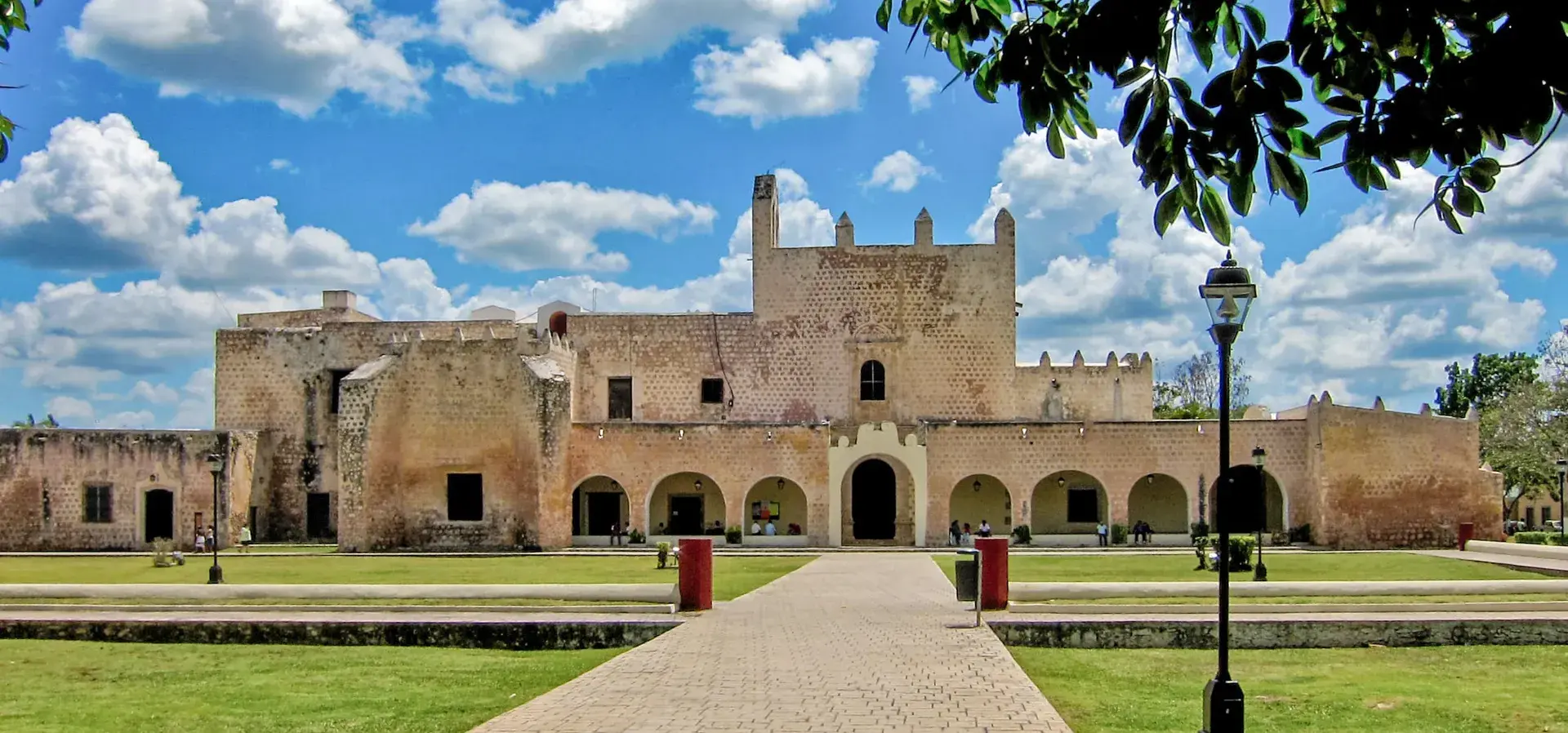
The Ex-Convento de San Bernardino de Siena, situated in the Barrio de Sisal in Valladolid, Yucatán, is the second-largest Franciscan monastic complex in the Yucatán Peninsula, spanning more than 14,000 square meters. Founded by the Franciscan Order in 1552 and consecrated around 1560, the complex was established in the indigenous settlement of Sisal—derived from the Maya term Síis Há, meaning "cold water"—to convert the Maya population of the former chiefdom of Zací.
Positioned on the edge of the colonial frontier, the monastery was engineered by its builders as a convento-fortaleza (fortified convent) capable of withstanding regional uprisings. The construction was directed by Friar Juan de Mérida—a former Spanish conquistador who took Franciscan vows and trained as an architect—alongside friars Hernando de Guevara and Francisco de la Torre. The compound features stone walls exceeding 10 meters in height and up to 1 meter in thickness, crowned with defensive crenellations and battlements (almenas). The stone doorway bears the carved Franciscan cord and the consecration date of 1560 in Roman numerals ("MDLX"), while an arcaded exterior loggia was added in the 17th century.
The Calzada de los Frailes and Urban Geography
The convent marks the southwestern terminus of the Calzada de los Frailes, a historic colonial corridor that originally separated the Spanish administrative center of Valladolid from the indigenous Maya quarter. Historically flanked by sacred ceiba trees, this axis linked the two distinct communities while underscoring the isolated, garrison nature of colonial Valladolid on the edge of the unconquered interior.
The Submerged Arsenal of Cenote Síis Já
During the Caste War of Yucatán (1847–1848), the convent served as a crucial military redoubt and sanctuary. When Maya forces besieged the complex, retreating government troops threw their weaponry down into Cenote Síis Já, an underground cavern situated directly beneath the cloister, to prevent the arms from being captured.
Subsequent underwater archaeological expeditions inside the cenote confirmed this event, uncovering an entire submerged 19th-century arsenal. Divers located more than 150 Spanish and British muskets, bullets, bayonets, and a preserved iron cannon resting on its original wooden carriage beneath the convent's cloister and kitchen.
Engineering Feats and Concealed Murals
In 1613, friars constructed La Noria, a massive hydraulic waterwheel made of stone and wood situated over the cenote cavity in the monastery’s rear orchard. As one of the largest colonial irrigation systems in the peninsula, the mechanism lifted groundwater to supply the convent's fountains, gardens, and expansive fruit orchards.
Centuries of architectural modifications also concealed earlier decorative elements. During major restoration work in 1978, specialists removed wooden altarpieces within the single-nave church to reveal previously hidden 16th-century religious wall murals painted directly on the original masonry.
Modern Museum and Cultural Site
Today, the restored complex operates as a museum and protected heritage monument overseen in coordination with Mexico's National Institute of Anthropology and History (INAH). Its interior spaces house exhibitions of colonial religious art, pre-Hispanic artifacts, and military weaponry recovered from the grounds.
The open atrium functions as an expansive public plaza connecting with the Calzada de los Frailes. In the evenings, the convent's limestone façade serves as the backdrop for a free bilingual sound-and-light projection show narrating the history of Valladolid and the regional Maya civilization.
FAQ
Why was the Convent of San Bernardino of Siena built like a fortress?
Because colonial Valladolid was an isolated frontier outpost vulnerable to indigenous revolts, master builder Friar Juan de Mérida designed the monastery with 10-meter-high fortified walls, parapets, and battlements to serve as a defensible citadel.
What historical items were discovered in the convent's cenote?
Underwater archaeologists exploring Cenote Síis Já beneath the cloister discovered a sunken 19th-century military cache from the Caste War, including an iron cannon on a wooden carriage and over 150 muskets, bayonets, and rounds of ammunition.
What was the purpose of La Noria at the convent?
Built in 1613 over the cenote cavity, La Noria was a massive stone-and-wood waterwheel that drew groundwater to power one of the colonial peninsula's largest irrigation networks, servicing the monastery's orchards and gardens.
Discover Valladolid like never before
Dive into Valladolid hidden stories and secret spots with Ciceru interactive tours.
Explore tour
Audioguide
Quizzes
Maps
Solo
Couples
Groups & families

© Photo by Tommaso Moleri via Google Maps · Google Places