Church of the Descent of the Holy Spirit, Łódź
The Asymmetrical Gateway
Situated at Piotrkowska Street 2/2a, the Church of the Descent of the Holy Spirit forms one-half of the architectural gateway leading from the octagonal Plac Wolności into the central pedestrian spine of Łódź. The building introduces visitors to the historic route while presenting a physical record of the city's shifting demographics and architectural ambitions over the centuries.
A History of Transformation
The site on what was then Nowy Rynek was originally designated by town planner Rajmund Rembieliński to serve an influx of German weavers and Protestant artisans. Built between 1826 and 1828 by architect Bonifacy Witkowski, the original classical Lutheran temple—the Evangelical-Augsburg Church of the Holy Trinity—was the first brick church in industrial Łódź. Witkowski intentionally designed the building to perfectly mirror the Old Town Hall across the street, providing symmetrical balance to the southern gate of the square.
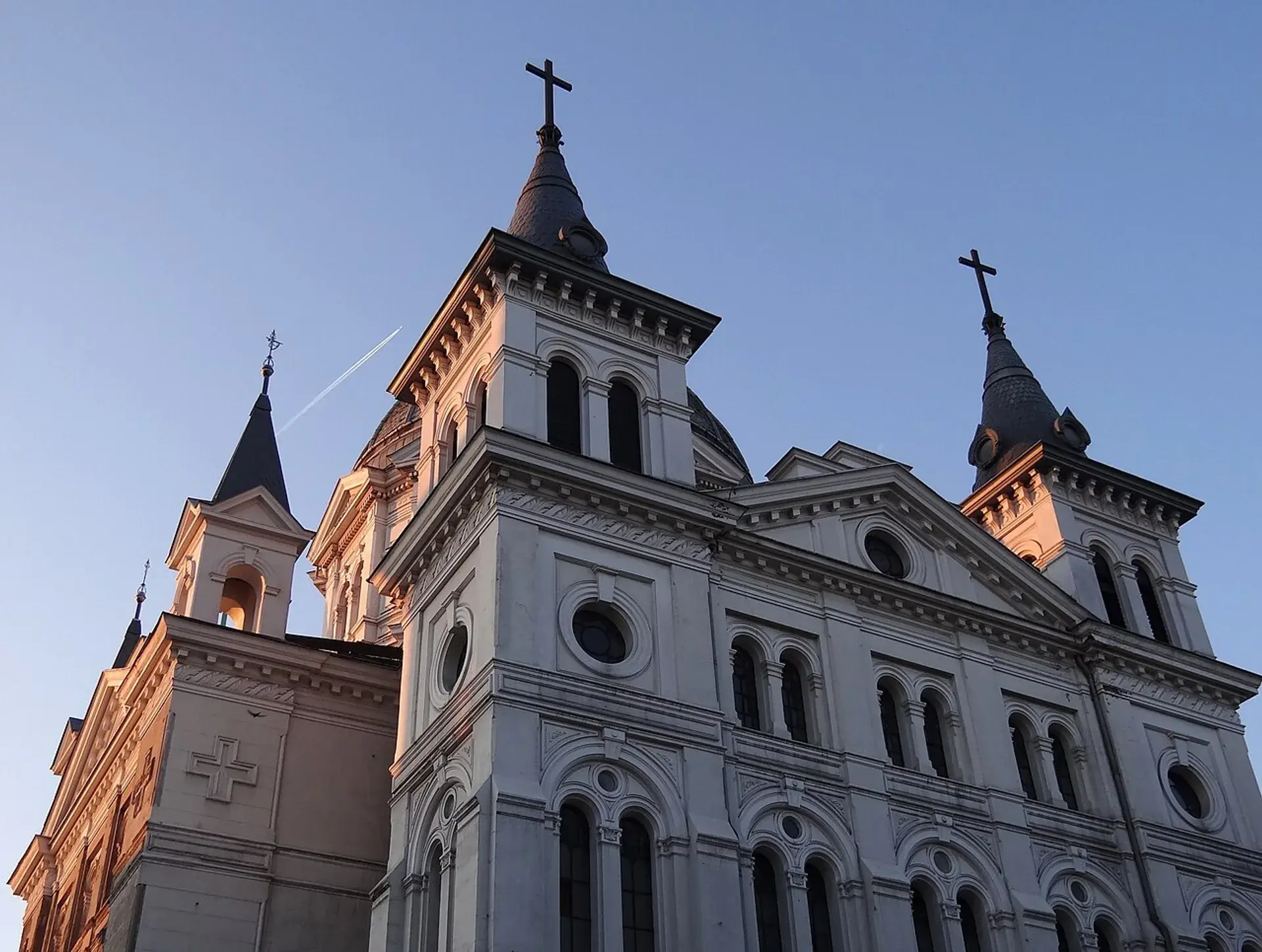
As the city experienced a rapid demographic boom, the modest church became too small for the growing Lutheran community. The original structure was demolished between 1888 and 1889 to make way for a grander building. The present Neo-Renaissance church was erected between 1889 and 1892 by Otto Gehlig, with contributions from city architects Hilary Majewski and Mikołaj Prokofjew. This monumental reconstruction deliberately broke the city's original symmetrical design by replacing the matching classical facade with a central dome inspired by St. Peter's Basilica.
Shifting Demographics and Faith
The evolution of the building reflects the complex multi-ethnic and multi-religious history of Łódź. Following World War II and the exodus of the German population, the building was transferred to the Roman Catholic Church in 1945. It initially served as a garrison church before being established as the Parish of the Descent of the Holy Spirit in 1948. The Catholic parish later officially purchased the temple from the Evangelical-Augsburg Church in 1989.
Architectural Details and Hidden Curiosities
The current structure features a Greek cross floor plan, a prominent central dome set on a high drum, classical pediments, and corner lantern towers. Despite operating as a Roman Catholic church today, the interior retains distinctive Protestant architectural features from its Lutheran origins. Most notably, two-story cast-iron galleries, known as empory, wrap around the interior to maximize congregation seating around the pulpit.
The church's interior is further enhanced by polychrome wall paintings illuminated by stained glass windows. Additionally, the building houses a 46-stop Romantic organ crafted by the renowned Silesian firm Schlag & Söhne. This instrument ranks among the oldest and largest historic organs of its kind in central Poland.
Present Day Use
Today, the Church of the Descent of the Holy Spirit is a registered cultural monument operating as an active Roman Catholic parish within the Archdiocese of Łódź. It holds regular religious services and remains open to visitors exploring the historic core of the city.
FAQ
Where is the Church of the Descent of the Holy Spirit located?
The church is located at Piotrkowska Street 2/2a on Plac Wolności (Liberty Square) in central Łódź, Poland.
What is the architectural style of the church?
The current building features a Neo-Renaissance eclectic design built on a Greek cross floor plan, complete with a central dome inspired by St. Peter's Basilica, corner towers, and classical pediments.
Was the church always a Roman Catholic parish?
No, it was originally established as the Evangelical-Augsburg Church of the Holy Trinity to serve Łódź's population of German Protestant weavers. It was transferred to the Roman Catholic Church in 1945.
What unique features can be found inside the church?
The interior retains Protestant architectural elements such as two-tier cast-iron galleries designed to maximize seating. It also houses a historic 46-stop Romantic organ crafted by the firm Schlag & Söhne.
Discover Odz like never before
Dive into Odz hidden stories and secret spots with Ciceru interactive tours.
Explore tour
Audioguide
Quizzes
Maps
Solo
Couples
Groups & families

© Adam Jones from Kelowna, BC, Canada | CC BY-SA 2.0