Manufaktura: Exploring Łódź's Reborn Cotton Empire
Manufaktura stands as a 27-hectare arts, commercial, and entertainment complex that shifted the functional center of gravity in modern Łódź. Originally the 19th-century textile empire of Izrael Poznański, this massive red-brick enclave illustrates the dramatic transition from a booming textile town into a pioneer of industrial regeneration. Today, the complex seamlessly blends historic masonry with modern glass and steel.
The Rise of a Cotton Empire
In 1871, Izrael Kalmanowicz Poznański began acquiring land along Ogrodowa Street. A year later, he launched a steam-powered weaving mill equipped with 200 mechanical looms imported from England. As one of the "Three Cotton Kings," Poznański helped transform Łódź from a small agricultural town into the "Polish Manchester," a leading textile powerhouse in Europe.
A City Within a City
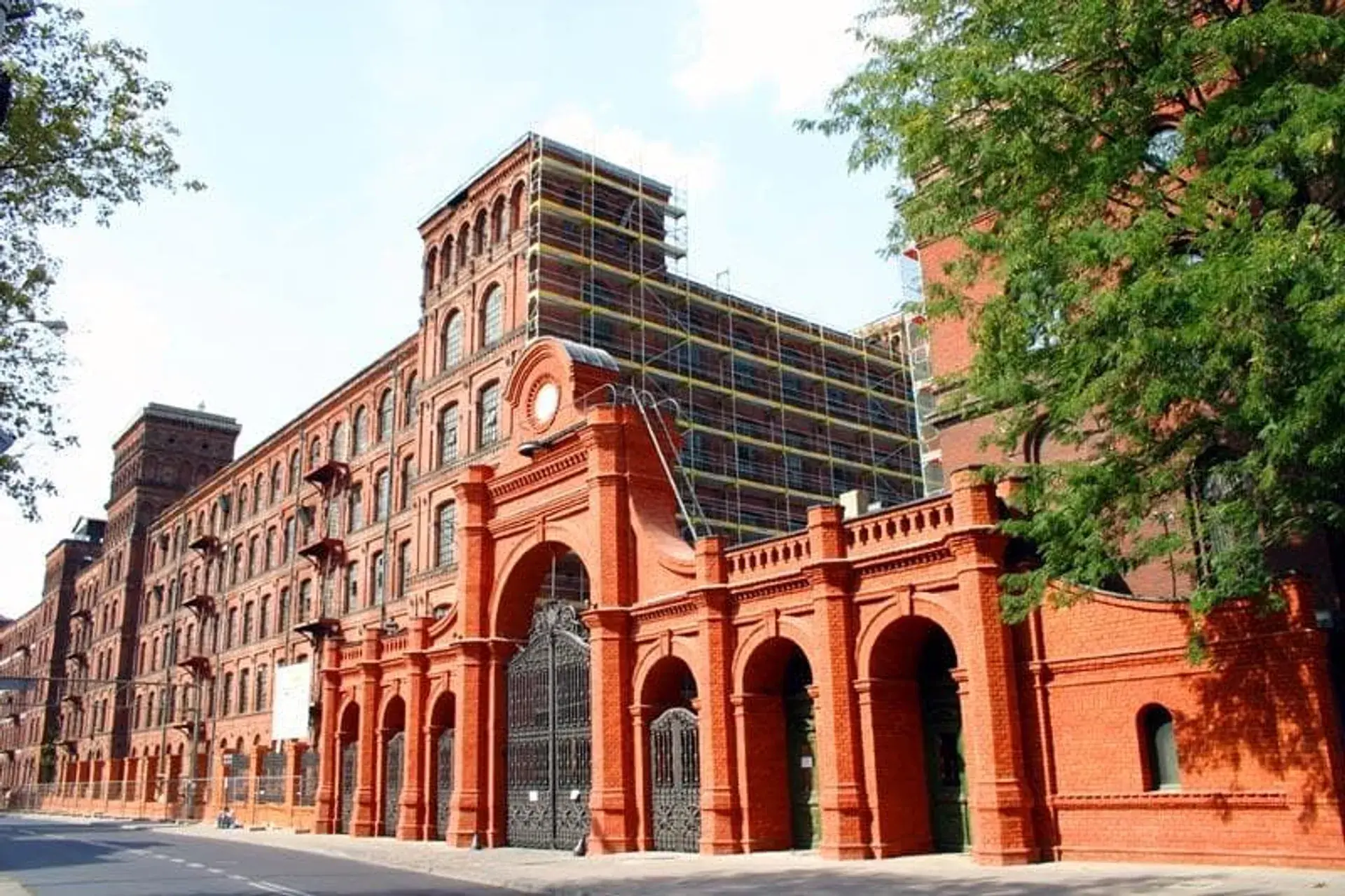
Over three decades, municipal architect Hilary Majewski designed a sprawling industrial compound that functioned as a self-sufficient enclave. The site featured massive spinning and weaving mills, bleaching plants, a private power plant, and a gasworks. It also supported a community infrastructure, housing worker estates known as famuły, a hospital, a fire station, and an adjacent opulent residence.
The historic entrance on Ogrodowa Street was deliberately shaped like a monumental triumphal arch to project industrial prestige. Inside, towering multi-story brick facades punctuated by cast-iron windows created a cavernous street canyon, displaying the immense wealth of an estate valued at up to 12 million Russian roubles by 1900—a stark contrast to the 12 roubles earned monthly by factory weavers.
Post-Industrial Renaissance
Following Poznański's death in 1900 and the financial strain of World War I, the complex was nationalized post-World War II. It operated as a state-run enterprise before entering liquidation in the 1990s due to the collapse of the communist-era textile industry. Between 1999 and 2002, the French firm Sud Architectes and British agency Virgile & Stone led a massive regeneration project, restoring over 45,000 square meters of exposed brick facades.
Opened to the public on May 17, 2006, the revitalized Manufaktura now houses the Muzeum Fabryki, the ms2 Museum of Art, and the Experymentarium science center. The historic five-story spinning mill has been repurposed as the four-star Vienna House by Wyndham Andel’s Hotel Łódź.
Modern Culture and Cinematic Legacy
A contemporary shopping hall with over 300 boutiques and numerous dining terraces complements the historic structures. The complex centers around a 3-hectare open-air plaza, bisected by a 300-meter-long linear fountain. This central square hosts seasonal public events, open-air concerts, and a winter ice-skating rink.
Beyond its modern attractions, the authentic industrial atmosphere provided the filming location for director Andrzej Wajda’s Academy Award-nominated 1974 film, The Promised Land. The film utilized the original textile works as a backdrop to dramatize the cutthroat rise of industrial Łódź, preserving the visual legacy of the city's historic cotton empires.
FAQ
When did Manufaktura open to the public?
The revitalized Manufaktura complex officially opened to the public on May 17, 2006, following a massive regeneration project that restored over 45,000 square meters of brick facades.
What museums are located inside Manufaktura?
Manufaktura is home to the Muzeum Fabryki, which highlights historical industrial exhibits; ms2, a museum of modern and avant-garde art; and the Experymentarium science center.
Who designed the original factory complex?
The original structures of Izrael Poznański’s textile empire were designed by Łódź’s official municipal architect, Hilary Majewski, starting in 1872.
Was Manufaktura featured in any famous movies?
Yes, the authentic textile works provided the real-world filming location for director Andrzej Wajda’s Academy Award-nominated 1974 film, The Promised Land.