Church of San Antón: Bilbao's Gothic Landmark
Medieval Origins and River Foundations
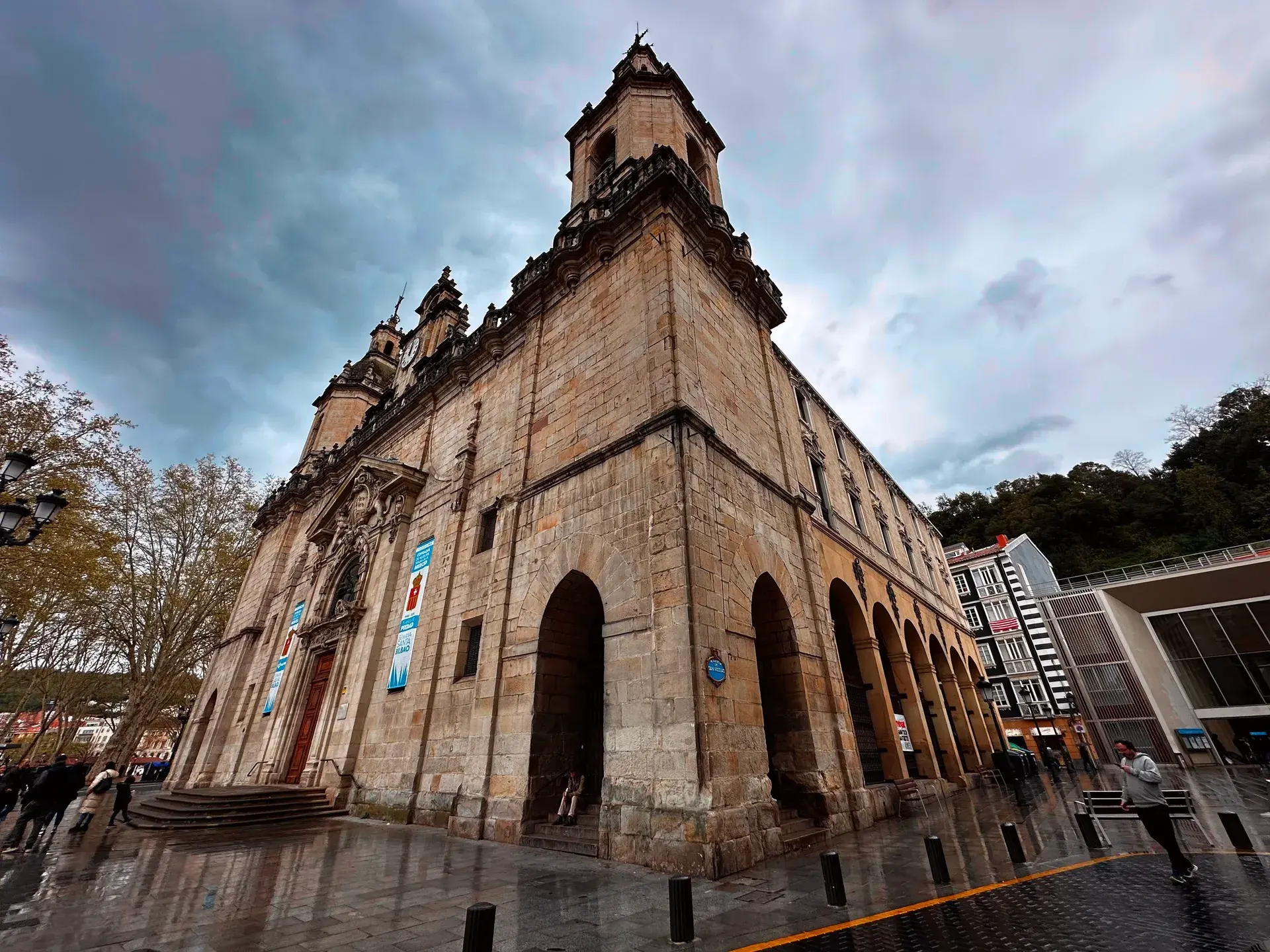
Formally known as the Church of San Antonio Abad, the Church of San Antón stands along the edge of the Nervión estuary at the southern perimeter of Bilbao's Old Town. Archaeological excavations carried out in 2002 confirmed that the rocky riverbank outcrop beneath the building was occupied by commercial river warehouses during the 12th and 13th centuries, predating the official foundation of Bilbao in 1300.
Following the granting of the town charter, the site formed a fortified corner of the medieval defensive wall and functioned as a protective river dyke. In 1433, a single-nave vaulted church was consecrated over a demolished section of this rampart. Sandstone foundations from this early structure remain visible behind the altar. By 1478, rapid urban population growth necessitated an extensive enlargement, prompting the construction of the present Gothic building directly along the tidal waterline.
Basque Gothic Architecture and Key Additions
Constructed primarily between 1478 and 1510, the church is a quintessential example of late Basque Gothic architecture. Designed as a hall church, it features ribbed vaulting and three stepped naves without a traditional apse. Over the subsequent centuries, several significant architectural elements were incorporated into the exterior.
Between 1544 and 1548, master masons Juan de Garita and Guiot de Beaugrant completed the Renaissance north portal, introducing a triumphal-arch doorway flanked by classical Corinthian columns and stone figures of Saints Peter and Paul. High above the structure rises an octagonal Baroque bell tower designed by Juan de Iturburu and finished in 1775. The tower is crowned with a weather vane carved by Gerónimo de Argos, representing an allegorical figure of Faith. In July 1984, the entire complex was declared a National Historic-Artistic Monument.
The Alderman's Balcony and Public Spectacle
Directly above the Renaissance portal rests a prominent exterior stone balcony added in 1559 by Juan de Láriz. Because the municipal town hall originally stood adjacent to the church, this elevated gallery was built specifically for city aldermen.
From this vantage point, local authorities observed public festivities and bullfights held in the neighboring square, as well as capital punishments conducted at the river crossing. Executions at the foot of the bridge involved a method known as empozamiento, where condemned individuals were thrown into the tidal river to drown with heavy stones bound around their necks.
Interior Relics and Funerary Curiosities
The interior of the church preserves unusual funerary arrangements stemming from its long history as a burial ground between the 15th and 19th centuries. The floor underfoot consists of an interlocking surface of repurposed gravestones, systematically rearranged during an extensive renovation in 1726.
Beneath the staircase leading to the choir is a dedicated ossuary. This repository houses historical human bones exhumed during past floor reorganizations and is flanked by guardian statues depicting Saints Cosmas and Damian.
Enduring Conflict, Floods, and Civic Identity
Because its stone foundations sit directly in the tidal currents of the Nervión estuary, the church has endured centuries of flooding. In August 1983, a catastrophic river surge inundated the building, causing extensive damage to its historic furnishings. The structure has also witnessed military conflict, having served as a munitions and supply depot during the 19th-century Carlist Wars.
The pairing of the Church of San Antón and its accompanying stone bridge holds deep civic resonance. The silhouette has appeared on Bilbao's official coat of arms since the 16th century and was formally integrated into the athletic crest of Athletic Club Bilbao in 1941. Today, the building remains an active Roman Catholic parish within the Diocese of Bilbao, welcoming visitors through coordinated heritage access with Bilbao Cathedral.
FAQ
What is the historical significance of the balcony on the church exterior?
Built in 1559 by Juan de Láriz, the stone balcony above the north portal served as a private viewing platform for municipal aldermen to watch bullfights in the adjoining square and public executions carried out by drowning at the bridge.
Why does the Church of San Antón appear on Bilbao's coat of arms?
The silhouette of the Church of San Antón alongside its adjacent bridge has been the central emblem on Bilbao's official coat of arms since the 16th century and was later incorporated into the crest of Athletic Club Bilbao in 1941.
What can be seen on the church floor?
The church floor is paved with an interlocking mosaic of repurposed stone gravestones, which were rearranged in 1726 after centuries of the building serving as an indoor parish cemetery.