Plaza Barria: Bilbao's Square That Became Venice
Discover the 19th-century neoclassical square that was once deliberately flooded and filled with gondolas to recreate Venice for a day. Located in the heart of Bilbao's medieval Old Town (Casco Viejo), Plaza Barria—also known as Plaza Nueva—serves as a vital civic forum connecting the historic "Seven Streets" with the city's 19th-century expansion across the estuary.
A Neoclassical Masterpiece
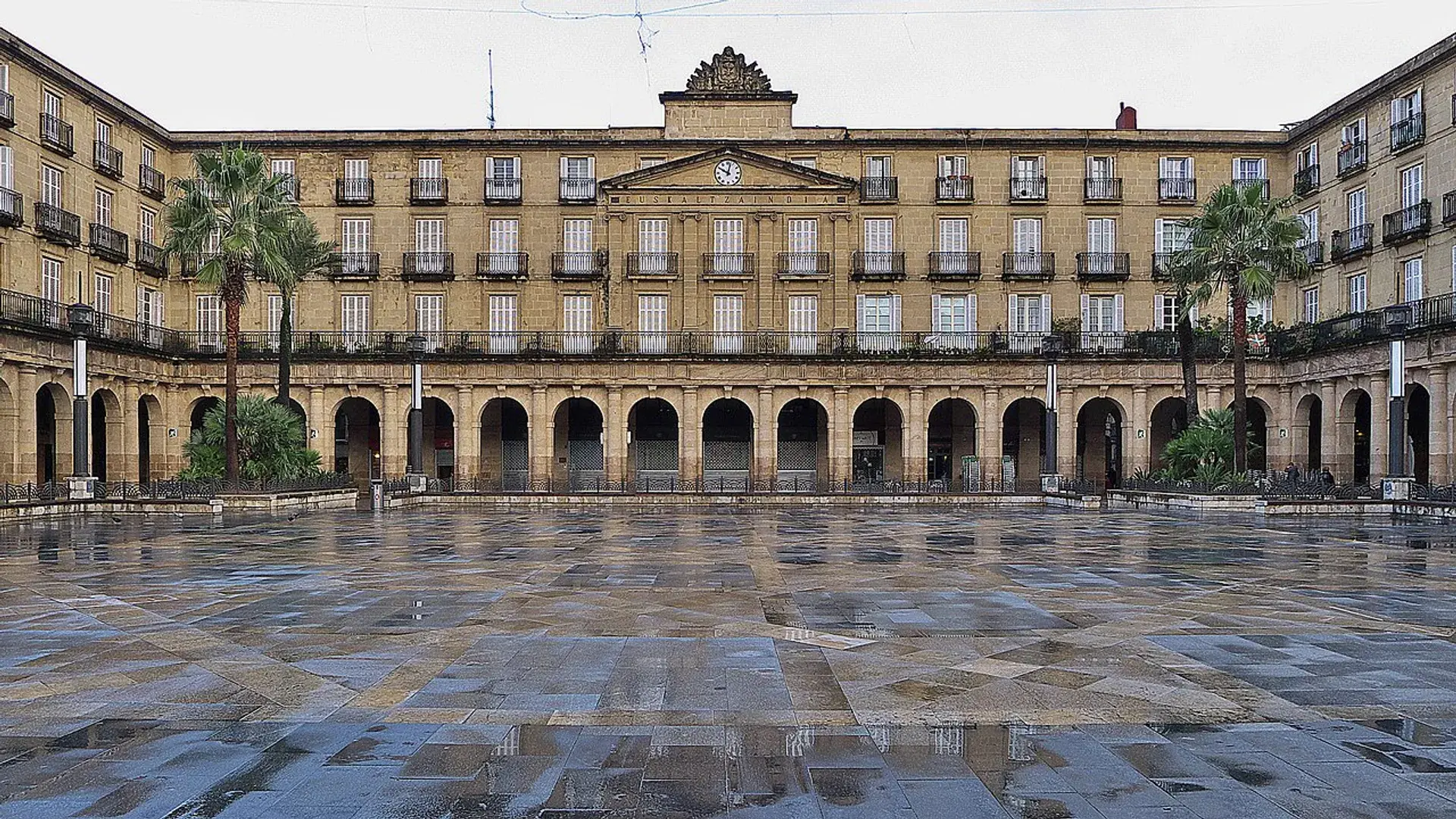
Conceived during the Enlightenment and officially inaugurated in 1851 by architect Antonio de Echevarría, the enclosed square spans 3,400 square metres. It was built to replace the congested medieval Plaza Vieja. The plaza is framed by uniform four-storey buildings supported by 64 semicircular arches and Doric columns. Access to the square is provided through vaulted archway portals known locally as "cuevas" or caves.
The grand building on the northern side originally served as the Biscay Provincial Government until 1890. Today, it houses Euskaltzaindia, the Royal Academy of the Basque Language. The square's architectural harmony has long served as a backdrop for local life, famously providing a childhood playground for philosopher and writer Miguel de Unamuno.
The 1872 Venetian Spectacle
The square holds a highly unusual place in Bilbao's history. On August 5, 1872, during a visit by the Italian-born King Amadeo I of Savoy, the city's festival committee transformed the plaza into a temporary Venetian lagoon. At the time, the central floor of the square was sunken below the arcade level. Organizers plugged the drains and sluices, flooding the basin with water.
Locals dressed as gondoliers and rowed decorated boats through the illuminated plaza. While it sounds like a local exaggeration, municipal archives confirm the event with precise payment records for boat rentals, carpenters, and water-jets. Bilbao painter Manuel Losada, who was born in a building facing the square, even immortalized the celebration in his artwork "Góndolas en la Plaza Nueva".
Pintxos and Sunday Markets
Today, the square's continuous stone arcades act as an acoustic sounding board, amplifying the hum of lively conversations and clinking glasses. These archways shelter patrons from the fine local drizzle known as sirimiri. The perimeter is a major hub for traditional and modern taverns, where patrons gather for local cuisine and txakoli wine.
On Sunday mornings, the central floor transforms into a bustling open-air flea market. Collectors arrive to browse vintage books, coins, stamps, postcards, and flowers. The space also frequently hosts Basque folk dances and concerts. Continuing its history of unique public events, the square hosted a Grand Slam Masters Final chess tournament in 2008 and 2009, with competitors playing inside a soundproof, transparent glass cube.
FAQ
Why is Plaza Barria also called Plaza Nueva?
Plaza Barria translates to Plaza Nueva (New Square) in Spanish. It earned this name because it was built to replace Bilbao's congested medieval Plaza Vieja (Old Square).
Did Bilbao really flood the square with gondolas?
Yes. In 1872, to honor a visit by the Italian-born King Amadeo I of Savoy, organizers plugged the square's drains to flood the sunken central esplanade. Locals dressed as gondoliers and rowed decorated boats, an event confirmed by municipal archives.
What happens in the square on Sundays?
Every Sunday morning, the central floor and perimeter of Plaza Barria host a popular open-air flea market featuring vintage books, coins, stamps, curiosities, and flowers.