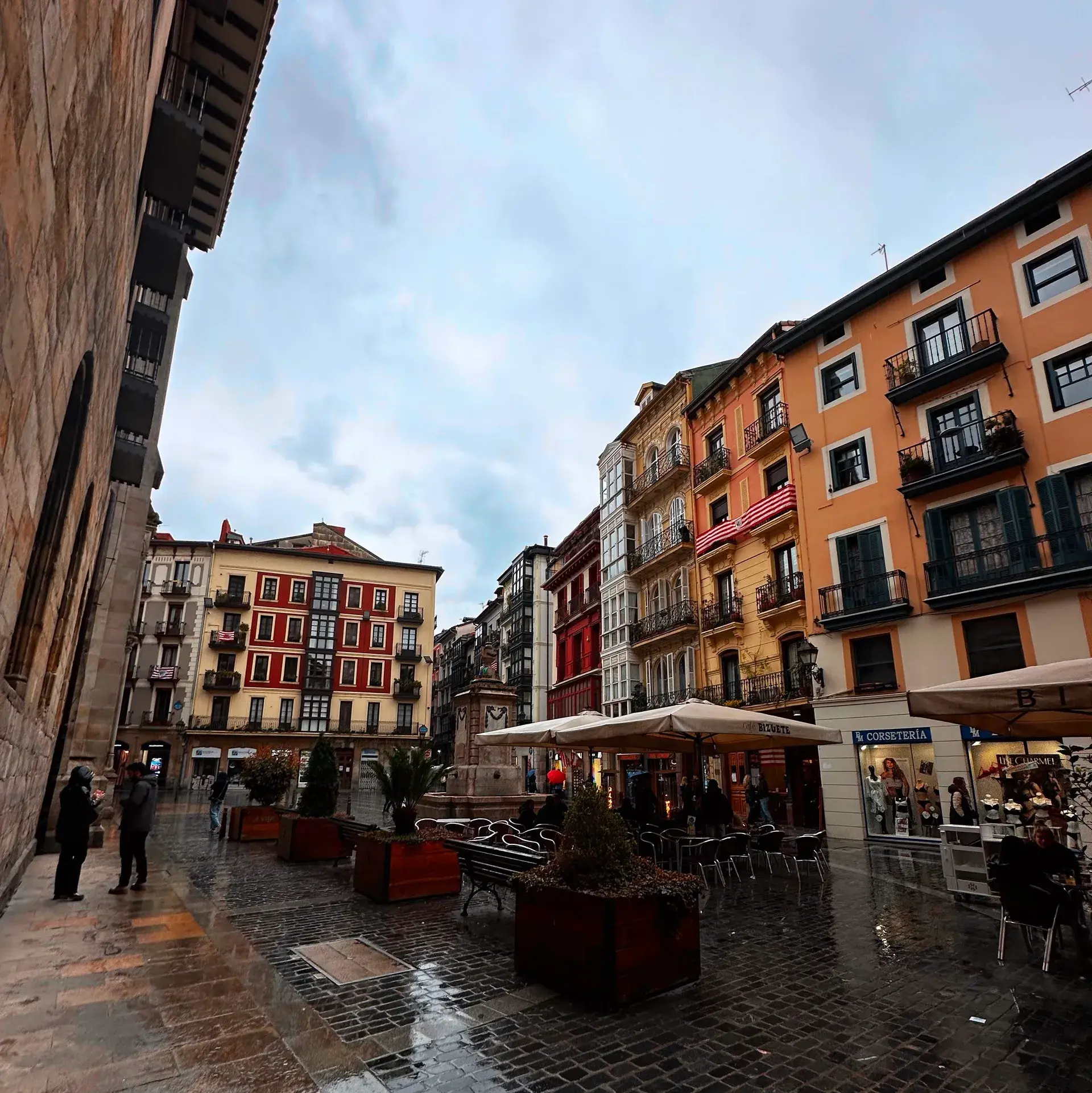
Plaza Miguel de Unamuno: Bilbao's Historic Square
The Gateway to Casco Viejo
Plaza Miguel de Unamuno is a prominent public square located at the northeastern edge of Bilbao's medieval quarter, known as Casco Viejo or Zazpikaleak. The square borders the Portal de Zamudio, an ancient entry point into the historic walled city.
Over the course of the twentieth century, the location underwent several name changes reflecting Spain's political shifts. Originally called Plaza de la Cruz, it was renamed Plaza de los Auxiliares in 1925. In 1937, it was redesignated after Francoist brigades, before ultimately receiving its current dedication to writer and philosopher Miguel de Unamuno in 1980. Unamuno, one of the city's most prominent literary figures, was born around the corner on Calle Ronda.
Bilbao: a self-guided walking tour of the Casco Viejo, with audio, quizzes & free eSIM
2 hours10 stopsAudio guideStart any day, at your own paceTicket on your phone · 30-day refundThe Unamuno Monument and Its Turbulent History
At the center of the square stands a monument inaugurated on September 29, 1984, commemorating the 120th anniversary of Unamuno's birth. The memorial features a realistic bronze bust sculpted by Victorio Macho, positioned atop a hybrid Ionic and Corinthian column resting on a white marble pedestal.
The square reflects Bilbao’s complex relationship with Unamuno, whose public opposition to Basque nationalism and fluctuating political stances generated controversy. In 1936, following his early support for the Nationalist faction during the Spanish Civil War, an earlier bust of Unamuno was removed from Bilbao City Hall and cast into the Nervión River. In 1999, the bust atop the square's column was torn down and thrown into the river as well, repeating history before being retrieved from the water in January 2000.
Cultural Hub and Social Center
Today, Plaza Miguel de Unamuno serves as an active pedestrian crossroads and a key transit hub, featuring an entrance to the Casco Viejo / Zazpikaleak metro station. It is surrounded by outdoor bar terraces that connect to surrounding pintxo routes along Calle Iturribide and Calle Askao.
The square also anchors two major cultural institutions: the Euskal Museoa (Basque Museum) and the Archaeological Museum of Bizkaia (Arkeologi Museoa), making it a focal point for regional history and heritage.
Design Features and the Mallona Steps
Beyond the central column, the square incorporates unique public design features. A plaza fountain includes inscriptions acknowledging the four classical elements written in the Basque language: sua (fire), lurra (earth), ura (water), and haizea (air).
The square also serves as the departure point for the Calzadas de Mallona. Built in 1745, this steep stone staircase ascends from the medieval valley floor toward the Basilica of Begoña on the hill above.
FAQ
What is the history behind the bust in Plaza Miguel de Unamuno?
Unveiled in 1984, the bronze bust was sculpted by Victorio Macho. In 1999, it was torn down and dumped into the Nervión River, mirroring an incident from 1936 when another bust of Unamuno was thrown into the river from Bilbao City Hall. The square's bust was recovered from the water in January 2000.
Which museums are located in Plaza Miguel de Unamuno?
The square is home to the Euskal Museoa (Basque Museum) and the Archaeological Museum of Bizkaia (Arkeologi Museoa).
What are the Calzadas de Mallona?
The Calzadas de Mallona is a stone staircase built in 1745 that begins at Plaza Miguel de Unamuno and leads uphill to the Basilica of Begoña.
What words are inscribed on the square's fountain?
The fountain features references to the four classical elements in Basque: sua (fire), lurra (earth), ura (water), and haizea (air).