Plaza Nueva in Bilbao: History, Architecture & Culture
Bilbao's Neoclassical Heart
Plaza Nueva, officially known in Basque as Plaza Barria, is an enclosed neoclassical square covering 3,400 square metres in Bilbao's Casco Viejo. Designed to introduce an open, hygienic public space away from the dense medieval grid of the Siete Calles, the square serves as an architectural hinge between the city's 14th-century merchant quarter and the 19th-century bourgeois Ensanche district across the Nervión Estuary. Its name distinguishes it from Plaza Vieja, the historic riverfront square situated near San Antón Church.
Architecture and Enclosure
The square is defined by four-storey perimeter blocks resting on 64 semicircular stone arches supported by square pillars and attached Doric columns. Five arched entrance passages, traditionally called cuevas, allow access to the interior. While four of these were part of the original design, the passage toward Calle del Correo was added later after the perimeter sustained damage during the Spanish Civil War.
The northern perimeter features the square's main institutional building, initially constructed for the Provincial Deputation of Biscay (Diputación Foral de Bizkaia), later used by Banco de Bilbao, and now housing Euskaltzaindia (the Royal Academy of the Basque Language). The building's pediment features an antique clock and the carved stone coat of arms of the Lord of Biscay (Señorío de Vizcaya). Beneath the uniform stone pavement lies a subterranean parking garage built in 1966, which displaced earlier 19th-century central gardens planted with magnolias and acacias.
Evolution and the 1872 Venetian Lagoon
First conceived in 1786 by Enlightenment architect Silvestre Pérez, Plaza Nueva required 65 years of development before its formal opening in 1851 under architects Antonio Echevarría and Avelino Goikoetxea. King Fernando VII backed the construction against the resistance of local landlords, though a planned central statue of the king was discarded after his death in 1833 and Bilbao's turn toward liberal politics. From 1939 to 1980, the Francoist regime officially titled the site Plaza de los Mártires before its traditional name was restored.
The square's watertight enclosure enabled an extraordinary civic spectacle in 1872 for the visit of King Amadeo I. Authorities sealed all arched entranceways and flooded the square to create an artificial Venetian canal. Dressed in gondolier costumes, local residents raced decorated gondolas across the flooded pavement, an event later commemorated by painter Manuel Losada in his work Fiesta veneciana en la Plaza Nueva.
Modern Culture and Social Life
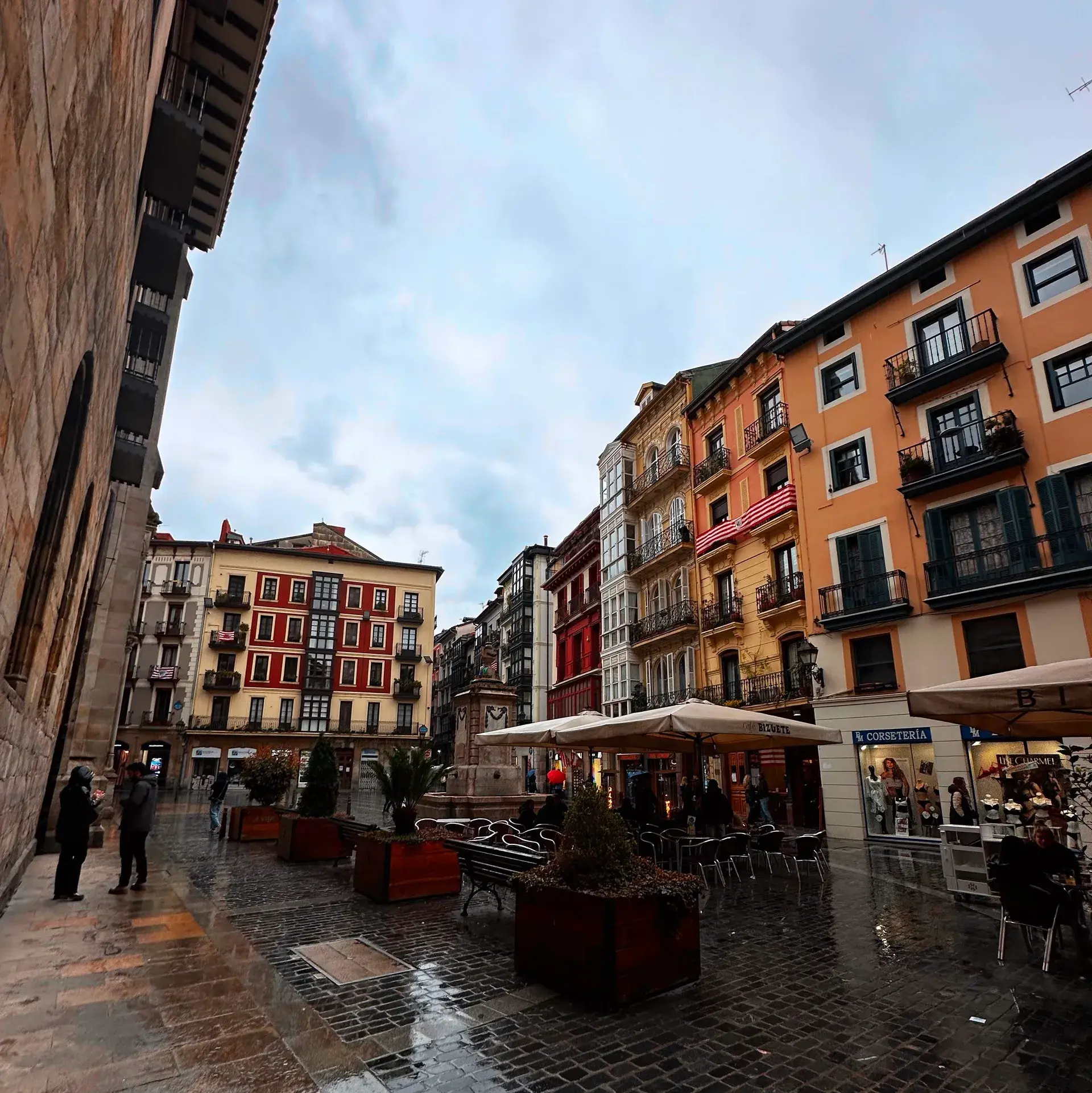
Plaza Nueva remains one of Bilbao's primary social centers. The covered ground-floor colonnades house renowned establishments such as Café Bilbao, Bar Sorginzulo, and La Olla, forming a major center for the txikiteo tradition of moving from bar to bar to enjoy pintxos and wine. The 64 sandstone arches provide shelter from the frequent Atlantic drizzle, known locally as sirimiri, while reflecting conversation and clinking glassware into an energetic acoustic atmosphere.
In addition to daily dining, the square hosts community events such as municipal concerts, Basque folk dance performances, and the annual Santo Tomás agricultural fair in December. In 2008 and 2009, the Grand Slam Chess Masters Final was staged in the square inside an enclosed glass structure. Every Sunday morning, the stone floor fills with an open-air collectors' market offering antique books, coins, stamps, minerals, and vinyl records.
FAQ
Why is the square named Plaza Nueva?
It was named Plaza Nueva (New Square) to distinguish it from Bilbao's historic riverfront Plaza Vieja (Old Square), located near San Antón Church.
Why was Plaza Nueva flooded in 1872?
During the 1872 visit of King Amadeo I, city authorities sealed the entrance arches and flooded the square to create an artificial Venetian canal, where locals raced decorated gondolas in full costume.
What takes place at Plaza Nueva on Sundays?
Every Sunday morning, the square hosts a traditional collectors' flea market specializing in coins, stamps, vintage books, minerals, and vinyl records.