Cathedral of Santiago de Compostela: A Pilgrim's Beacon
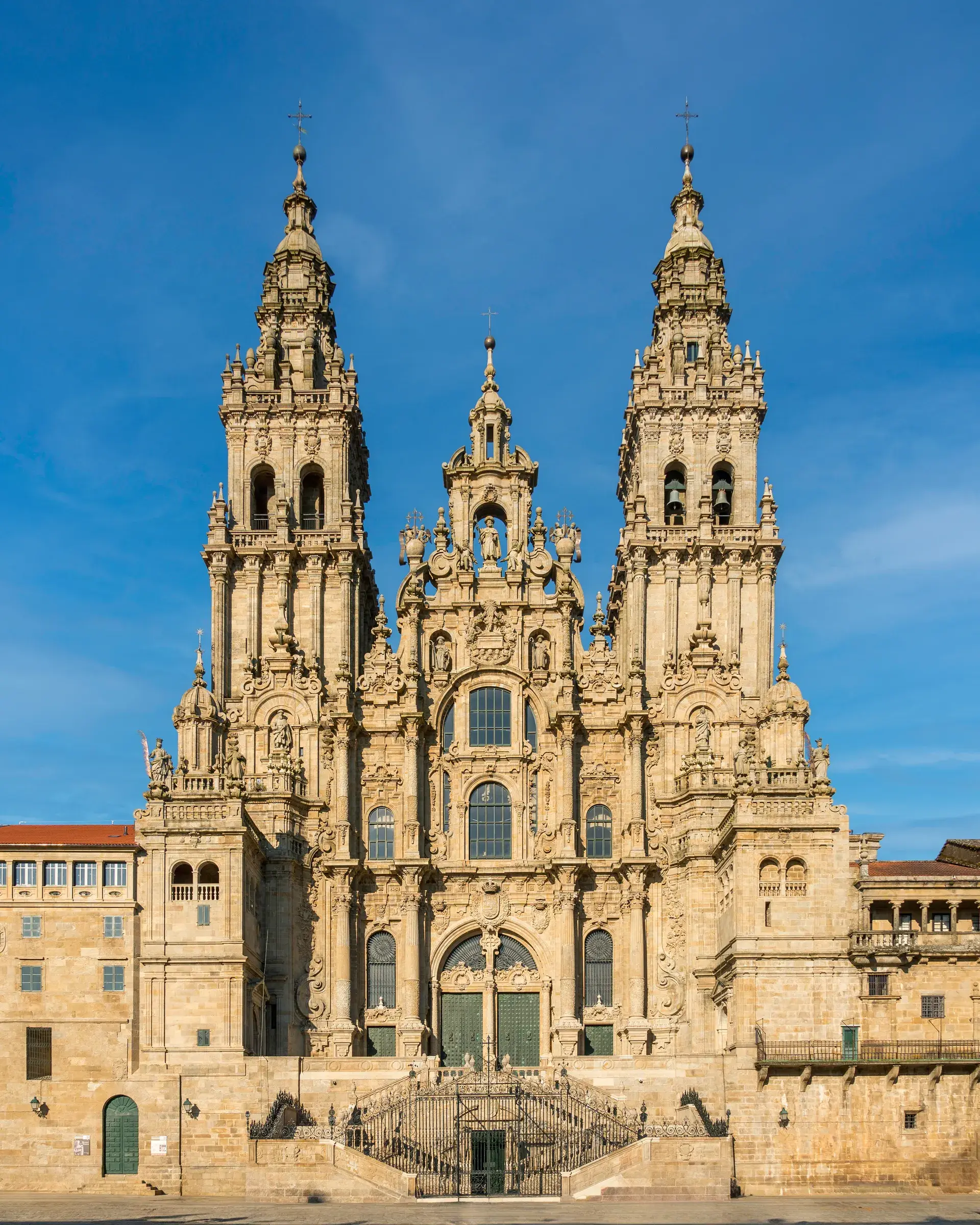
From the Praza do Obradoiro, the soaring facade of the Cathedral of Santiago de Compostela stands as the ultimate spiritual beacon for pilgrims worldwide. As the destination of the Camino de Santiago pilgrimage route, this UNESCO World Heritage site has been a focal point of European faith and culture for centuries.
A History Forged in Faith and Legend
The cathedral's origins are tied to the legend of Saint James the Great, one of Jesus's twelve apostles. Tradition holds that after his martyrdom in Jerusalem around 44 AD, his remains were transported back to Galicia, Spain. For centuries, the tomb's location was lost until the 9th century when a hermit named Pelayo was guided by strange lights in the sky. This spot became known as 'Campus Stellae' or 'Field of Stars,' the origin of the name 'Compostela.'
Following the rediscovery, King Alfonso II of Asturias, considered the first pilgrim, ordered a chapel to be built over the tomb in 813 AD. This was replaced by a larger church by 899, which was subsequently destroyed during a raid by the Islamic leader Almanzor in 997, who famously took its bells to Cordoba. Reconstruction efforts began in 1003, paving the way for the grander structure to come.
Architectural Evolution Through the Ages
Construction on the present-day cathedral began in 1075 during the reign of King Alfonso VI. Built largely in the Romanesque style, it features thick granite walls, a cruciform layout, round arches, and barrel vaults. The magnificent structure was officially consecrated in 1211.
Over the centuries, the cathedral integrated Gothic, Renaissance, and Baroque elements. The Romanesque Pórtico da Gloria, a masterpiece by Mestre Mateo, was completed in 1188. The cathedral's most recognizable feature, the elaborate Baroque Obradoiro facade, was designed by Fernando de Casas Novoa and finished between 1738 and 1750. Interestingly, two of the cathedral's towers exhibit a noticeable lean; the Berenguela tower has an inclination of twelve centimeters, while the Torre de las Campanas leans by forty centimeters.
The Cathedral Today: A Living Center of Pilgrimage
Today, the Cathedral of Santiago de Compostela continues to welcome hundreds of thousands of pilgrims annually. Multiple Pilgrim's Masses are held daily at the main altar, with services at 7:30 am, 9:30 am, 12:00 noon, and 7:30 pm, alongside a daily English-language Mass.
Pilgrims participate in several time-honored rituals, including embracing the statue of Saint James located behind the main altar and visiting the crypt believed to house the Apostle's remains. During Holy Years, the Holy Door (Porta Santa) is opened, allowing pilgrims to gain plenary indulgence. The cathedral also offers guided tours, including access to the rooftops for unique views of the city.
The Botafumeiro and Other Curiosities
The Botafumeiro is a massive thurible, or incense burner, that is dramatically swung through the cathedral during specific solemn Masses. Beyond its ceremonial role, it served a practical purpose in medieval times, as its fragrant smoke helped to mask the odors of the many unwashed pilgrims who had completed their long journey.
Among the cathedral's hidden details is a small, self-representing figure of Mestre Mateo, the sculptor of the Pórtico da Gloria, located at the portico's base. University students once had a tradition of bumping their heads against it for wisdom, a practice now forbidden to prevent further deterioration of the statue.
FAQ
Why is the Cathedral of Santiago de Compostela so important?
It is the reputed burial site of Saint James the Great, one of Jesus's apostles, and serves as the final destination for the Camino de Santiago, one of the most significant Christian pilgrimage routes in the world. It was recognized as a UNESCO World Heritage site in 1985.
What is the Botafumeiro?
The Botafumeiro is a famous, massive thurible (incense burner) that is swung through the cathedral during solemn Masses. Historically, its fragrant smoke also served the practical purpose of masking the odors of unwashed pilgrims who often slept inside the church.
When did construction of the current cathedral begin?
Construction of the present Romanesque cathedral began in 1075 under the reign of King Alfonso VI. It was built on the site of earlier chapels and was consecrated in 1211.
Can visitors see the tomb of Saint James?
Yes, visitors and pilgrims can visit the crypt located beneath the main altar, which is believed to house the remains of the Apostle Saint James.