Guide to Bundesplatz: Bern's Federal Square
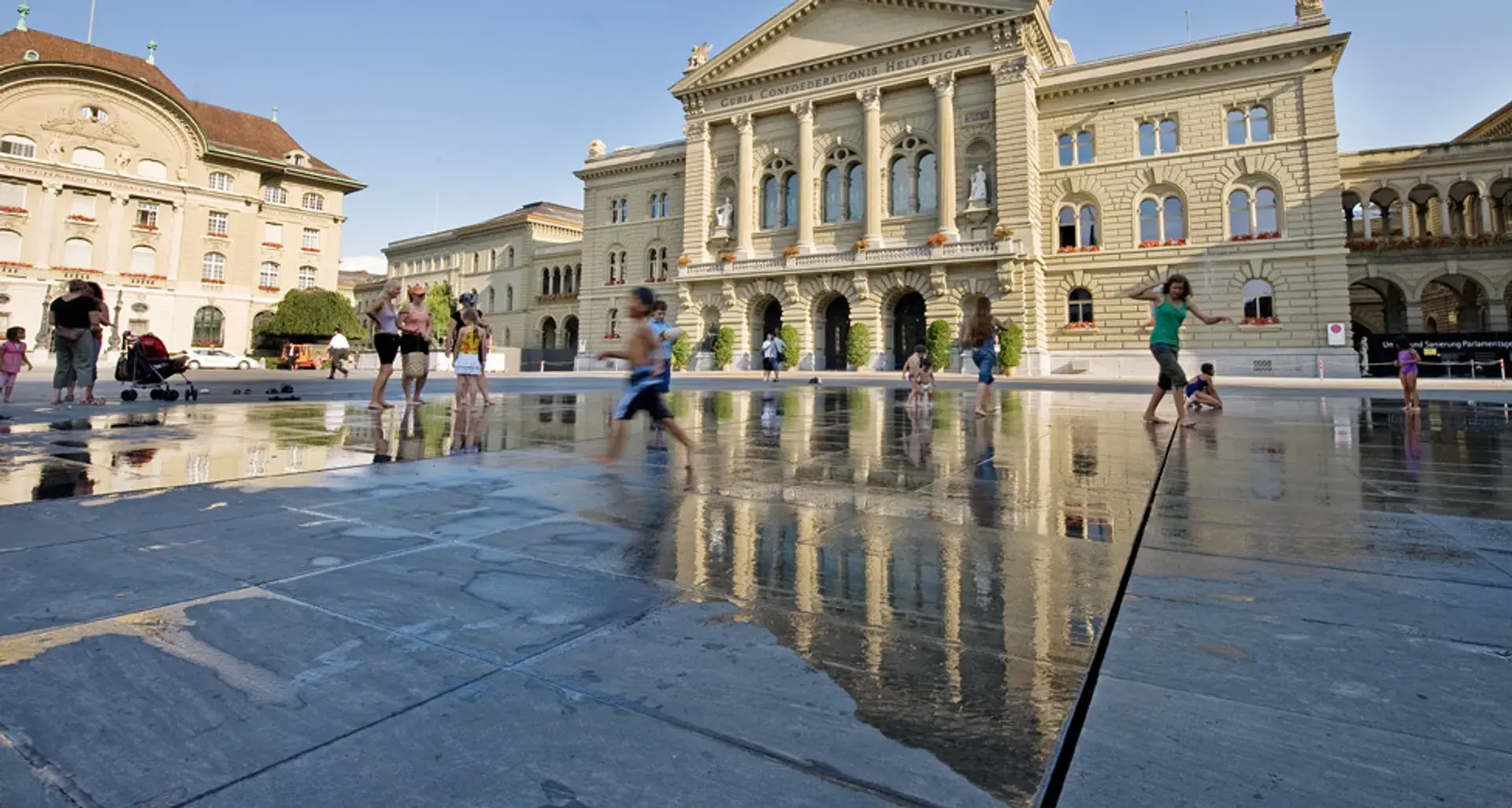
Bundesplatz serves as the central civic square in front of the Swiss Parliament Building in Bern. Known for the 26 geyser-like water fountains that animate the open plaza, this pedestrian-only space acts as the political anchor of Bern's UNESCO-listed Old Town. Situated immediately south of Bärenplatz, it marks the transition from the city's medieval street grid to the grand civic monuments of the Swiss federal state.
A Barrier-Free Democracy
Unlike heavily barricaded parliament plazas worldwide, Bundesplatz remains entirely open and accessible. Pedestrians and playing children mix directly outside the doors of the federal government, even while parliament is in session. The square is bordered to the south by the Federal Parliament, to the east by the Swiss National Bank, and to the west by the Bernese Cantonal Bank.
The 26 Fountains and Modern Design
The current plaza design, created by Christian Stauffenegger, Ruedi Stutz, and Stephan Mundwiler, was officially inaugurated on Swiss National Day (August 1, 2004). The surface is paved with approximately 3,600 dark, veined Vals gneiss slabs quarried in the canton of Grisons.
Integrated directly into this greenish-grey stone are 26 flush water jets, which symbolically represent the 26 Swiss cantons. The jets cycle through programmed or randomized sequences, spraying water several meters high and filling the square with rhythmic splashing sounds. By night, the wet stone reflects a subtle curved strip of ground lighting.
From Medieval Moat to Parking Lot
In the Middle Ages, this area was part of Bern's outer western fortifications, featuring a moat known as the Oberer Graben. The modern open square was formed around 1902 under architect Hans Wilhelm Auer, who oversaw the demolition of existing houses and a casino to create a ceremonial entrance plaza following the completion of the Parliament Building.
Officially named Bundesplatz in 1909, the site spent more than five decades in the 20th century as a crowded public car park before the city voted to reclaim it as a pedestrian space. Today, the underground mechanical room and recirculating water tank powering the fountain jets are constructed directly inside the excavated trench of the city's old medieval moat.
Civic Life and Annual Events
Bundesplatz is a hub of daily activity, hosting traditional open-air fruit, vegetable, and flower markets on Tuesday and Saturday mornings. It is also the central venue for national celebrations, state receptions for visiting foreign dignitaries, sports events, and political rallies. Every autumn, the square hosts Rendez-vous Bundesplatz, a free outdoor light-and-sound show that projects animated stories onto the facade of the Parliament Building.
FAQ
What do the fountains in Bundesplatz represent?
The square features 26 flush water jets embedded in the stone pavement. These fountains symbolically represent the 26 Swiss cantons.
Are there markets at Bundesplatz?
Yes, Bundesplatz hosts traditional open-air fruit, vegetable, and flower markets on Tuesday and Saturday mornings.
What kind of stone is used to pave Bundesplatz?
The square is paved with approximately 3,600 large natural-stone slabs of dark, veined Vals gneiss, which is quarried in the Swiss canton of Grisons.
What is Rendez-vous Bundesplatz?
Rendez-vous Bundesplatz is a free outdoor light-and-sound show held in autumn. It projects animated stories directly onto the facade of the Swiss Parliament Building.