Hohensalzburg Fortress (Funicular Base)

Tips and tours for explorers and travellers

Salzburg City Guide

Salzburg pairs a compact UNESCO-listed Baroque Old Town with dramatic Alpine foothills, shaped by Mozart's musical heritage, the world-renowned Salzburg Festival, and pedestrian lanes tucked beneath Hohensalzburg Fortress.

Country
Austria
Language
German
Currency
Euro (EUR)
Plug
type C/F
Time zone
Europe/Vienna
Emergency
112, 133, 144, and 122
Tap water
Safe to drink
Dialling code
+43

The stops

Things to do in Salzburg

Salzburg's compact centre unfolds on foot between the Salzach river and Mönchsberg cliff. Historic squares, Mozart landmarks, and Baroque courtyards connect seamlessly, while steep climbs lead up to Hohensalzburg Fortress.

Mirabell Palace and Gardens – scandal in bloom

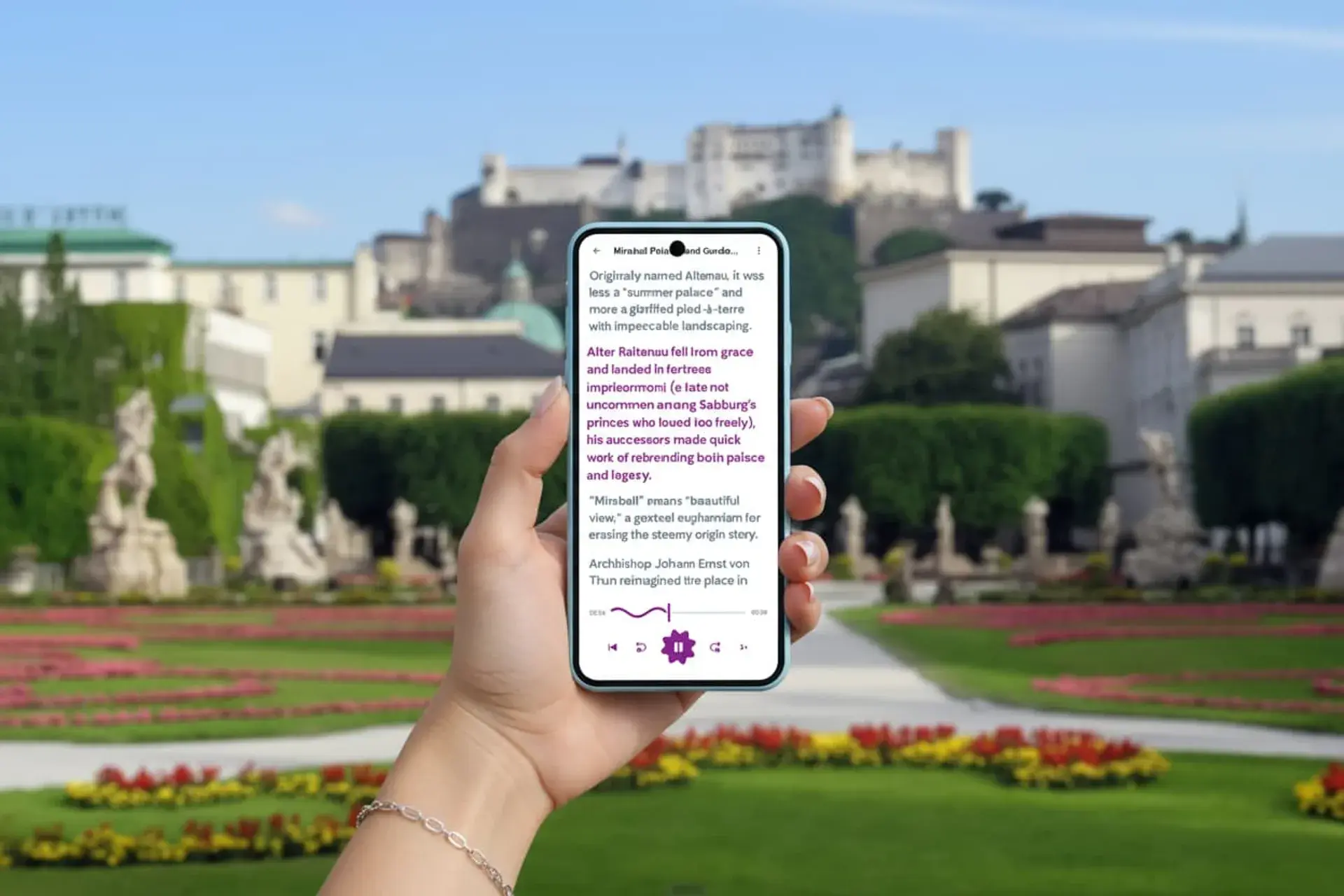
In Salzburg, even the scandals come landscaped. This refined city, threaded along the Salzach River and backed by snow-dusted hills, carries centuries on its shoulders like a well-tailored coat. You’ll find elegance in its Baroque façades, genius in its music halls, and a surprising amount of personality tucked between palaces and pastries. This walk invites you into the layered charm of Salzburg’s history. Not just the postcard version, but the winks, quirks, and human contradictions that fill its alleyways and bell towers. From ecclesiastical strongholds to twirling Do-Re-Mi meadows, local folklore shares pavement with world fame. And while the city’s most celebrated son—Mozart—makes frequent curtain calls, he’s far from the only story worth hearing. We begin with a garden that once bloomed for love, rumor, and a defiant archbishop’s family tree. It’s orderly now, but the roots remember. Mirabell was born out of scandal, which makes its present respectability all the more ironic. Around 1606, Prince-Archbishop Wolf Dietrich Raitenau built this palace—not for God, country, or cultural posterity—but for his mistress, Salome Alt, and their 15 children. Originally named Altenau, it was less a “summer palace” and more a glorified pied-à-terre with impeccable landscaping. After Raitenau fell from grace and landed in fortress imprisonment (a fate not uncommon among Salzburg’s princes who loved too freely), his successors made quick work of rebranding both palace and legacy. “Mirabell” means “beautiful view,” a genteel euphemism for erasing the steamy origin story. Archbishop Johann Ernst von Thun reimagined the place in the Baroque mode, adding a grand marble hall and sculpted gardens that today host weddings more politically correct than their namesake’s domestic arrangements. The gardens, a choreography of hedges and fountains, are more obedient than their original royal patron. You’ll spot the Pegasus fountain and the hedge theater, which now plays more Mozart sonatas than moral scandals. And of course, there’s the Dwarf Garden. Originally 28 strong, these bulbous stone figures were carved for amusement, then scandalized into storage. A few survivors now grin toothlessly for selfie-seeking tourists. Modern crowds remember it less for ecclesiastical gossip and more for Julie Andrews twirling to “Do-Re-Mi.” Mirabell now houses the mayor’s office rather than mistresses, and the Marble Hall doubles as one of Europe’s loveliest registry offices. It’s as buttoned-up as a civil servant—only with vastly better drapery. Children tell tales of the “Hexenkuss,” a tree bark formation they claim grants wishes if kissed. Botanically implausible, but charmingly persistent. Touch at your own peril—or promises. Come early. The only thing more surgically trimmed than the topiary are the tourists’ schedules. At sunrise, the scent of clipped yews and fresh blooms hangs in the air, unbothered yet by camera shutters. Raitenau would have hated the modesty. And just across the river, another Salzburg household brimming with sound and tension awaits—Mozart’s later home and creative crucible.
Mozart’s Residence – genius at close quarters

<p>Makartplatz 8 is surprisingly sedate for a house that once echoed with symphonies, family quarrels, and the squawks of a pet starling with suspiciously refined taste. This is where the Mozarts moved in 1773 when their old apartment—above a busy street and below their increasing fame—could no longer contain their ambitions or elbows.<br><br>Leopold Mozart, ever the stage father with a manuscript in one hand and a travel itinerary in the other, designed an octagonal music room here, ideal for shaping Austria’s most precocious export. Wolfgang, by this point just 17, already had the posture of a man weary of small talk and provincial rituals. Many early masterpieces were composed beneath these ceilings.<br><br>WWII bombings shattered much but didn’t silence it. The residence was meticulously reconstructed, giving the building a faintly ghostly feel—the kind of place where the past hangs behind the plaster like a second wallpaper. Within, there’s Mozart’s own fortepiano (still sturdier than his finances ever were) and family instruments that saw more rehearsals than reconciliations.<br><br>The house is heavy with father-son tension, sibling talent (Nannerl, brilliant in her own right, mortally overshadowed), and creative genius caged. Even the alleged starling gets a mention—a bird who memorized Mozart’s tunes and maybe improved them. That kind of feedback loop is hard to come by on Spotify.<br><br>Today, hushed visitors drift through the rooms, headphones on, reverently peering at compositions like naturalists observing a rare fossil. Out the window, the modern city carries on with buses and bratwurst carts, oblivious to internal arias.<br><br>You leave realizing two truths: one, even Mozart needed better acoustics; and two, no genius is ever at home in a house for long.<br><br>From domestic dramas to defensive grandeur, before crossing the bridge we’ll pause by the riverbank and look south to the Hohensalzburg Fortress, which rises above the city like a stone crown still keeping watch over every note and rooftop.</p>

Hohensalzburg Fortress – the view from power

<p>You are not climbing it today, just admiring it from afar. Perched on Mönchsberg since 1077, Hohensalzburg began as a holy man’s backup plan: if diplomacy failed, build higher walls. It still dominates the skyline, a pale fortress that has outlasted its founders and the arguments that built it.</p> <p>Over centuries, each Prince-Archbishop added another layer, tower, or torture implement, crafting Europe’s fortification equivalent of a bureaucratic nesting doll. Archbishop Leonhard von Keutschach was especially fond of upgrading, adding princely apartments, self-aggrandizing crests, and what can only be described as medieval flexes. His family’s radish emblem appears in more places than is strictly necessary.</p> <p>Centuries passed. Empires fell. Hohensalzburg remained stubbornly unconquered. Even Napoleon, usually so skilled at turning castles into smoking ruins, declined the invitation. It served as a prison, a bastion, and, ironically, a symbol of safety from the men who built it.</p> <p>Inside, visitors now find museums devoted to war, puppetry, and princely taste, because Salzburg believes in categorizing its ghosts. Then there is the Salzburg Bull, not livestock but a wheezing mechanical organ built to psych out attackers by pretending the fortress had endless cattle. It plays daily, a moody soundtrack that seems to suggest, “We hear you down there, and we are incredibly unbothered.”</p> <p>The Torture Tower, once a medieval HR office, still looms beside the princely rooms, proof that splendor and dread often share hallways. From below, the panorama is just as grand. The fortress that once kept peasants out now welcomes them three times a day via guided tours. Even ramparts lose their edge after a few centuries.</p> <p>You can climb it after the tour if you wish, either on foot or by funicular from the Old Town. For now, keep the fortress in your sight as you head toward the river, where Salzburg’s quieter side glints ahead over a bridge heavy with declarations of love and locks.</p>

Makartsteg Bridge – locks, keys and good intentions

Getreidegasse – alley of commerce and memory

Getreidegasse is Salzburg’s answer to the question: what happens when centuries of commerce squeeze into an alley no wider than a marching band? Answer: gorgeously compressed chaos, with an aroma of strudel and capitalism. The name translates to “Grain Lane,” a nod to its Middle Ages functionality. But let’s not be quaint. This was a business street, where grain, shoes, cheese, and possibly gossip were traded with equal vigor. The street’s real genius lies in its signage: wrought-iron symbols so elaborate, even McDonald’s bowed to tradition and swapped out its golden arches for curlicues. Above the shops, you’ll spot the narrow, high-gabled houses reaching for sun like Florentine tenements. Hidden courtyards nestle behind archways, once secret merchant passageways and now Instagram catnip. At No. 9, Mozart entered the world and promptly began upstaging everyone else on the street. Today, Getreidegasse is more boutique than Baroque premise, but the bones remain: uneven cobbles, iron hooks where pigs once hung, and windows designed for window-shopping long before display ads existed. Locals tell whispered tales of passageways between buildings—an anecdotal labyrinth for evading taxes or love triangles. True or not, they track with the street’s mercantile cunning. If you listen, there’s a particular sound: expensive heels clip-clopping over stones worn by generations of bargains and schemes. It’s the soundtrack of a street that’s survived Romans, revolutions, and rent hikes—and still sells leather handbags at full markup. Among all these facades, one address hums a little louder—just ahead is the modest apartment where Mozart first heard the world.

Mozart’s Birthplace – small rooms, big echoes

It’s not especially big. Or lavish. Or noticeably purple, which is to say, it’s not how we usually imagine a genius’s nursery. But Getreidegasse 9 is where Wolfgang Amadeus Mozart was born on January 27, 1756—a third-floor tenant above a grocery shop, with a view of shopkeepers, street noise, and destiny. The Mozarts lived here for over 15 years. The apartment, by all accounts, was snug—a polite way of saying Leopold’s violin might’ve occupied more space than a sibling. It was here that infant Wolfgang banged keys and then promptly rewrote the instruction manual for European music. Inside, the museum displays aren’t glitzy. That’s the point. There’s his childhood violin (less than half his adult height), a battered clavichord, and family letters that read like dispatches from a very musical, very tense powder keg. There’s something uncanny about the reconstructions: a silent kitchen barely big enough for elbows, a modest living space drowned in foot traffic from fans with iPhones. Even legends start small—sometimes three rooms and a view of bakers. Legend says loud trumpet blasts once made baby Mozart burst into tears. Not fear—ear pain. Even at one year old, he was already critiquing the brass section. You leave realizing this: Mozart didn’t grow up in a palace. He grew up in a rental unit, squeezed in with parental ambition and melodic instincts. And that makes his music feel less divine and more miraculous. From a prodigy's cradle to a prince-archbishop’s front yard—next, we enter Residenzplatz, where religion, rule, and fountain drama converge.

Residenzplatz – theater of the archbishops

Salzburg Cathedral – stone, sound and salvation

Kapitelplatz – order, art and a golden orb

Your private guide, in your pocket

Ready to walk these?

  • Self-guided, start now or later
  • Offline audio, 7 languages
  • 30-day money-back guarantee
  • 500MB global eSIM included

from

€5.00

1 self-guided tour in Salzburg

See the tours

Plan the days

How many days in Salzburg? A perfect 1-day itinerary

Day 1

Walk Salzburg's Old Town from Mirabell

Cross the Salzach from Mirabell through the pedestrian Altstadt, then use trolleybuses for longer hops.

€5.00

Weather & crowds

Best time to visit

July is Salzburg’s warmest normal month at 25.0°C, but June–August are also the wettest period, each above 180 mm at Freisaal. September combines a 20.4°C high normal with less rain than summer; December–February are quieter but cold.

Recommended

Cold, quieter winter

Dec–Feb

-3–7°C/ 27–45°F

Few visitorsOccasional rain
  • Advent atmosphere
  • Lows stay below freezing in December and January

Don't miss

  • Salzburg Christmas Market

Spring shoulder

Mar–May

1–20°C/ 34–69°F

Getting busierWet
  • Mild May afternoons
  • May rainfall reaches 169.7 mm

Don't miss

  • Easter Festival Salzburg

Festival summer

Jun–Aug

12–25°C/ 54–77°F

Peak seasonWet
  • Salzburg Festival
  • June to August average over 180 mm of rain each month

Don't miss

  • Salzburg Festival

Crisp autumn

Sep–Nov

1–20°C/ 34–69°F

BusyOccasional rain
  • Warm September days
  • November high normal drops to 9.2°C

Don't miss

  • Rupertikirtag

Transport

How to get to & around Salzburg

Salzburg Airport

How to get to & around Salzburg
City bus 2 to Hauptbahnhofapprox. 23 min€3.00
City bus 10 to city centreapprox. 15 min€3.00

Obus and city bus

Best default

Salzburg Verkehr’s 1-hour core-zone ticket is €2.60 at a machine, online or in the app; the 24-hour version is €5.20. Validate advance tickets as required.

Guest Mobility Ticket

Free for guests

Overnight guests receive free province-wide public transport for the stay. The mobility fee is €0.50 per person aged 15+ per night from 1 May 2025 to 30 April 2027.

Walking

Strong in Altstadt

Salzburg’s centre is compact and many routes are easiest on foot; the catch is cobbled historic streets, bridges and steep approaches around the city hills.

Bicycle

Flat river routes

Cycling works well along the Salzach and between outer districts, but check local signs around the protected Old Town and pedestrian areas before riding through.

Walk the Altstadt and use the Obus for longer hops. If staying overnight, the Guest Mobility Ticket covers province-wide public transport, beating individual ticket purchases.

Budget

How much does it cost to visit Salzburg?

Salzburg is not a low-cost city-centre base: transport is manageable, but the visitor budget is affected by accommodation demand around the July–August festival period and by the €3.50 general-levy-plus-mobility charge per taxable night, before the separate €0.05 fund contribution.

How much does it cost to visit Salzburg?
Salzburg 1-hour core ticket€2.60–€3.00
Salzburg 24-hour core ticket€5.20–€6.40
Salzburg five-ride ticket€12.50
P+R combo, up to five people€7.50–€15.00
Airport P4 parking, one day€37.00–€39.00

Cash or card?

Salzburg Verkehr sells core-zone tickets at machines, online and in the smartphone channel; the operator’s 2026 fare page does not guarantee that every vehicle accepts foreign cards, so buy before boarding when practical.

Where to stay

Where to stay in Salzburg

Altstadt

first visit

Salzburg’s historic centre is the most walkable base for the riverfront and central cultural venues. Expect cobbles, pedestrian restrictions and premium demand in festival weeks.

Neustadt / Andräviertel

central, quieter evenings

Just east of the Salzach, Neustadt keeps the centre walkable while offering a more residential grid than the Altstadt. Obus routes make longer trips simple.

Schallmoos

rail access, value

Schallmoos is north-east of the centre and close to Salzburg Hauptbahnhof; it trades postcard streets for practical transport and local everyday life.

Elisabeth-Vorstadt

trains, short stays

The district around the main station is useful for early departures and regional rail, with bus links into the centre. Station-area traffic and a less historic feel are the downside.

Maxglan / Riedenburg

residential, airport side

West of the Salzach, Maxglan and Riedenburg are residential districts with bus access toward the centre and airport. They are calmer, but less convenient for repeated Old Town returns on foot.

The tours

Salzburg, one story at a time

Scratch to win

Give it a scratch

Something good might be under there. If you win, we'll show you how to use it.

One prize per traveller. Good for 2 years.

Word of mouth

What travellers say

Safety

Is Salzburg safe?

Salzburg is generally safe for visitors. The practical issues are pedestrian and transport awareness in a compact historic centre, restricted vehicle access in the Old Town from July 2026, weather exposure on hill paths, and ordinary theft precautions in busy arrival and festival areas. Emergency numbers are 112, 133, 144 and 122.

Old Town vehicle zone

From 1 July 2026, regular car access to Salzburg’s Old Town is largely restricted. Do not follow navigation blindly through bollards; hotel guests should obtain the accommodation’s access instructions before arrival.

Festival crowds

The Salzburg Festival runs in July and August and draws high demand. Keep phones and wallets closed in queues, on crowded buses and around event entrances, especially when moving through the Altstadt.

Wet hill paths

Salzburg’s June–August rainfall normals exceed 180 mm at Freisaal. After heavy rain, slow down on wet cobbles and steep paths around the city hills; the normal emergency number is 112, with ambulance on 144.

Cycling and pedestrians

Do not assume a pedestrian zone is a cycle route. Follow Salzburg’s local signs around the Altstadt and dismount where required; conflicts are most likely on narrow bridges and crowded river crossings.

Urgent medical help

Call 144 for an ambulance. Salzburg’s tourist information directs visitors to 1450 for health advice and treatment recommendations; the emergency medical service is 141.

Good to know

Good to know

Guest Mobility Ticket

Every taxable overnight guest aged 15+ pays a €0.50 mobility fee from 1 May 2025 to 30 April 2027 and receives free public transport throughout the Province of Salzburg for the stay.

Old Town bollards

Salzburg’s regular car access rules change on 1 July 2026: the Old Town is largely closed to ordinary traffic, with hotel access handled through the accommodation’s guidance system.

Salzburg Festival origin

The Salzburg Festival dates its birth to 22 August 1920, when Hugo von Hofmannsthal’s Jedermann was performed in Salzburg under Max Reinhardt’s direction.

Questions

Salzburg FAQ

Yes. Salzburg AG confirms the city’s water can be drunk directly from the tap without concern; around 90% comes from protected groundwater sources and the remainder from springs.

Ready to go?

Self-guided audio tours across Salzburg.

See the tours in Salzburg