Château Frontenac

Tips and tours for explorers and travellers

Québec City City Guide

Québec City pairs historic Upper and Lower Town streets connected by steep public stairways with distinct borough life, lively cultural festivals, and severe winter seasons. French is the official language, and navigating the city involves balancing scenic walking with local RTC bus routes.

Country
Canada
Language
French
Currency
Canadian Dollar (CAD)
Plug
type A/B
Time zone
America/Toronto
Emergency
911
Tap water
Safe to drink
Dialling code
+1

The stops

Things to do in Québec City

Exploring Québec City means navigating vertical terrain between Upper and Lower Town, historic ramparts, and distinct neighbourhoods connected by public stairways and RTC transit lines.

Before you walk: an introduction to Québec City

<p>Before you set off, know this: Québec City isn’t a museum piece—it’s a negotiation between centuries. Perched on a cliff above the St. Lawrence River, it remains the only fortified city north of Mexico still intact, which tells you everything about its temperament. Stone walls, copper roofs, and French street names coexist with espresso machines and Wi-Fi, and somehow none of it feels forced. The city doesn’t perform history; it inhabits it.</p> <p>This tour follows that layered rhythm—from the modern heights of the <strong>Observatoire de la Capitale</strong> down to the waterfront markets of the <strong>Old Port</strong>. Along the way you’ll encounter fortresses that never fought, churches that refused to die, prisons turned libraries, and murals that turned history into architecture. Think of it less as sightseeing and more as time travel without the paradoxes.</p> <p><strong>Distance:</strong> about 4.5 kilometers (roughly 2 hours).<br><strong>Terrain:</strong> steep in places—Upper Town is confident in its elevation.<br><strong>Pace:</strong> unhurried. Every leg is under 10 minutes; linger freely.<br><strong>Essentials:</strong> good shoes, layered clothing, and curiosity. You won’t need to enter any buildings; every story can be read from the street.</p> <p>Québec’s weather changes its mind often—sun, mist, drizzle, sometimes all before lunch. Treat it as part of the narrative. The same sky that once watched over Champlain’s wooden settlement now shades buskers, bureaucrats, and the odd ghost tour.</p> <p>You’re about to walk through a city fluent in time, where survival doubles as an art form. Open the app near the <strong>Observatoire de la Capitale</strong>, take in the skyline, and let the city begin its argument with eternity.</p>
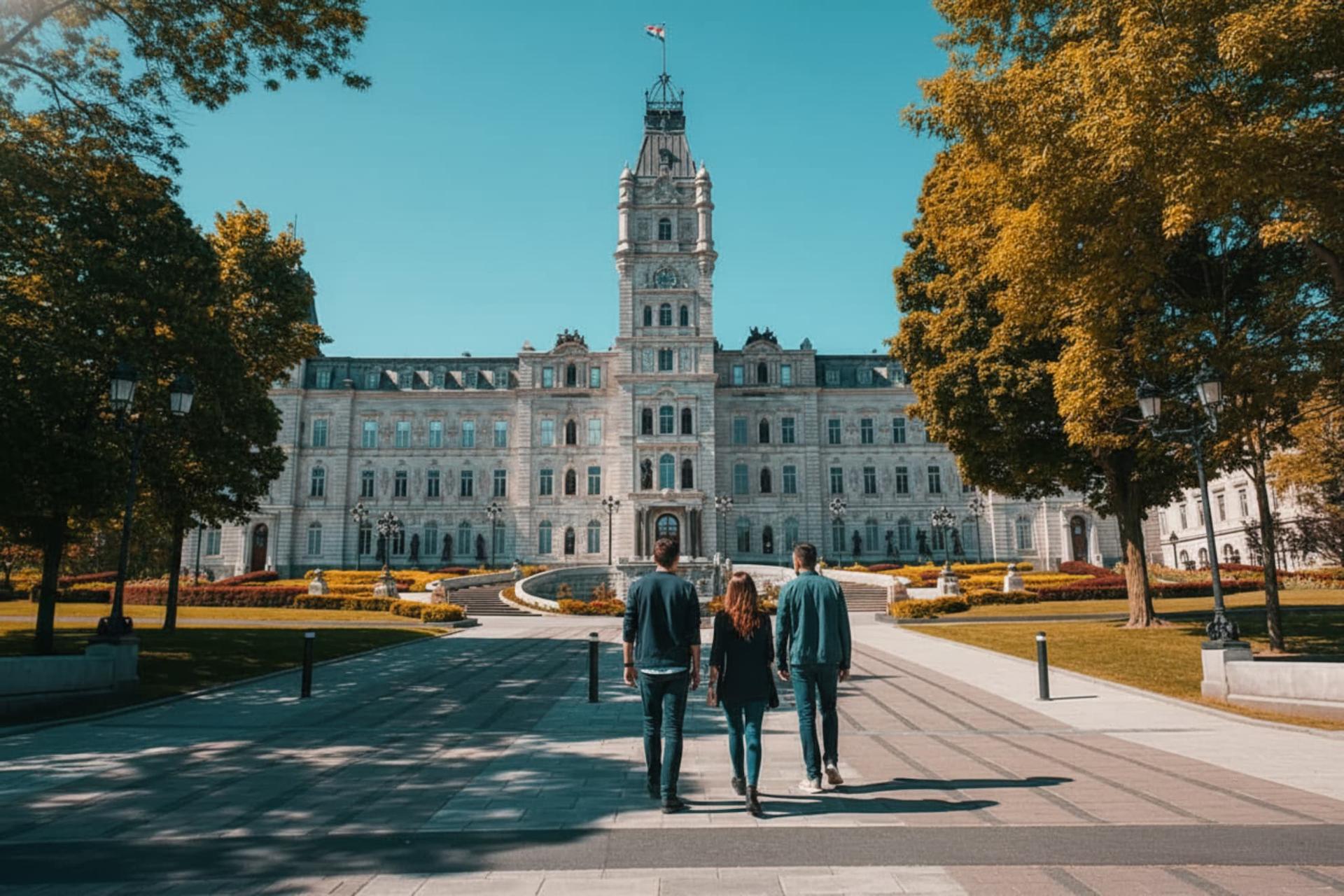
Politics carved in stone

The fortress that never saw battle

<p>Don’t be fooled by the quiet. The Citadelle was built for a war that refused to arrive. Between 1820 and 1850, British engineers carved this star-shaped fortress into Cap Diamant, a cliff so steep that Samuel de Champlain once mistook its glittering quartz for diamonds. When the stones proved worthless, the French coined a proverb: <em>“false as a Canadian diamond.”</em> The fortress inherited both the sparkle and the irony.</p> <p>After the War of 1812, Britain feared the Americans might try again, so the Duke of Wellington ordered a stronghold “to discourage ambition.” Lieutenant-Colonel Elias Walker Durnford obliged, hauling stone by barge and horse hoist up 360 feet of cliff to form what became North America’s largest British-built fortress. It was designed as a “last refuge” during siege or uprising—complete with rainwater reservoirs, barracks, and paranoia in five-point symmetry. The rebellion never came, but the bills did.</p> <p>History compensated with theatrics. In 1943 and 1944, Winston Churchill and Franklin D. Roosevelt met here to plan the Allied invasions of Europe and Asia. The D-Day calendar was finalized in rooms meant for musket drills. The same bastions that once braced for cannon fire now hosted secretaries, interpreters, and the faint smell of pipe tobacco. Not bad for a fort that never saw a battle.</p> <p>Today, the Citadelle serves three masters: Canada’s Governor General, the Royal 22e Régiment (the “Van Doos”), and two hundred thousand annual visitors. At 10 a.m. sharp in summer, the Changing of the Guard fills the parade ground with scarlet uniforms, bear-fur hats, and Batisse the goat—descendant of a Persian gift to Queen Victoria. When the noon gun fires, car alarms across town respond like an unplanned salute.</p> <p>At night, guides whisper of phantom footsteps on the ramparts—soldiers who died of duty or frost, or maybe just echoes of all that discipline. Either way, the ghosts are punctual; you could set your watch by them.</p> <p>Wind needles your skin along these granite walls, cold as empire. Look down at the river, glittering where Champlain’s “diamonds” once fooled a dreamer. For four centuries, Cap Diamant has defended many things—some real, some imagined. Mostly, it defends the idea that vigilance itself is a kind of heritage.</p> <p>Next stop: the Morrin Centre — where the fortress walls turn inward, and Québec trades gunpowder for grammar.</p>

Where walls change their mind

<p>From the outside, the Morrin Centre looks polite—Victorian stone symmetry, wrought-iron balconies, and a library’s hush. You’d never guess it began as Québec’s most notorious jail. Architect François Baillairgé built it in 1812 on the new model of “moral reform”: thick limestone walls, solitary cells, and the belief that silence could civilize. The windows you see now once opened onto isolation. Between 1812 and 1867, thieves, rebels, and debtors were confined behind them; sixteen left by way of the gallows that once stood above the front door. In 1823, half the city crowded these streets to watch a public hanging—a civic ritual that passed for justice.</p> <p>When the last prisoners were transferred to a newer facility, the building reinvented itself as Morrin College. The new purpose came courtesy of Dr. Joseph Morrin, a Scottish-born physician and twice mayor who believed education could rescue what punishment couldn’t. The façade you’re facing hides an improbable metamorphosis: prison cells converted into lecture halls, and gallows replaced by Greek Revival trim. Behind those windows, Québec’s first English-language degrees were earned—including one by a woman in the 1880s, proof that the walls were learning too.</p> <p>Look closely and you’ll spot the contrast between the original stone blocks and later Victorian masonry—architectural layers of repentance. The balcony railings where guards once paced now frame the library windows of the Literary and Historical Society of Québec, the province’s oldest English cultural institution. Inside those shelves rest volumes older than the city itself, rescued from two fires and a century of bilingual politics.</p> <p>Locals still claim that on quiet evenings, the sound of footsteps drifts from the basement vents—a faint echo of chains or maybe applause from a poetry reading. From out here, it’s hard to tell which would be stranger.</p> <p>The building stands as proof that walls, like people, can outgrow their original sentence. A place once designed to suppress voices now preserves them in ink and memory.</p> <p>Next stop: Château Frontenac — where penitence gives way to opulence, and the ghosts finally get room service.</p>

Faith rebuilt — again and again

The hotel that sold Canada to itself

<p>Stand here and look up: this isn’t just a hotel; it’s Canada’s most successful sales pitch in stone. The Château Frontenac was born in 1893 from the Canadian Pacific Railway’s belief that tourism could be industrialized. If Europe had castles, Canada would simply build better ones. Architect Bruce Price borrowed his blueprints from the Loire Valley, added turrets for theatrical effect, and let the whole structure loom over the St. Lawrence like a medieval fortress that accidentally joined a marketing campaign.</p> <p>The result was a fairytale built on capitalism. CPR president William Van Horne—who quipped, “If we can’t export the scenery, we’ll import the tourists”—named it after Louis de Buade, Comte de Frontenac, the 17th-century governor who once ruled New France and refused to surrender to the British. Fittingly, the hotel now rules every postcard rack in the country.</p> <p>The site beneath those copper roofs has hosted four centuries of authority. The Château Frontenac replaced a line of vanished powerhouses: the French Château Saint-Louis, the British Château Haldimand, then, finally, this baronial hybrid where empire met expense account. Each rebuild erased the previous occupant while pretending to preserve it—a tradition Québec has perfected.</p> <p>During the Second World War, the hotel briefly doubled as Allied headquarters. Inside, Churchill and Roosevelt drafted the plans for D-Day while Canada’s own Prime Minister Mackenzie King played the role of polite host, excluded from most conversations. Outside, locals simply noted that the lights stayed on past curfew.</p> <p>The copper roof above you—replaced entirely between 2011 and 2014—still wears its green patina like aged armor. In winter, the air carries a hint of metal and salt from the river; in summer, the turrets flare orange at sunset, as if the building remembers its 1926 fire. Rumor has it that Frontenac’s ghost still patrols his namesake tower, not out of torment but because he refuses to give up the view.</p> <p>The Château’s silhouette tells you everything about Québec’s self-esteem: half fortress, half fantasy, always photogenic. You don’t need to stay the night to feel its pull—the façade already performs hospitality on a civic scale.</p> <p>Next stop: Dufferin Terrace — the wooden promenade that turned defense into leisure and keeps the river company year-round.</p>

Where the fortress became a boardwalk

<p>If you ever needed proof that history can loosen its collar, this is it. Dufferin Terrace began as the governor’s private patio—an off-limits platform for lords to admire the river in solitude. Today, it’s 430 meters of democracy on timber, where anyone with shoes can walk the same edge once reserved for aristocracy.</p> <p>Look down through the glass skylights and you’ll see the bones of the old Château Saint-Louis, the 17th-century seat of New France. That château burned in 1834, leaving a literal power vacuum. Five years later, Lord Durham—British governor, reformist, and part-time controversy magnet—ordered the ruins turned into a public promenade. It was a radical idea: let commoners enjoy the governor’s view. The result was Durham Terrace, a short wooden platform with a railing and a message—“authority can afford transparency.”</p> <p>Four decades later, Lord Dufferin took the concept personally. In the 1870s he arrived in Québec, fell hopelessly in love with the city, and stopped municipal engineers from demolishing the fortifications. Instead, he doubled down on preservation and spectacle. Between 1878 and 1879, the terrace stretched to its current length, with six green-and-white gazebos named after the usual suspects—Frontenac, Victoria, Princess Louise, Dufferin himself. On June 28, 1879, Princess Louise cut the ribbon. The British Empire had just inaugurated Canada’s most photogenic boardwalk.</p> <p>Then came 1885, when 34 arc lamps flickered on along this very railing—electric light beamed 30 kilometers from Montmorency Falls. For one week, Dufferin Terrace was North America’s most modern boulevard, glowing over a 200-year-old cliff. Québec had officially entered the future without leaving its past.</p> <p>In winter, this place belongs to the toboggan slide, a 140-year-old wooden rocket run where riders hit 70 kilometers an hour screaming patriotic nonsense into the wind. In summer, street performers juggle and mimes mime while tourists photograph the Champlain monument—whose sculptor, Paul Chevré, later survived the Titanic. Québec never wastes a good plot twist.</p> <p>Listen for the whistle of river wind around Château Frontenac’s turrets, the wood creaking under millions of footsteps, the faint smell of cedar and brine. This boardwalk is more than a viewpoint; it’s a declaration that history doesn’t have to hide behind walls.</p> <p>Next stop: Rue du Petit-Champlain — where the view descends to street level, and commerce becomes the city’s native language again.</p>

The oldest street that refuses to age

The wall that remembers everything

Your private guide, in your pocket

Ready to walk these?

  • Self-guided, start now or later
  • Offline audio, 7 languages
  • 30-day money-back guarantee
  • 500MB global eSIM included

from

€5.00

1 self-guided tour in Québec City

See the tours

Plan the days

How many days in Québec City? A perfect 1-day itinerary

Day 1

Walk Québec City's Upper and Lower Town

Link the historic Upper and Lower Town through Québec City's steep lanes, landmark squares, and public stairways, then use RTC buses for longer hops.

€5.00

Weather & crowds

Best time to visit

July is Québec City’s warmest normal month at 25.0°C, but June–October are the wettest stretch in the table. May and September are the useful compromise months; January–March bring severe cold, while summer and December event calendars increase visitor pressure.

Recommended

Deep winter

Jan–Mar

-17–0°C/ 2–33°F

BusyWet
  • Québec Winter Carnival
  • January low normal is -16.7°C.

Don't miss

  • Québec Winter Carnival

Spring thaw shoulder

Apr–May

-1–18°C/ 30–64°F

Getting busierWet
  • May reaches 17.5°C by day
  • April precipitation normal is 94.4 mm.

Warm festival season

Jun–Sep

8–25°C/ 47–77°F

Peak seasonWet
  • Festival d’été de Québec
  • July precipitation normal is 118.7 mm.

Don't miss

  • Festival d’été de Québec

Colour and late autumn

Oct–Dec

-11–11°C/ 11–52°F

BusyWet
  • German Christmas Market
  • December high normal is -3.3°C.

Don't miss

  • Québec City German Christmas Market

Transport

How to get to & around Québec City

Québec City Airport

How to get to & around Québec City
RTC route 80 to downtownNot publishedCA$3.85
RTC route 76 to Sainte-Foyunder 30 minCA$3.85

RTC buses

Best default

RTC’s 2026 general fare is 3.85 CAD by ticket or 4.00 CAD in cash; a 1-day pass is 10.50 CAD and a 5-day pass is 34.75 CAD. Routes 800 and 801 are the useful high-frequency corridors.

Walking

Strong in centre

Vieux-Québec and nearby central neighbourhoods reward walking, but Québec has many public stairways, steep links between Upper and Lower Town and winter ice or snow underfoot.

Bicycle

Summer only

Cycling is practical in warmer months on signed paths; hills, stairs, snow and busy road crossings make it a poor default in winter. Official city sources do not establish a visitor bike fare.

Taxi or rideshare

Late or outer trips

Use a taxi or rideshare for YQB at awkward hours or for outer boroughs. The airport publishes taxi and rideshare availability but not a single official visitor fare on its public-transport page.

Walk Vieux-Québec and central districts, using RTC routes 800, 801, 76 and 80 for longer hops. The 1-day pass beats three ticket fares, while the 5-day pass serves stays with ten or more rides.

Budget

How much does it cost to visit Québec City?

Québec City’s published public-transport fares are moderate: a 1-day pass is 10.50 CAD and the 5-day pass is 34.75 CAD. Representative current coffee, lunch, beer and taxi ranges were NOT FOUND in acceptable official sources, so do not treat this as a complete food budget.

How much does it cost to visit Québec City?
RTC ticket, electronic or ticketCA$3.85
RTC fare, cashCA$4.00
RTC 1-day passCA$10.50
RTC 5-day passCA$34.75
RTC unlimited weekendCA$19.00

Cash or card?

YQB’s terminal RTC machine accepts major cards and mobile wallets. The current city fare page distinguishes ticket and cash fares; keep a small CAD balance if travelling outside the airport’s supported payment setup.

Where to stay

Where to stay in Québec City

Vieux-Québec

first visit

The historic core is the most compact base for steep Upper/Lower Town walking and central bus connections. Expect stairs, cobbles, event traffic and less everyday quiet.

Saint-Jean-Baptiste

cafés, central evenings

Saint-Jean-Baptiste sits just outside the walls with a lively street grid and easy walking access to Vieux-Québec. The grade and stair links remain real drawbacks in winter.

Saint-Roch

nightlife, local feel

Saint-Roch is a lower-town neighbourhood with urban services and useful bus links. It is more mixed and less postcard-like than Vieux-Québec, which is precisely its advantage for a longer stay.

Montcalm

quieter, culture

Montcalm is a residential central neighbourhood with parks, cafés and a calmer street pattern than the tourist core. Plan for a longer walk or bus ride back uphill to Vieux-Québec.

Sainte-Foy

airport, space, transit

Sainte-Foy is a practical western base near the airport and major bus connections, including the route 76 airport link. It is a poor first choice if every evening is meant for the old city.

The tours

Québec City, one story at a time

Scratch to win

Give it a scratch

Something good might be under there. If you win, we'll show you how to use it.

One prize per traveller. Good for 2 years.

Word of mouth

What travellers say

Safety

Is Québec City safe?

Québec City is generally comfortable for visitors. The specific hazards worth planning around are winter ice and snow, steep stair routes between Upper and Lower Town, bus and road crossings, and crowd compression during major summer and winter events. Call 911 for police, fire or ambulance; Québec’s official health line is 811 for non-urgent advice.

Winter stairs and ice

Québec’s many public stairways and steep Upper/Lower Town links can be slippery after snow or freezing rain. Use handrails, wear grippy footwear and choose a bus route rather than forcing a staircase in poor conditions.

Festival crowding

The official Québec City event calendar lists the Winter Carnival, Festival d’été de Québec and December German Christmas Market. Keep valuables closed in dense queues and on buses around event sites.

Bus and road crossings

Do not step from a curb while watching a phone, especially on broad roads linking Vieux-Québec with Saint-Roch and Saint-Jean-Baptiste. Check for buses and turning vehicles before crossing.

Sudden weather changes

Québec/Jean Lesage normals reach 25.0°C in July but -16.7°C for January average daily lows. Carry layers, water and weatherproof footwear when a day crosses the riverfront, stairs and open viewpoints.

Urgent medical help

Call 911 for an emergency. For a non-urgent health problem, Québec’s Info-Santé 811 connects callers with a nurse; the official material checked did not confirm English availability at every service interaction.

Good to know

Good to know

French is the public language

French is Québec’s sole official and common language. A simple bonjour and a French place name help with everyday interactions, signs and public services even though many tourism workers also use English.

Six city boroughs

Québec City has six arrondissements: Beauport, Charlesbourg, La Cité-Limoilou, La Haute-Saint-Charles, Les Rivières and Sainte-Foy–Sillery–Cap-Rouge. A “Québec City” address can therefore be far from Vieux-Québec.

The stair city

The city’s own heritage material highlights its many public stairs. Treat Upper Town to Lower Town as a vertical route, not a flat walk, and check winter conditions before choosing the shortest line on a map.

Questions

Québec City FAQ

RTC route 80 connects YQB to downtown Québec City via Les Saules. Route 76 connects the airport to Sainte-Foy in under 30 minutes, where frequent routes 800 and 801 continue toward downtown.

Ready to go?

Self-guided audio tours across Québec City.

See the tours in Québec City