Sydney Harbour Bridge: The Coathanger from Below
The official opening of Sydney's most monumental structure was famously hijacked. On March 19, 1932, Captain Francis de Groot of the paramilitary New Guard rode up on horseback and slashed the ceremonial ribbon with his sword before New South Wales Premier Jack Lang could make the first cut. After De Groot was arrested, the ribbon was retied for the official completion of the Sydney Harbour Bridge.
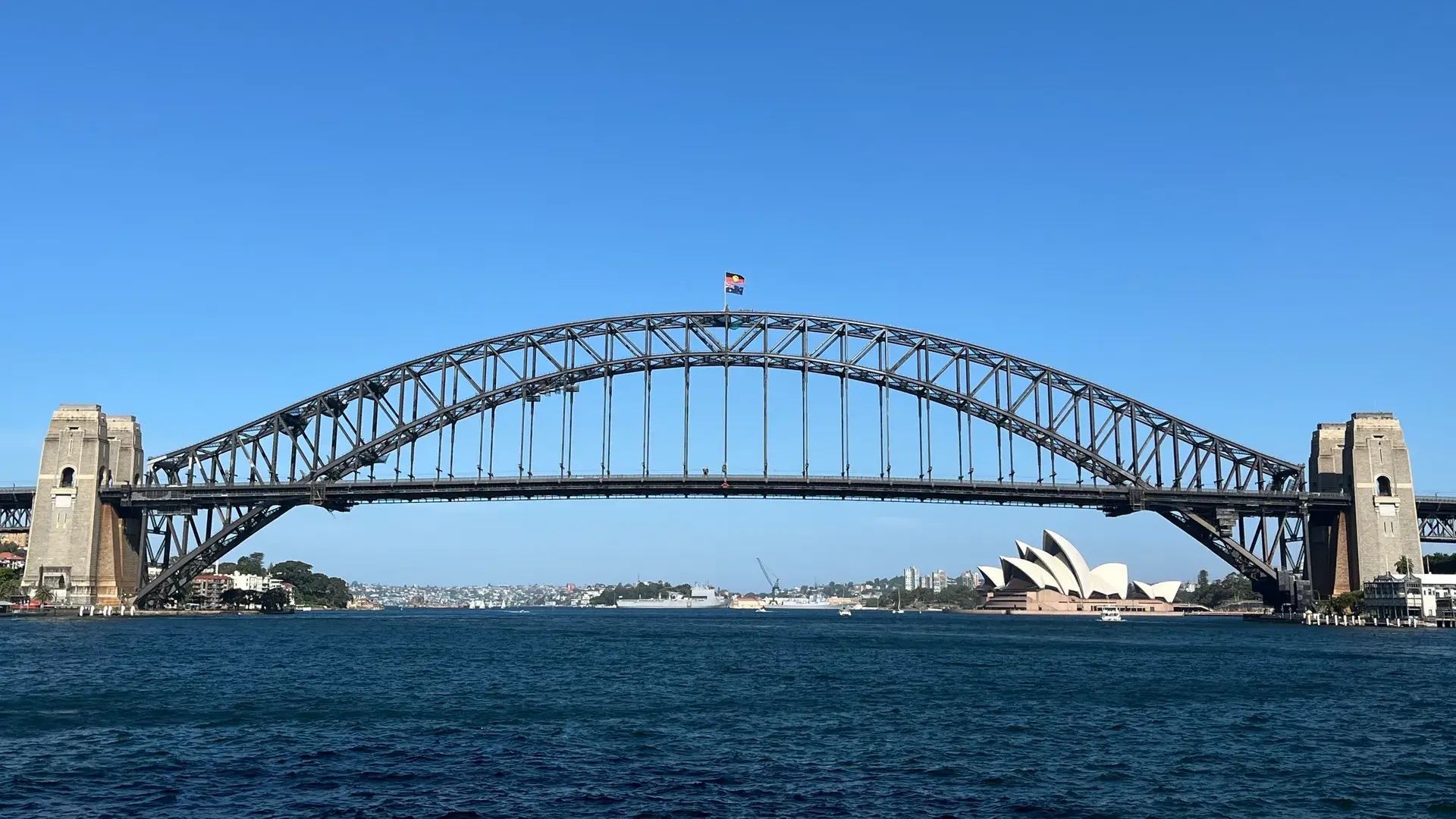
Locally nicknamed "The Coathanger" for its distinctive shape, the bridge stretches 1,149 metres long and reaches 134 metres above sea level, making it the tallest steel arch bridge in the world.
The Engineering of the Steel Arch
Proposals for a harbour crossing date back to 1815, but construction officially began in July 1923. Engineered by Dr. J.J.C. Bradfield and constructed by Dorman Long & Co., the structure required approximately 52,800 tonnes of steel and around six million hand-driven rivets.
The bridge was built outward over the water using massive creeper cranes without any under-scaffolding. The two halves of the 503-metre main arch finally met and were pinned at the center in August 1930.
The Illusion of the Granite Pylons
Four 89-metre-tall granite-faced pylons anchor the ends of the bridge, but they harbor a surprising architectural secret. Designed by architect Thomas S. Tait, these massive pylons support none of the main arch span's weight.
Tait added them strictly for visual balance. In the 1930s, the public feared an unadorned steel arch would be structurally unstable, so the heavy stone pylons were erected to visually reassure citizens regarding the structure's safety.
The Iron Lung of the Great Depression
The bridge project coincided with the Great Depression, employing up to 2,000 workers over eight years. The immense site earned the nickname the "Iron Lung" because the thousands of jobs it generated kept the local economy breathing. The work was highly dangerous, and 16 workers died during construction.
Before the bridge was completed, overland travel between the southern Central Business District and the North Shore required a 20-to-30-kilometre detour over five different bridges on the Parramatta River. The new crossing physically unified the northern and southern sides of the harbour, driving the modern expansion of Sydney's transport grid.
The Bridge Today from Dawes Point
Today, the Sydney Harbour Bridge is managed by Transport for NSW and carries eight lanes of road traffic, two rail tracks, a pedestrian path, and a cycleway. It accommodates approximately 160,000 vehicles and 480 trains daily. To withstand the harsh marine environment, maintenance crews continuously abrasive-blast and repaint the steel structure.
Beneath the southern pylon, Dawes Point Park (Tar-ra) provides a public open space directly linking the historic streets of The Rocks to the waterfront. From directly underneath, the towering latticework of steel beams and massive granite piers blocks out portions of the sky, casting deep shadows. Train traffic crossing overhead generates a distinctive, deep, rhythmic thrumming and mechanical rumble that echoes off the stone foundations and down into the park.
FAQ
Why is the Sydney Harbour Bridge called The Coathanger?
The Sydney Harbour Bridge is locally nicknamed "The Coathanger" because its massive arched steel framework resembles the shape of a traditional wire coat hanger.
Do the stone pylons support the Sydney Harbour Bridge?
No, the four 89-metre-tall granite-faced pylons support none of the main arch span's weight. Architect Thomas Tait added them strictly for visual balance to reassure a 1930s public who worried a purely steel arch would be unstable.
How many vehicles and trains cross the bridge daily?
The bridge accommodates approximately 160,000 vehicles and 480 trains every day across its eight road lanes and two rail tracks.