Marketplace Hallstatt: History & Architecture
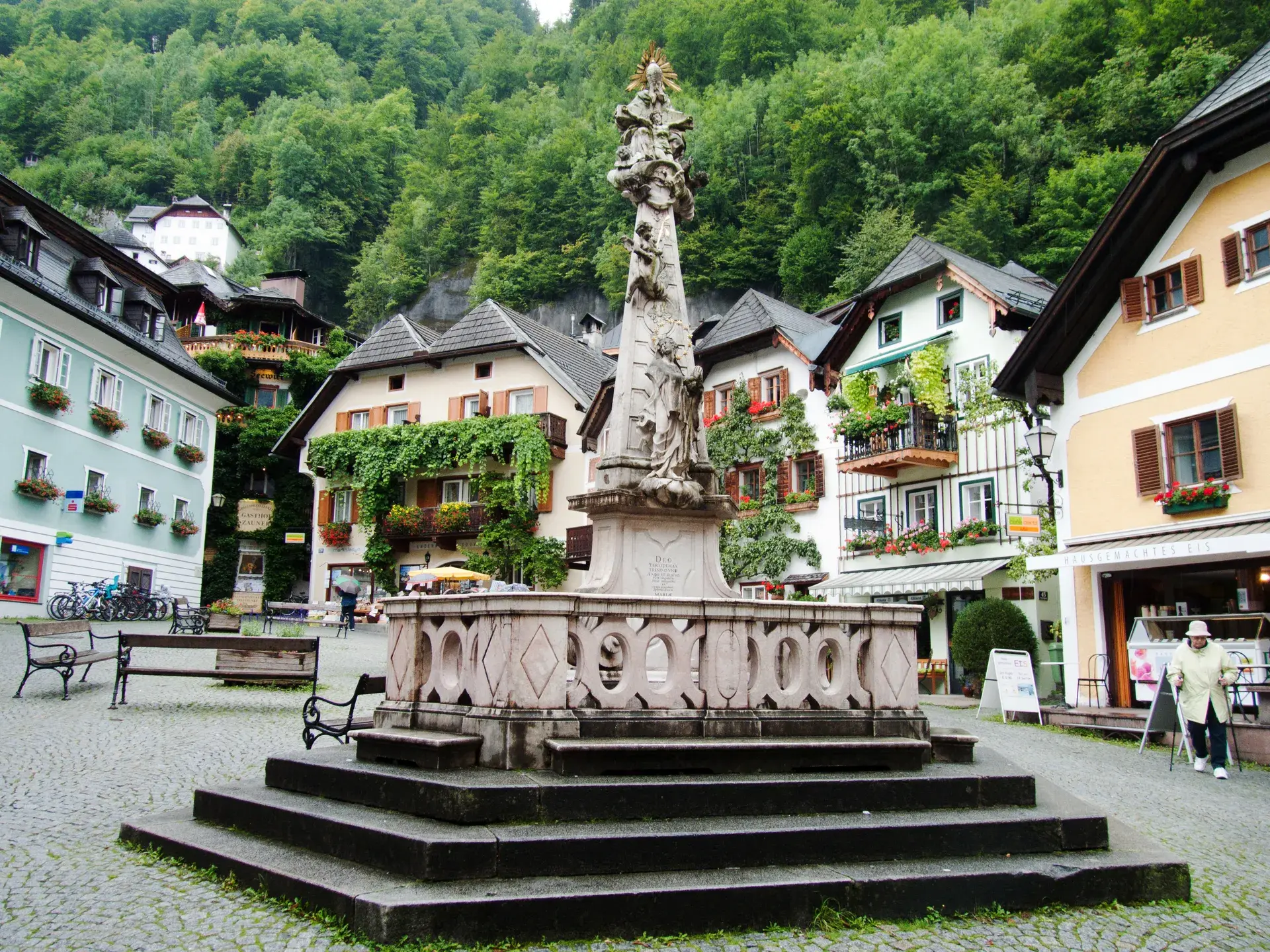
The historic Marketplace Hallstatt features pastel late-Baroque facades, cobblestone pathways, and the central Holy Trinity Column. Squeezed onto a narrow strip of flat ground between the Plassen mountain slope and Lake Hallstatt, the unusually compact market square serves as the social and pedestrian center of the town. A 1750 blaze wiped out Hallstatt's original timber center, leaving behind a late-Baroque stone square and driving its industrial core outside the village.
The Catastrophic Fire of 1750
The layout of Hallstatt's Marktplatz traces back to the 14th century, when it operated as the town's civic, trading, and commercial hub. On September 20, 1750, a major fire devastated the square's original timber buildings. The blaze ignited in a master baker's house, known as the Keferbäck, when the baker's wife allegedly attempted to heat a garret room using an ember covered with ash.
Constrained by the dense village layout, the flames spread rapidly until they were finally stopped at the Aichbergerhaus. The fire claimed four lives and consumed 35 homes, the court and hospital chapel, the old Habsburg residence, the salt pan house, and Court Administration Office archives. Official damage was assessed at 32,025 Gulden.
A Late-Baroque Rebuilding
Following the disaster, the Imperial Salt Administration housed displaced residents and initiated a massive reconstruction effort. The square and its surrounding homes were rebuilt in the late Baroque style, transitioning primarily from timber to masonry construction. Wealthy salt administrators and court secretaries financed the ornate Baroque embellishments that reshaped the square.
The 1750 disaster also permanently shifted the town's industrial layout. The historic salt pan house was deemed too hazardous to rebuild in the center, prompting authorities to relocate all salt-boiling operations to nearby Lahn. Today, the late-Baroque stone rebuilding of Marktplatz forms a contrast to the tiered alpine timber construction prevalent elsewhere in the settlement.
The Holy Trinity Column
At the center of the square stands the Baroque Holy Trinity Column (Dreifaltigkeitssäule). The monument was erected in 1744 as a donation by local salt merchant Johann Ignaz Etzinger and his wife. The column depicts the Father, the Son, and the Holy Spirit in the form of a dove, flanked by an angel and the Virgin Mary.
Surprising historians and locals alike, the Holy Trinity Column survived the catastrophic 1750 fire virtually undamaged. It remained fully intact even as 35 surrounding buildings burned to the ground just six years after the monument was erected.
Modern Events and Gatherings
Today, Marktplatz is occupied by cafes, restaurants, hotels, and shops. Sound reverberates tightly against the encircling stone facades, echoing the splash of the central fountain and footsteps across the cobblestone surface.
The square functions as an event venue throughout the year. It serves as an altar station during the spring Corpus Christi procession before the event moves onto the lake, and it hosts summer concerts by the Saline brass band. In the winter, the square holds seasonal folk events, including a children's Krampus run and the annual one-day Hallstatt Christmas Market on December 8.
FAQ
When was the Marketplace Hallstatt rebuilt?
The market square was rebuilt in the late Baroque style after a devastating fire on September 20, 1750, destroyed the town's original timber structures.
What is the statue in the center of the Hallstatt market square?
The center features the Baroque Holy Trinity Column, erected in 1744. It depicts the Father, Son, and Holy Spirit, and it miraculously survived the 1750 fire completely undamaged.
Are there events held at the Marketplace Hallstatt?
Yes, the square hosts summer concerts by the Saline brass band, acts as an altar station for the spring Corpus Christi procession, and holds a children's Krampus run and a Christmas Market every December 8.