Heldenplatz: Vienna's Imperial Square and History
Heldenplatz, or Heroes' Square, is the grand open plaza of Vienna's Hofburg palace complex in the Innere Stadt. Bordered by the sweeping, curved Neue Burg wing, the historic Leopoldine Wing (Leopoldinischer Trakt), and the Neoclassical Outer Castle Gate (Äußeres Burgtor), the square serves as an imposing threshold between Vienna's historic center and the grand 19th-century Ringstraße boulevard.
The square occupies the site of the former Burgbastei, a key fortification in Vienna's defensive ring. Napoleon's troops blew up the bastion in 1809, and the debris was cleared between 1817 and 1819 to form a level military parade ground that eventually evolved into the monumental public space seen today.
Monumental Statues and an Engineering Feat
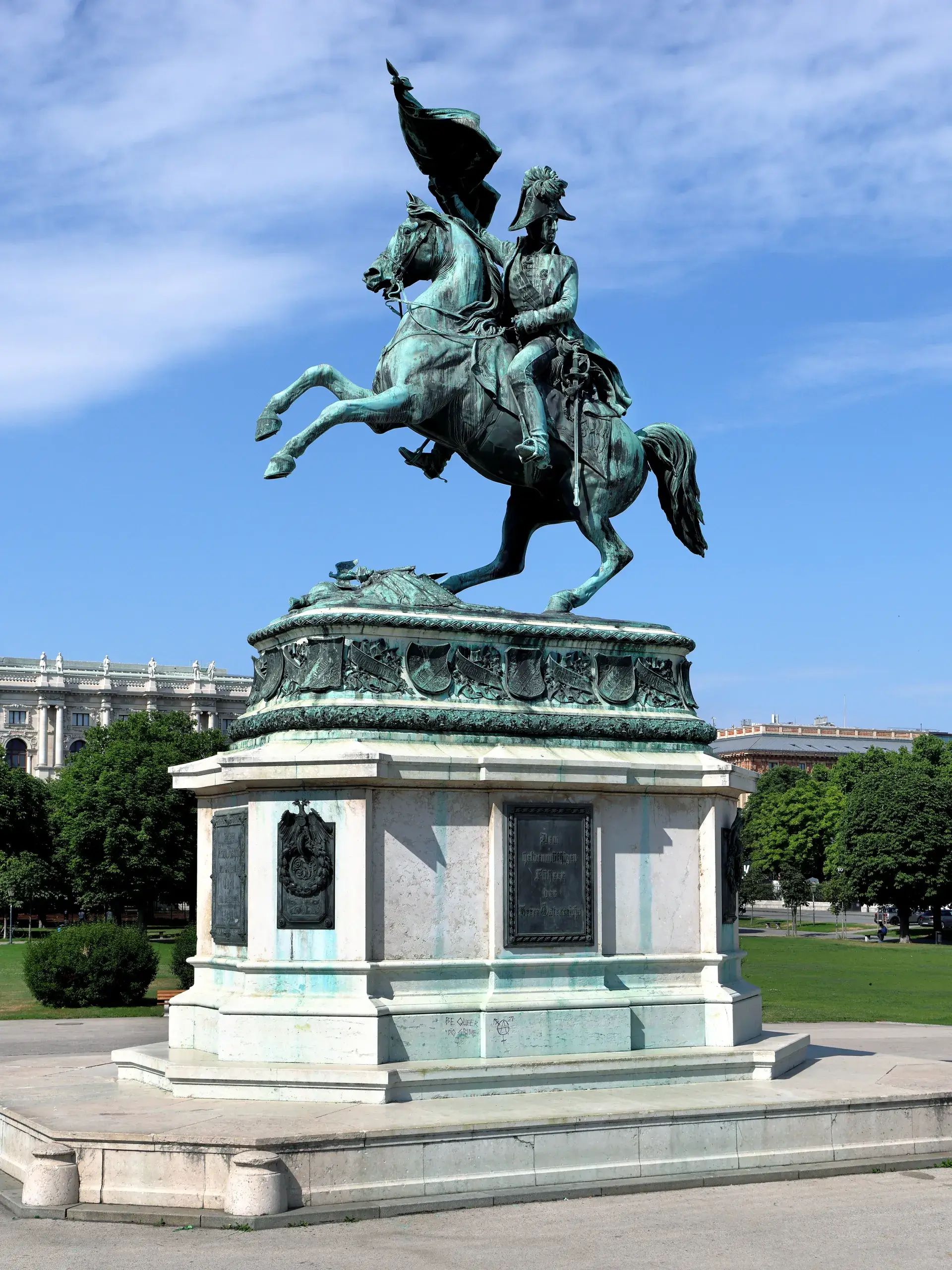
Heldenplatz takes its name from two massive bronze equestrian monuments sculpted by Anton Dominik Fernkorn. The first, depicting Archduke Charles (Erzherzog Karl), was unveiled in 1860. The second, portraying Prince Eugene of Savoy, was unveiled nearby in 1865.
The statue of Archduke Charles represents an extraordinary technical achievement in bronze casting. Fernkorn designed the rearing horse to balance its entire bronze weight strictly on its two hind legs, requiring no structural support from the tail. This feat proved difficult to replicate; when Fernkorn cast the statue of Prince Eugene years later, the horse's tail had to rest firmly against the plinth to keep the monument upright and stable.
Archduke Charles and the Viennese Christmas Tradition
Beyond military history, the household of Archduke Charles played an instrumental role in shaping Austrian holiday traditions. Historically, Austrian Catholic Christmas customs focused almost entirely on church liturgies, midnight Mass, and nativity cribs (Krippen). The decoration of an indoor evergreen tree was regarded as an alien, North German Protestant custom.
The tradition entered the Habsburg court through Princess Henriette of Nassau-Weilburg, a Reformed Protestant who married Archduke Charles. In 1816, following the birth of their first daughter, Henriette erected the first recorded candlelit Christmas tree in the Habsburg family at their city palace. Emperor Franz I attended the celebration, found himself captivated by the tree, and decreed that an evergreen tree be installed inside the Hofburg Palace every year following.
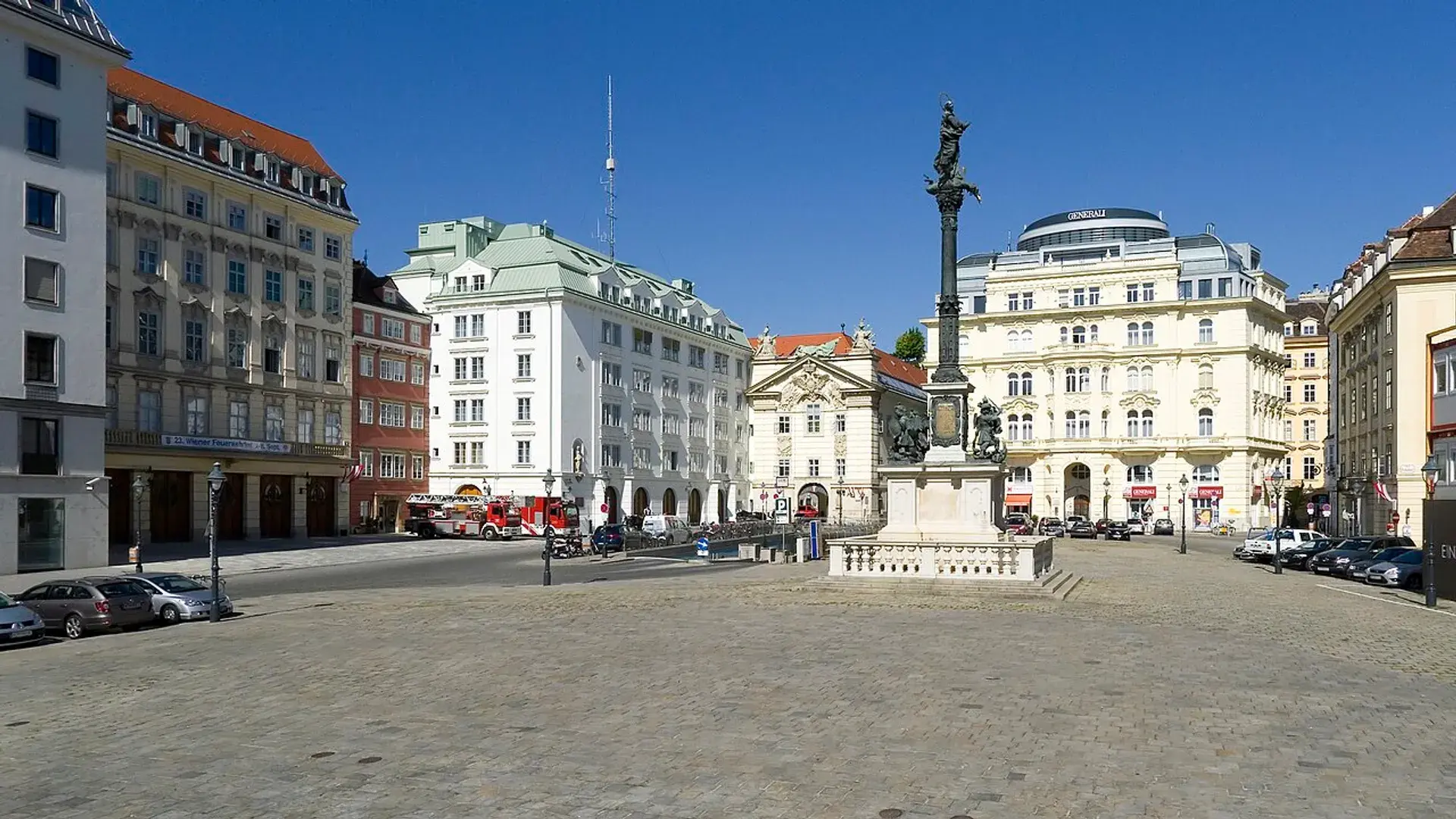
The aristocracy and the Biedermeier middle class quickly adopted the royal fashion. By the late 1820s, tree merchants operated at the Schottentor, and by 1851 the seasonal market on Am Hof resembled a pine forest. This cultural shift transformed Viennese Advent fairs from practical food and utility markets into festive hubs centered on holiday decorations, toys, and family gifts. When Henriette died in 1829 at the age of 32 after nursing her children through scarlet fever, Emperor Franz I insisted she be interred in the Imperial Crypt (Kapuzinergruft) despite pushback from Catholic clergy, leaving her as the only Protestant buried there.
The Unfinished Kaiserforum and Modern Public Life
Heldenplatz is also the central remnant of the never-completed Kaiserforum (Imperial Forum) envisioned in the late 19th century by architects Gottfried Semper and Carl von Hasenauer. The grandiose plan called for a second curved palace wing that would mirror the Neue Burg across the plaza, occupying the grounds of today's Volksgarten. While this ambitious imperial layout was never fully realized, the open expanse retains a monumental scale.
Today, the plaza functions as a major ceremonial hub and public gathering space directly outside the official offices of the Austrian Federal President in the Leopoldine Wing. During the winter Advent season, the square serves as a primary pedestrian corridor, connecting crowds traveling between the historic inner-city Christmas markets and the open-air stalls on Maria-Theresien-Platz. Traditional horse-drawn Fiaker carriages frequently line the square, ferrying visitors across the stone pavement beneath the illuminated facade of the Neue Burg.
FAQ
What makes the statue of Archduke Charles on Heldenplatz architecturally unique?
Sculpted by Anton Dominik Fernkorn and unveiled in 1860, the bronze equestrian statue of Archduke Charles is engineered to balance its entire weight exclusively on the horse's two hind legs without support from the tail.
How is Heldenplatz connected to the tradition of Christmas trees in Vienna?
Archduke Charles was married to Princess Henriette of Nassau-Weilburg, who introduced the first recorded candlelit Christmas tree to the Habsburg family in 1816. Emperor Franz I loved it and instituted an annual Christmas tree inside the Hofburg Palace, popularizing the practice across Vienna.
What was the original Kaiserforum plan for Heldenplatz?
Architects Gottfried Semper and Carl von Hasenauer designed an imperial forum that included a second curved palace wing mirroring the Neue Burg across the square, planned on the grounds of today's Volksgarten, though it was never constructed.