Kirche am Hof: Vienna's Historic Baroque Church
The Architectural Anchor of Am Hof
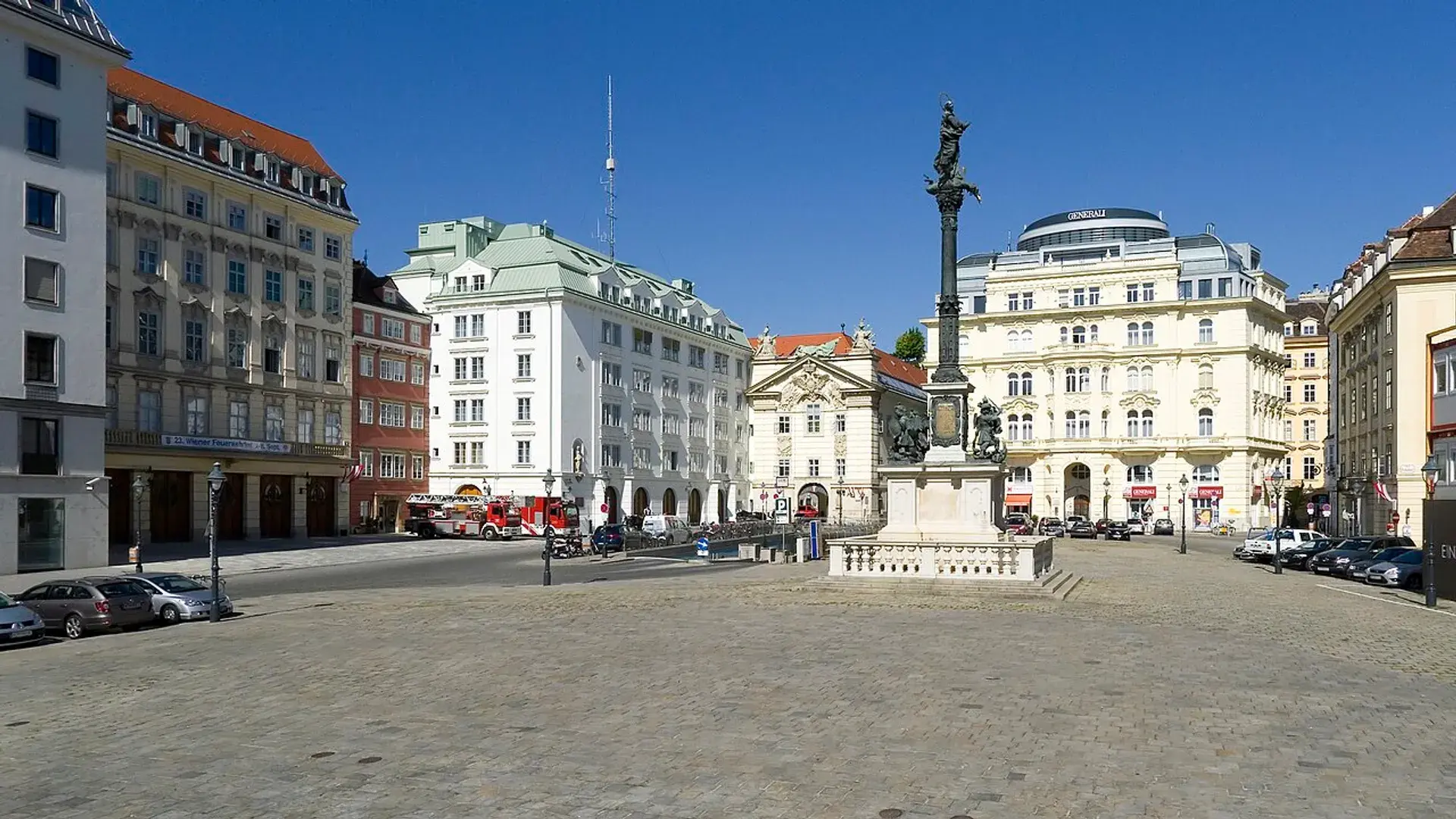
Kirche am Hof, formally known as the Kirche zu den neun Chören der Engel, stands as the central architectural anchor of Am Hof, one of the oldest and largest public squares in Vienna's Innere Stadt. Characterized by its early Baroque facade complete with a grand balcony, the church's pale stone presence presides over a space that has evolved across eight centuries of Viennese civic and political history.
Am Hof forms a direct geographic pair with the adjacent Freyung square, located only a short distance away. Together, these open spaces delineate the shift of medieval Vienna from monastic enclaves into grand open plazas capable of accommodating major religious gatherings, military installations, and city commerce.
From Ducal Court to Civic Marketplace
The square's history dates back to 1155–1156, when Duke Heinrich II "Jasomirgott" of the Babenberg dynasty selected this site for his ducal residence, or Pfalz, giving Am Hof its enduring name ("At the Court"). This noble era concluded around 1280, when the ruling Habsburgs relocated their imperial seat to the grounds that became the Hofburg Palace complex.
With the departure of the ducal court, the square transitioned into a bustling municipal trade center. By 1358, Am Hof operated as an officially regulated wine market. Throughout the fourteenth and fifteenth centuries, merchants traded fish, crayfish, fruits, vegetables, and baked goods across its cobblestones, anchoring the everyday commerce of medieval Vienna.
Significant Monuments and Landmarks
Surrounding Kirche am Hof are several historic structures and monuments that span multiple centuries:
- The Mariensäule: Standing centrally in the plaza, this bronze Marian column was erected during the seventeenth century as an act of thanksgiving after the Swedish army bypassed Vienna in 1645 during the Thirty Years' War.
- Bürgerliches Zeughaus: An eighteenth-century civic armory that once stored the city's weapons, the structure was later rebuilt and currently serves as the headquarters of Vienna's central fire station.
- Palais Collalto: This aristocratic palace marks the location where a six-year-old Wolfgang Amadeus Mozart presented his very first public musical performance in Vienna in 1762.
- Ancient Roman Infrastructure: Deep beneath the modern cobblestones rests an intact stone wastewater canal (Lagerhauptkanal) from the ancient Roman legionary garrison of Vindobona, which can still be accessed through the basement of the fire station.
Revolutionary Turmoil in 1848
Beyond imperial ceremonies and commerce, the square was the scene of dramatic political violence during the 1848 revolution. An armed insurgent crowd stormed the Austrian War Ministry building located on Am Hof, capturing Austrian War Minister Count Baillet von Latour. The mob lynched the minister from a central street lantern in the middle of the plaza. In the aftermath of this uprising, the square was briefly redesignated as the Volksplatz (People's Square) before returning to its historic title.
The Evolution of the Seasonal Market
In 1842, city authorities relocated Vienna's primary Christkindlmarkt from the Freyung to Am Hof to resolve vendor disputes and alleviate heavy congestion. Am Hof served as the main Advent market venue through 1918, typically operating from late November through January 5, and briefly resumed this role between 1939 and 1942.
After hosting flea and antique markets in the 1970s and 1980s, organizers introduced Advent stalls during the 1990s, culminating in the 1998 establishment of the modern Weihnachtsmarkt am Hof. Operating annually from mid-November through December 23, the market features more than 70 stalls. These include culinary booths serving regional delicacies, spiced Glühwein, and hot Uhudler punch, alongside an artisanal craft fair (Kunsthandwerkmarkt) set in walk-in wooden huts that shield patrons against winter breezes.
FAQ
What is the historical origin of the square around Kirche am Hof?
The square was founded around 1155–1156 when Duke Heinrich II 'Jasomirgott' of the Babenberg dynasty built his ducal court there. After the Habsburgs moved their residence to the Hofburg around 1280, the plaza transitioned into a civic market.
Why was the Mariensäule erected in front of Kirche am Hof?
The bronze Marian column was erected in the seventeenth century in gratitude after the Swedish army bypassed the city of Vienna in 1645 during the Thirty Years' War.
What major historical event took place at Am Hof in 1848?
During the 1848 revolution, an insurgent crowd stormed the imperial War Ministry on the square and lynched Austrian War Minister Count Baillet von Latour from a lantern, briefly causing the plaza to be renamed Volksplatz.
What Roman remnants exist beneath the square?
An intact Roman stone sewer canal (Lagerhauptkanal), which once drained wastewater from the Roman garrison of Vindobona, remains preserved directly beneath the square's paving stones.