St. Charles's Church Vienna: History & Architecture
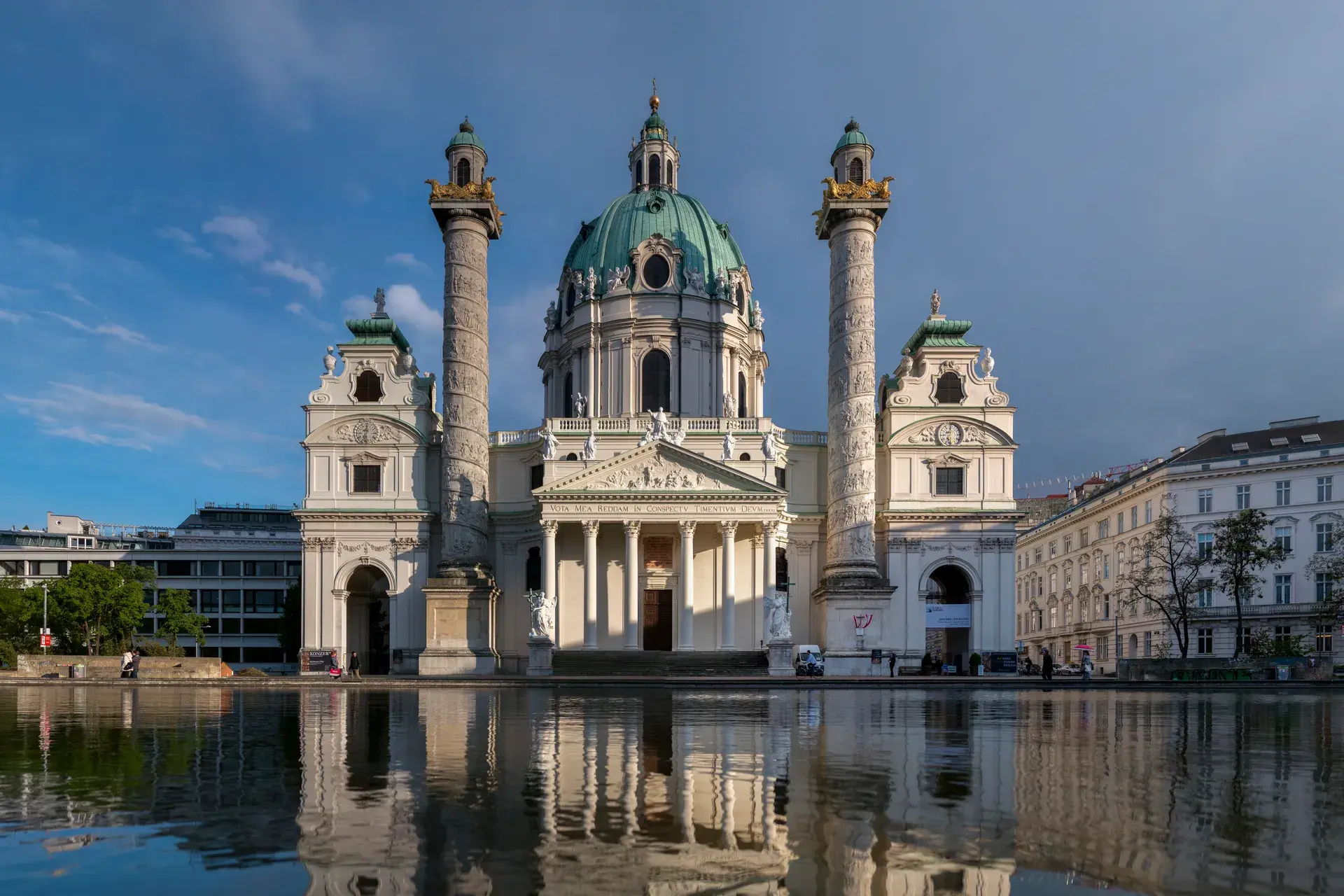
St. Charles's Church (Karlskirche) stands as one of Vienna's most dramatic Baroque monuments, dominating the south side of Karlsplatz with its turquoise oval dome and twin monumental columns. Constructed as an imperial votive church, the building serves as both an active Catholic parish and an enduring testament to early 18th-century statecraft, architectural ambition, and public devotion.
The Imperial Plague Vow and Origins
In 1713, Vienna suffered its last catastrophic outbreak of the Black Death, an epidemic that claimed over 8,000 lives. In response to the crisis, Holy Roman Emperor Charles VI vowed to erect a grand church dedicated to his patron saint, Saint Charles Borromeo, the 16th-century Archbishop of Milan renowned for his pastoral care during plagues.
Following an architectural competition in 1716, court architect Johann Bernhard Fischer von Erlach secured the imperial commission. After his death in 1723, construction was carried forward by his son, Joseph Emanuel Fischer von Erlach. The church was consecrated on October 28, 1737.
Unlike traditional medieval churches clustered tightly within Vienna's inner city walls, Karlskirche was erected outside the fortifications on the open Glacis near the Wien River. This deliberate location provided an uninterrupted vista connecting the church directly to the imperial Hofburg palace. Above the entrance, a Latin inscription commemorates the fulfilled pledge: Vota mea reddam in conspectu timentium deum ("I will pay my vows in the sight of them that fear him").
Architectural Synthesis and Sacred Art
The exterior of Karlskirche fuses classical Roman, Greek, and Baroque traditions. The facade centers on an antique hexastyle temple portico flanked by two 47-meter-tall triumphal columns inspired by Trajan's Column in Rome. Sculpted by Lorenzo Mattielli, the spiraling bas-reliefs on these columns chronicle the life and charitable works of Saint Charles Borromeo during plague epidemics.
Above the portico, an oval dome rises over 70 meters high, flanked by pavilion towers crowned with pagoda-like lanterns. Inside, the ceiling is dominated by a 1,250-square-meter fresco executed by Johann Michael Rottmayr. The expansive painting illustrates Saint Charles Borromeo petitioning divine mercy for the suffering city, while an angel sheathes the sword of plague, symbolizing the end of the affliction.
Directly fronting the church is a large reflecting pool. Since 1978, it has held Hill Arches, a large bronze sculpture by British artist Henry Moore. Moore specifically requested that the sculpture sit off-center within the water basin so its curvilinear forms would complement and frame the church’s oval dome rather than obstruct its sightlines.
The Resting Place of Antonio Vivaldi
Karlskirche maintains a profound historical connection to the Italian composer Antonio Vivaldi. Having relocated to Vienna late in life, Vivaldi died destitute in July 1741 and was buried in an unmarked pauper's grave in the Bürgerspital-Gottesacker, a hospital cemetery directly beside the church.
Although the cemetery was built over in the late 18th century and is now part of the technical university campus, Karlskirche pays homage to the composer as a premier classical concert venue. His masterpiece, The Four Seasons, is routinely performed within the sanctuary just steps from where he was laid to rest.
Art Advent on Karlsplatz
Every November and December, the vast plaza in front of Karlskirche hosts the Art Advent Kunst & Handwerk am Karlsplatz. This winter market is recognized for its strict artisan standards, permitting only juried, locally handmade craft items rather than commercially manufactured goods. Furthermore, it operates as the only Christmas market in Austria where all catering and gastronomy are certified 100 percent organic.
During the festival, the reflecting pond is drained and filled with tons of straw and hay bales, turning the basin into a play space beneath the illuminated facade. In keeping with the market's focus on craftsmanship and sustainability, the carousels and rail carts are constructed from reclaimed scrap metal and operated entirely by pedal and human muscle power.
FAQ
Why was St. Charles's Church built?
Holy Roman Emperor Charles VI commissioned the church after making an imperial vow during the 1713 plague epidemic. It was dedicated to Saint Charles Borromeo, an intercessor against the Black Death, as an offering of gratitude when the contagion ended.
What is the connection between Antonio Vivaldi and Karlskirche?
Composer Antonio Vivaldi died impoverished in Vienna in July 1741 and was buried in an unmarked grave in the Bürgerspital pauper cemetery directly adjacent to the church. Karlskirche frequently hosts performances of Vivaldi's works, including 'The Four Seasons', near his burial site.
What makes the Karlsplatz Art Advent market unique?
Art Advent am Karlsplatz is Austria's only holiday market featuring 100 percent certified organic food and beverages. It features juried artisan crafts, a drained fountain basin filled with straw for children, and pedal-powered rides constructed from scrap metal.