Maria-Theresien-Platz: Vienna's Twin Museum Market
Situated along the Burgring section of Vienna's Ringstraße in the 1st district, Maria-Theresien-Platz is one of the Austrian capital's most monumental public squares. Positioned directly opposite the Hofburg Palace complex and Heldenplatz to the northeast, and bordering the Museumsquartier to the southwest, the square forms a symmetrical imperial corridor. During the winter season, this grand architectural setting hosts the Weihnachtsdorf Maria-Theresien-Platz, a traditional Christmas market framed by two identical museum palaces.
The Kaiserforum Vision and Imperial Architecture
Until the mid-19th century, the land occupied by Maria-Theresien-Platz formed part of the Glacis, an undeveloped open defensive zone surrounding Vienna's medieval fortifications. Following Emperor Franz Joseph I's 1857 decree to raze the walls and develop the Ringstraße boulevard, architect Gottfried Semper presented the ambitious Kaiserforum plan in 1870. Semper envisioned linking the imperial Hofburg Palace to the imperial court stables across the Ringstraße with monumental triumphal arches, defining Heldenplatz on one side and Maria-Theresien-Platz on the other.
While the connecting arches were ultimately abandoned, the square's defining architectural features were carried out by Semper alongside architect Carl von Hasenauer. Flanking the plaza are two Neo-Renaissance twin palaces designed to consolidate the dynastic Habsburg collections: the Naturhistorisches Museum (Natural History Museum, opened in 1889) and the Kunsthistorisches Museum (Museum of Fine Arts, opened in 1891). Each building measures approximately 170 by 70 meters with central domes rising roughly 65 meters. While their exterior facades appear mirror-matched, the figures crowning their domes signify their distinct purposes: the Kunsthistorisches Museum is topped by a statue of Pallas Athena, whereas the Naturhistorisches Museum is crowned by the sun god Helios.
The Maria Theresa Monument and Fountains
At the center of the square stands the Maria Theresa Monument, the largest Habsburg memorial in Vienna. Designed by sculptor Caspar von Zumbusch and architect Carl von Hasenauer, the 19.4-meter-tall bronze memorial rests on a 632-square-meter base and was unveiled on May 13, 1888. The central figure depicts Empress Maria Theresa holding the Pragmatic Sanction of 1713, the constitutional decree issued by her father, Emperor Charles VI, that permitted female succession to the Habsburg throne. Encircling the base are statues and relief medallions of leading military commanders, advisors, and intellectuals of her reign, including a sculpted relief figure of a young Wolfgang Amadeus Mozart.
Surrounding the monument within geometric lawn compartments are four identical Triton and Naiad fountains (Tritonen- und Najadenbrunnen). Carved from Carrara marble and conglomerate rock, the fountains were sculpted between 1887 and 1894 by Anton Schmidgruber, Hugo Haerdtl, and Edmund Hofmann von Aspernburg.
The Weihnachtsdorf Christmas Market
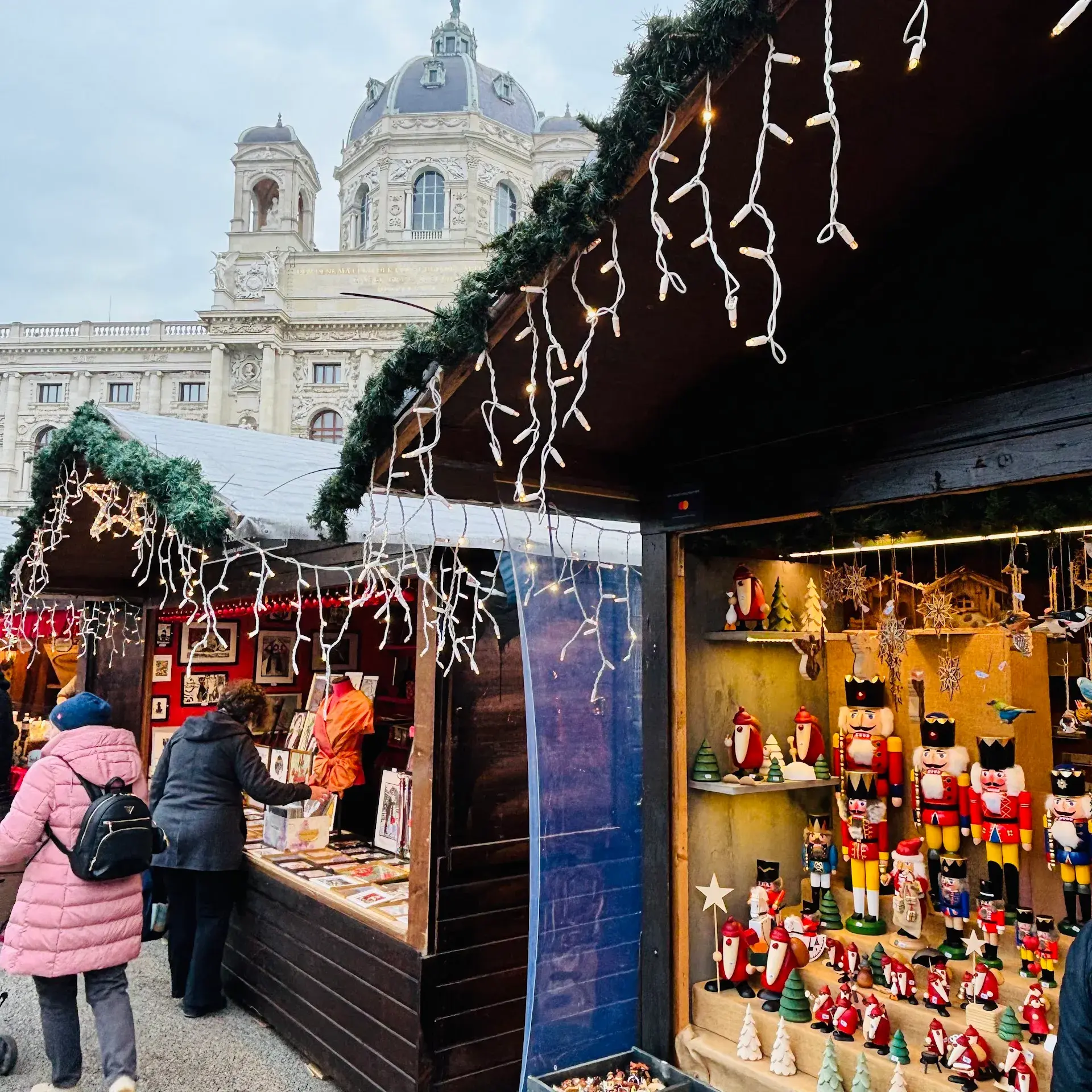
During Advent, Maria-Theresien-Platz transforms into the Weihnachtsdorf Maria-Theresien-Platz. Viennese locals colloquially call this festive site "Zwidemu," an abbreviation for "zwischen den Museen" ("between the museums"). Unlike Vienna's older Advent fairs that originated in medieval trading grounds or monastic courtyards, the market at Maria-Theresien-Platz reflects the Late Historicist grandeur of the late 19th-century Ringstraße era.
The village typically features around 70 wooden stalls arranged along the garden lanes and circling the Maria Theresa Monument. By planning tradition, market stalls closer to the Kunsthistorisches Museum focus primarily on artisanal crafts, decorative souvenirs, Viennese snow globes, and blown-glass ornaments. Stalls lining the side near the Naturhistorisches Museum concentrate on seasonal culinary fare, offering roasted chestnuts, sausages, hot chocolate, and warm spiced punch.
The market traditionally operates daily from mid-November through December 26, often transitioning into a smaller New Year market (Silvesterdorf) running through December 31. Under the property administration of the Burghauptmannschaft Österreich, the seasonal market was scheduled for a temporary pause during Advent 2025 to accommodate municipal and museum construction work providing barrier-free entrance areas.
FAQ
What distinguishes the two twin museums at Maria-Theresien-Platz?
Although the facades of the Kunsthistorisches Museum and Naturhistorisches Museum appear identical, they are distinguished by the statues atop their 65-meter domes: the art museum features Pallas Athena, while the natural history museum is crowned by Helios.
What does the local nickname "Zwidemu" mean?
"Zwidemu" is a Viennese colloquial abbreviation for "zwischen den Museen" ("between the museums"), referring to the square and its seasonal Christmas market nestled between the two institutions.
Which historical figures are depicted on the Maria Theresa Monument?
The monument features Empress Maria Theresa holding the Pragmatic Sanction of 1713, surrounded by advisors, military figures, and court artists, including a relief carving of a young Wolfgang Amadeus Mozart.
Why was the Christmas market scheduled to pause in Advent 2025?
The market was scheduled for a temporary pause in 2025 due to municipal and museum construction work coordinated by the Burghauptmannschaft Österreich to create barrier-free entrances.
Discover Wien like never before
Dive into Wien hidden stories and secret spots with Ciceru interactive tours.
Explore tour
Audioguide
Quizzes
Maps
Solo
Couples
Groups & families

© Photo by Franz ANGELO Gruber via Google Maps · Google Places