Nebet Tepe: Plovdiv's Ancient Acropolis
Stand exactly where one of Europe's oldest continuously inhabited cities began over 6,000 years ago. Trace the crumbling stone walls of the ancient fortress at Nebet Tepe while taking in sweeping panoramic views of the city below.
The Urban Cradle of Plovdiv
Nebet Tepe is the northernmost of Plovdiv's "Three Hills," serving as the historical and geological core of the city. Settlement traces on this elevation date back to the Copper-Stone Age around 4000 BC, substantiating Plovdiv's status as one of Europe's oldest continuously inhabited locations. Between the 12th and 6th centuries BC, Thracians fortified the natural elevation and established a cult center. Local historical tradition names this early Thracian settlement "Evmolpia," after the mythical Thracian ruler and singer Evmolp. Another ancient tradition refers to the site as "The Hill of Musaeus," linking it to a talented disciple of the mythical musician Orpheus.
Following its conquest by Philip II of Macedon in 342 BC, the site served as the primary acropolis for the newly named city of Philippopolis. The fortress maintained its status as a vital stronghold through the Roman and Byzantine periods, even as the city expanded into the plains below. Emperors Marcus Aurelius and Justinian I both oversaw major rebuilds of the defensive walls to protect the hilltop garrison.
Architectural Layers and Ancient Masonry
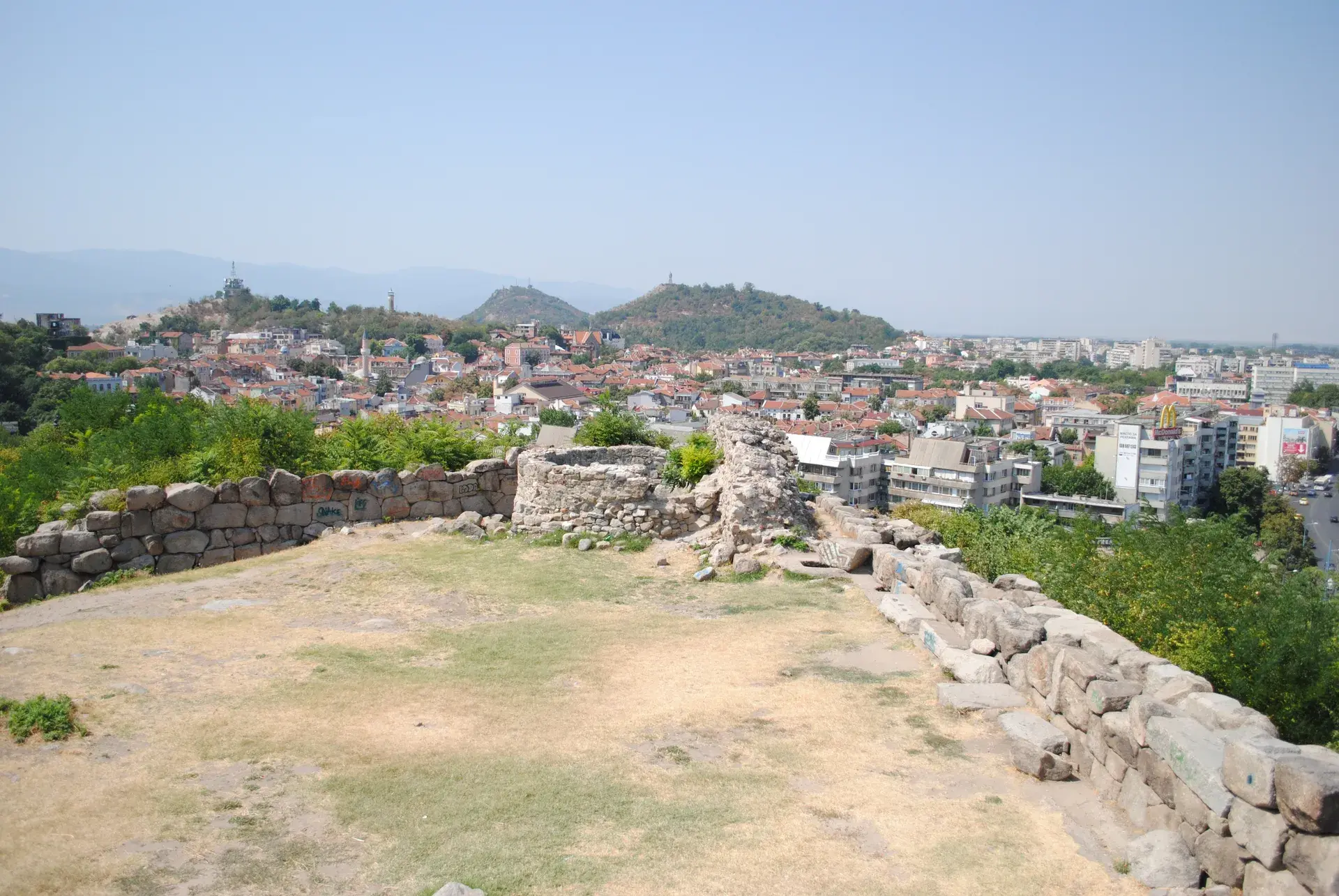
Designated as a national cultural monument and archaeological reserve, Nebet Tepe features a dense layering of historical structures. The oldest surviving fortifications from the 4th century BC feature a square tower entrance. These early walls were constructed using "cyclopean masonry," a technique utilizing massive syenite stone blocks fitted closely together without any mortar.
Other key archaeological features include a 1st-century AD Roman bastion and a postern from Emperor Justinian's era that leads down toward the Maritsa River. The site also contains vaulted underground water cisterns, though documentation disputes their exact capacity, with estimates ranging from 70,000 liters for the Roman-era cistern up to 300,000 liters for a medieval reservoir.
By the Ottoman period, inner imperial cities no longer required heavy defense. The hill's defensive function waned, and it eventually became the foundation for Bulgarian National Revival houses, which were built directly into or over the ancient stone walls. During this era, the site earned its current name, which translates to "Hill of the Guards" from the Ottoman Turkish words "nevbet" (guard) and "tepe" (hill).
A Modern Archaeological Park
Today, Nebet Tepe operates as a free, open-air archaeological park and a central viewing point. Following an EU-funded restoration project, the site officially reopened to the public in March 2025. It is managed by the Regional Archaeological Museum, which offers optional guided tours of the ancient structures.
The restored grounds feature stone walking paths and interpretive signage. Night illumination along the perimeter wall visually highlights the ancient masonry against the dark hill. Standing 207 meters above sea level and 46 meters above the surrounding streets, the summit provides open 360-degree views across the Old Town rooflines, the modern city center, and the Maritsa River below.
FAQ
Is Nebet Tepe free to visit?
Yes, Nebet Tepe operates as a free, open-air archaeological park and is open to the public daily.
How old are the ruins at Nebet Tepe?
Settlement traces on the hill date back to 4000 BC, making it one of Europe's oldest continuously inhabited locations. The oldest surviving stone walls at the site date back to the 4th century BC.
What does the name Nebet Tepe mean?
The name translates to 'Hill of the Guards.' It is derived from the Ottoman Turkish words 'nevbet' (guard) and 'tepe' (hill), referencing the historic garrison once stationed at the summit.