Ancient Theatre of Philippopolis: Plovdiv's Roman Gem
A 1960s landslide in the Old Town of Plovdiv revealed a buried Roman structure that had been lost for centuries. Today, the Ancient Theatre of Philippopolis stands fully restored, once again echoing with live performances and serving as a premier cultural landmark. Nestled in the natural saddle between the Dzhambaz Tepe and Taksim Tepe hills, the theatre perfectly encapsulates Plovdiv's status as one of Europe's oldest continuously inhabited cities.
Unearthing a Roman Masterpiece
Constructed in the 1st and early 2nd centuries AD, the classical venue suffered severe damage from an earthquake or fire in the late 4th century. It sustained further devastation during the 5th-century invasions by Attila the Hun. Over subsequent centuries, soil layers and landslides buried the remaining structure under 4.5 meters of earth.
Following its dramatic rediscovery, the Plovdiv Archaeological Museum conducted systematic excavations from 1968 through 1979. Between 1979 and 1981, conservationists painstakingly reassembled original marble blocks and structural fragments using the anastylosis method. This monumental effort is widely recognized as a major achievement in Bulgarian historical conservation.
Architecture and Ancient Acoustics
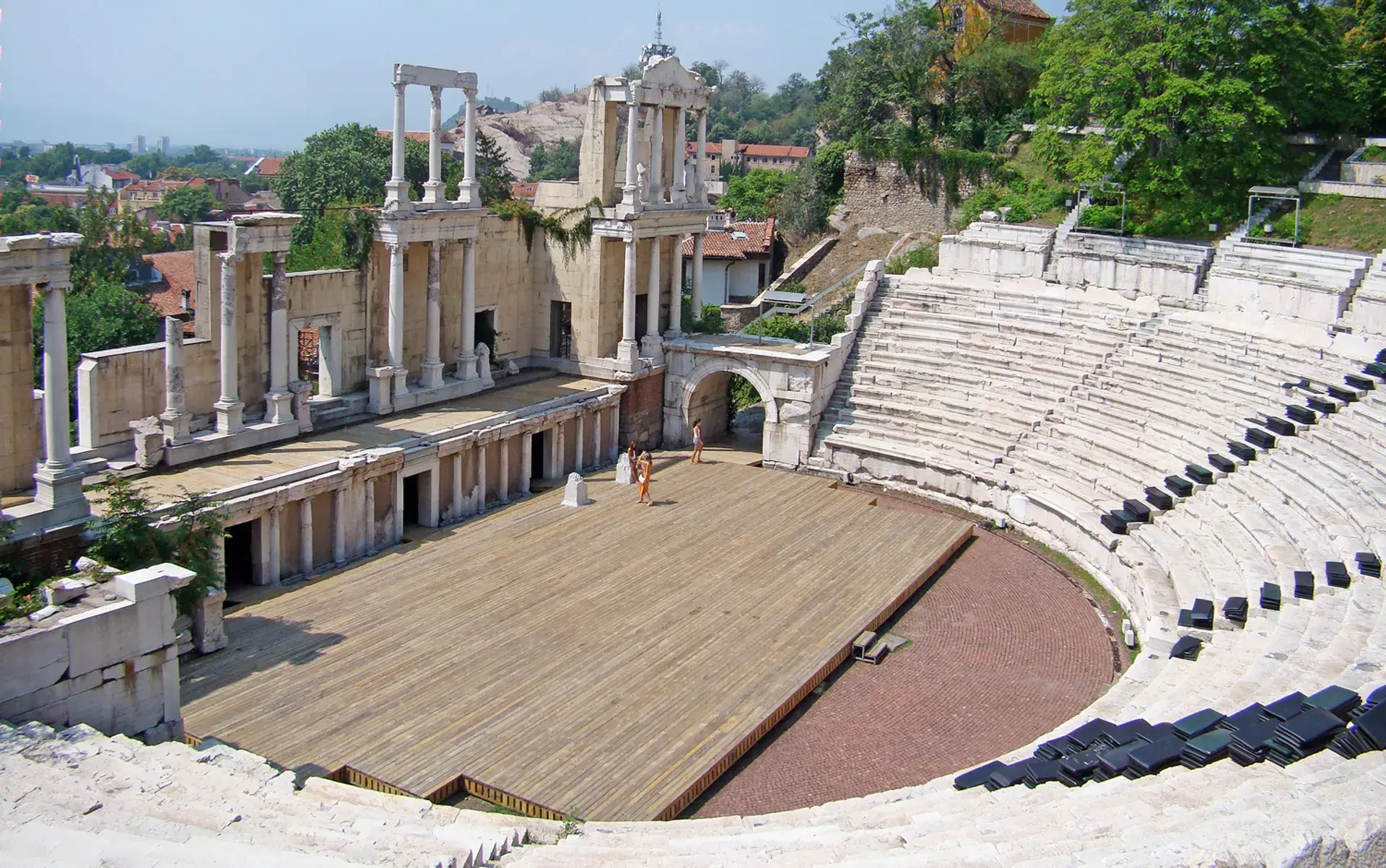
Built facing south toward the lowland city and the distant peaks of the Rhodope Mountains, the classical semi-circular theatre features an 82-meter outer diameter. Its layout includes 28 concentric marble seating rows, divided into upper and lower tiers by a wide horizontal walkway. At the center lies a 26.64-meter horseshoe-shaped stage backed by a three-tiered background structure.
The bowl-shaped marble seating carved into the hillside naturally directs acoustic vibrations. This masterful engineering allows unamplified vocal and instrumental sounds from the stage to reach the highest tiers with remarkable clarity. Sunlit white marble steps offer sweeping panoramic vistas across modern Plovdiv.
Civic Life in Ancient Philippopolis
In antiquity, the theatre served as the civic and cultural epicenter of ancient Philippopolis, hosting provincial assemblies, theatrical performances, and gladiator games. Benches throughout the marble seating tiers retain engraved names of municipal city quarters. These inscriptions reveal that Roman-era residents were directed to sit within assigned neighborhood sectors.
Pedestal inscriptions show construction was led by Titus Flavius Cotys, a Roman official and direct descendant of the local Thracian royal lineage. Notably, inscriptions found throughout the venue are written in ancient Greek rather than Latin, documenting a policy of Hellenized administration within the Roman province of Thrace.
A Modern Open-Air Auditorium
While estimated to hold between 5,000 and 7,000 spectators in antiquity, the venue today accommodates between 2,200 and 3,500 people. Operating as a ticketed archaeological monument during the day, the theatre transforms into an active open-air auditorium at night.
Though frequently mislabeled as an amphitheatre in popular travel literature, its classical semi-circular layout strictly defines it as a theatre. Today, the ancient stones regularly host classical opera, ballet, rock concerts, and international events like the Opera Open festival, directly integrating preserved Roman architecture into modern civic life.
FAQ
Is the Ancient Theatre of Philippopolis an amphitheatre?
No. Though frequently mislabeled as an amphitheatre, its classical semi-circular layout defines it strictly as a theatre.
When was the Ancient Theatre of Philippopolis discovered?
The theatre was rediscovered in the late 1960s following a landslide in Plovdiv's Old Town. It had been buried under 4.5 meters of earth for centuries.
How many people could the ancient theatre hold?
In antiquity, the spectator capacity was estimated at 5,000 to 7,000 people. Today, modern usable capacity for seated events is between 2,200 and 3,500 spectators.
Are there still performances at the Ancient Theatre?
Yes. The venue operates as an active open-air auditorium at night, hosting rock concerts, classical opera, ballet, and international events like the Opera Open festival.