Gooderham Flatiron Building: Toronto's Iconic Landmark
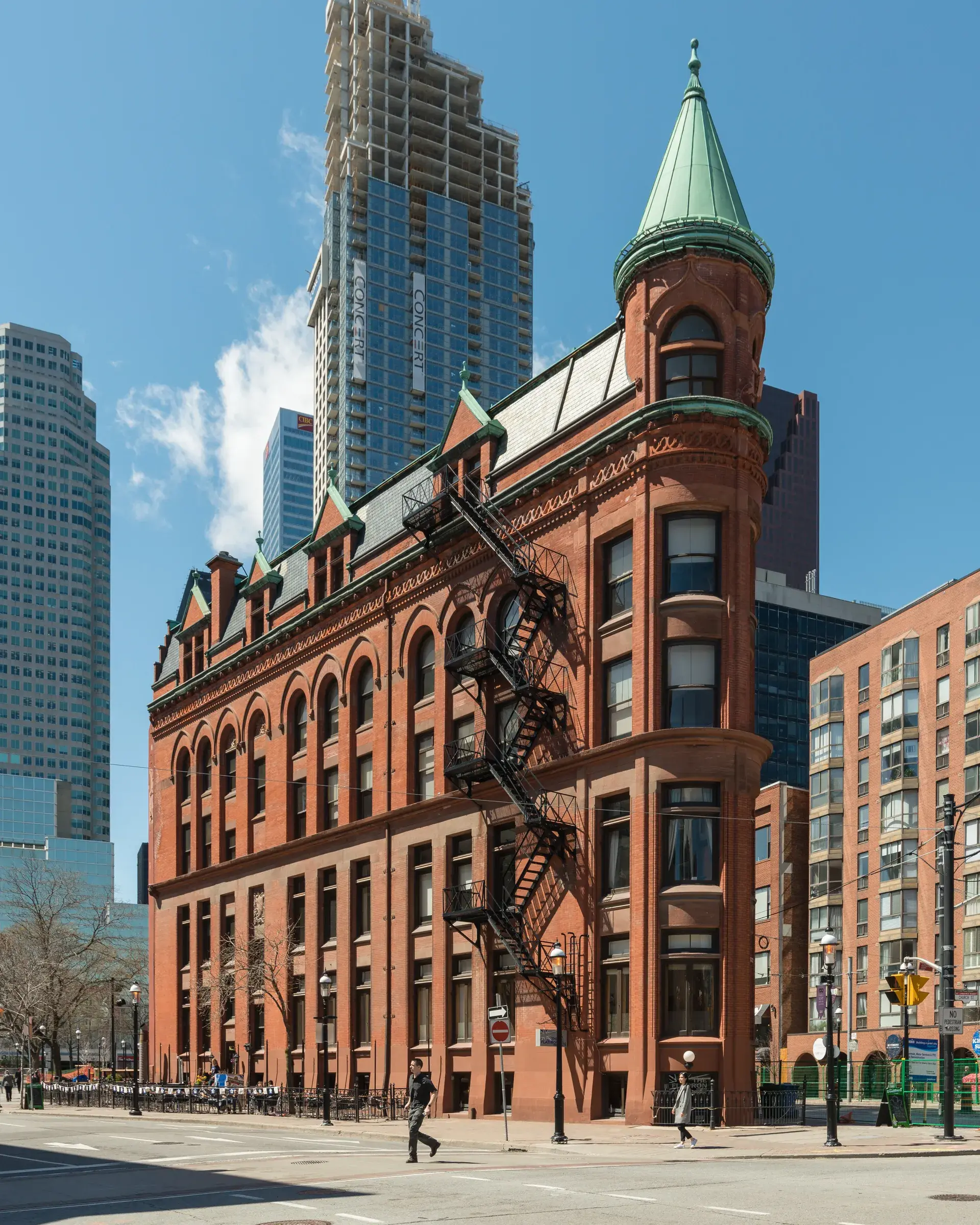
The Gooderham Building, commonly known as Toronto's Flatiron Building, is one of the city's most photographed and recognizable landmarks. Located at 49 Wellington Street East, this five-story, wedge-shaped office building serves as a historic anchor for the St. Lawrence Market neighborhood, its distinctive form a product of Toronto's early city planning.
Architectural Design and Construction
Completed in 1892, the Gooderham Building was designed by architect David Roberts Jr. for an estimated cost of $18,000. It showcases a blend of Romanesque Revival and Gothic Revival styles, characterized by its red-brick facade, gracefully arched windows, and a prominent, steeply pitched copper roof. The building's unique triangular shape is a direct result of the intersection of Wellington Street, which follows the city's grid, and Front Street, which traces the original shoreline of Lake Ontario.
Adding to its visual appeal is a trompe l'oeil mural on its flat west facade. Created by artist Derek Besant in 1980, the mural creates an illusion of additional windows and architectural depth, enhancing the building's picturesque quality.
A Symbol of Industrial Power
The building was commissioned by George Gooderham Sr., son of the Gooderham and Worts distillery founder, to serve as the company's new head office. It was a statement of the family's immense wealth and influence during Toronto's late 19th-century economic boom. At the time of his death in 1905, Gooderham was recognized as the wealthiest man in Ontario. He also served as president of the Bank of Toronto, which he founded, and the Manufacturers Life Insurance Company.
Reflecting his powerful position, Gooderham had a secret tunnel constructed connecting the building's basement to the Bank of Toronto across the street. This allowed for the discreet transfer of large sums of money. Inside, the building still contains one of Toronto's oldest manually-operated Otis elevators, encased by a central wooden staircase.
A Story of Preservation
The Gooderham Building served as the distillery's headquarters until 1952. It narrowly survived the extensive urban renewal projects of the 1950s and 1960s, which saw many surrounding historical structures demolished. Its fortunes turned when it was purchased and renovated in the 1970s.
In 1975, the structure was designated a historic site under the Ontario Heritage Act, securing its protection from future demolition. This designation marked a significant shift in the city's approach to heritage preservation. Further restorations in 1998 helped maintain its historic character.
The Gooderham Building Today
Today, the Gooderham Building continues to operate as commercial office space, housing various tenants and featuring a popular pub in its basement. It remains a vital cultural landmark, drawing the attention of tourists and architecture enthusiasts alike. As a visual endpoint to the downtown skyline, it stands as a cherished link between Toronto's Victorian past and its modern identity.
FAQ
When was the Gooderham Building in Toronto built?
Construction on the Gooderham Building began in 1891 and was completed in 1892.
Is the Toronto Flatiron Building older than the one in New York?
Yes, Toronto's Gooderham Building was completed in 1892, which is nearly a decade before New York City's more famous Flatiron Building was constructed.
Who was the original owner of the Gooderham Building?
The building was commissioned by George Gooderham Sr. to be the head office for the Gooderham and Worts distillery, a company founded by his father.
What is the Gooderham Building used for today?
The Gooderham Building is currently used as commercial office space for a variety of tenants. It also contains a pub in its basement and is a major Toronto landmark and tourist attraction.