First Parliament of Upper Canada Site: Toronto History
At the corner of Front and Parliament Streets in Toronto lies the site of the first purpose-built Parliament Buildings of Upper Canada, a foundational chapter in Ontario's democratic history. For over a century, this nationally significant location was largely forgotten, hidden beneath a car wash, a parking lot, and other commercial businesses until its rediscovery in the 21st century.
The First Parliament Buildings
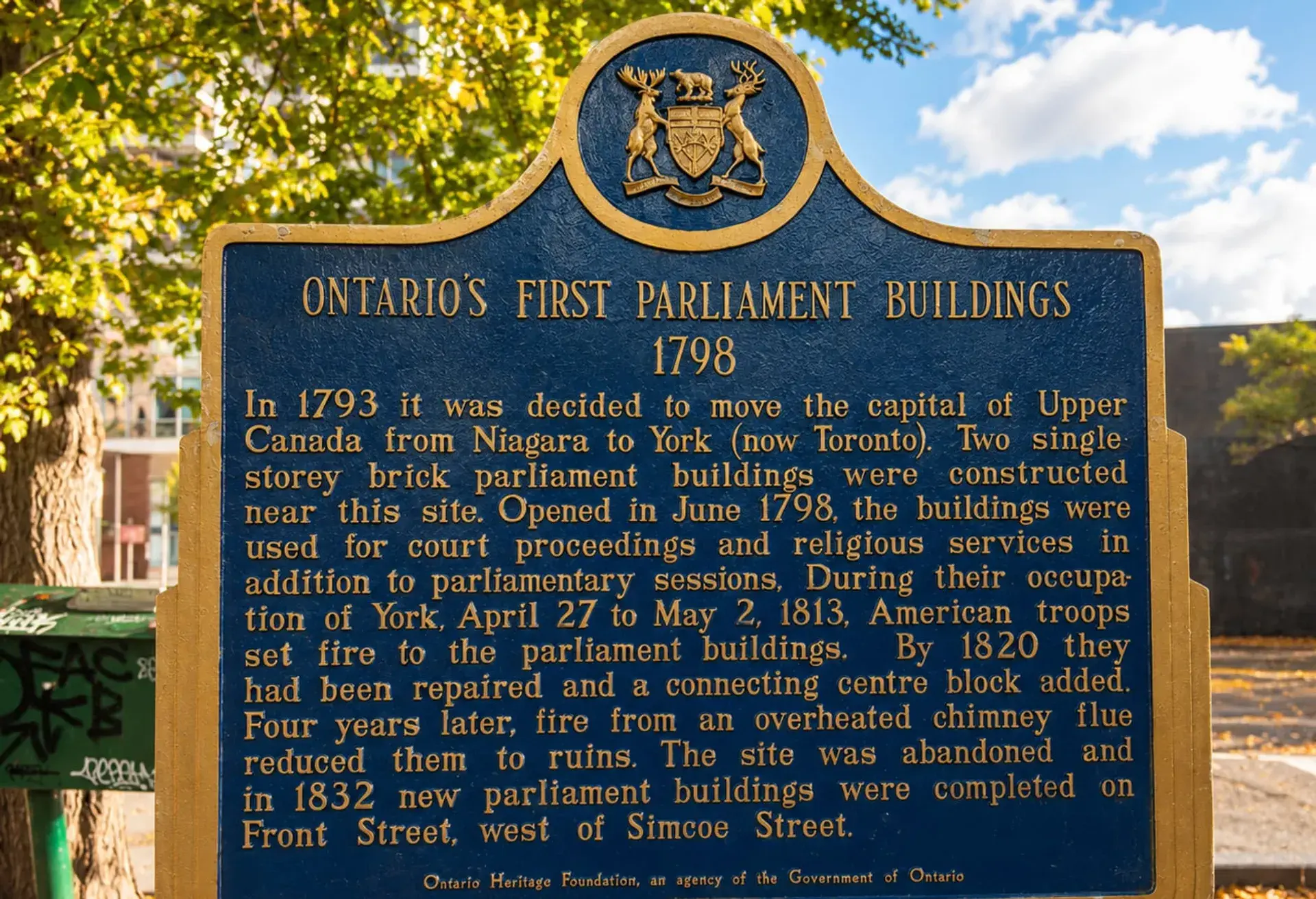
Following Lieutenant-Governor John Graves Simcoe's decision to move the capital from Newark (now Niagara-on-the-Lake) to York (now Toronto) in 1796, construction began on the new parliament buildings. Built between 1795 and 1797, the complex consisted of two English vernacular Georgian brick structures. These buildings housed the Legislative Council and the House of Assembly for the young colony of Upper Canada. Beyond their legislative purpose, the buildings also served as a community hub, hosting public events, Anglican Church services, and even providing temporary housing for new immigrants.
A History of Fire and War
The original buildings met a fiery end during the War of 1812. In 1813, invading American troops looted and burned the structures. This act prompted a significant retaliation by the British, who burned the U.S. Capitol in Washington, D.C. the following year. During the 1813 raid, the ceremonial mace, a symbol of parliamentary authority, was stolen by American forces.
A second parliamentary complex was constructed on the same site starting in 1819. However, this new set of buildings was also short-lived. In 1824, it was completely destroyed by an accidental fire, believed to have been caused by an overheated chimney flue. After this second disaster, the site was abandoned for legislative purposes.
A Forgotten Site Rediscovered
For the remainder of the 19th and most of the 20th century, the historic site saw a variety of uses. It was home to the Home District Gaol from 1837 to 1860, and later occupied by the Consumers' Gas Company starting around 1879. In the modern era, the block was covered by a Porsche dealership, a car rental agency, a parking lot, and a car wash.
The site's profound history was brought back to light in 2000. Prompted by urban history enthusiast Rollo Myers, an archaeological assessment led by Ron Williamson uncovered charred remnants of the original buildings, including floor joists and floorboards, beneath the car wash parking lot. This discovery confirmed the exact location and historical significance of the site.
The Site Today and Future Plans
Today, a portion of the area is occupied by Parliament Square Park, a small public green space with a ball diamond and sports field. In 2012, the City of Toronto acquired the entire historic city block. Plans are now underway to redevelop the site, which will include the construction of a new district library. As part of this project, the archaeological remnants of the first parliament buildings will be preserved beneath the new development, safeguarding this important piece of Canadian history.
FAQ
What happened to the first Parliament buildings of Upper Canada?
The original buildings were burned by American troops in 1813 during the War of 1812. A second set of buildings constructed on the same site was later destroyed by an accidental fire in 1824.
Where were the first Parliament buildings of Upper Canada located?
They were located in Toronto at what is now the corner of Front and Parliament Streets. For many years, the historic remains were buried under commercial properties, including a car wash and a parking lot.
What was the consequence of the burning of York's Parliament buildings?
The destruction of the Parliament buildings in York (now Toronto) by American forces in 1813 directly led to a retaliatory act by the British: the burning of the U.S. Capitol in Washington, D.C. in 1814.
What happened to the stolen parliamentary mace?
The ceremonial mace was taken by American troops when they burned the buildings in 1813. It was not returned to Canada until 1934, as a gesture for Toronto's centenary celebrations.