Catedral Primada de Colombia: Four Acts of Faith
The Four Acts of the Cathedral
The presence of the Catedral Primada de Colombia on the eastern edge of Plaza de Bolívar in Bogotá represents "faith in four acts"—a succession of four distinct religious buildings constructed on the exact same plot of land since the 16th century.
Act I began on August 6, 1538, when Friar Domingo de las Casas celebrated the first Catholic mass following the arrival of Spanish conquistador Gonzalo Jiménez de Quesada. This service took place inside a modest thatch and wattle-and-daub chapel named Nuestra Señora de la Esperanza.
Act II commenced in 1553 when Bishop Fray Juan de los Barrios commissioned a more durable church made of brick and rammed earth. In 1560, on the eve of its planned inauguration, the roof collapsed. In spite of the ruined state of the building, Pope Pius IV formally elevated it to cathedral status in 1562.
Act III took shape in March 1572 when Juan de los Barrios rallied the community by personally carrying the first stone to rebuild the site. This effort produced a three-nave stone church, finished in 1590, to which a bell tower was added in 1678. After sustaining severe structural fractures during the earthquake of July 12, 1785, the cathedral was condemned as unsafe and demolished around 1805.
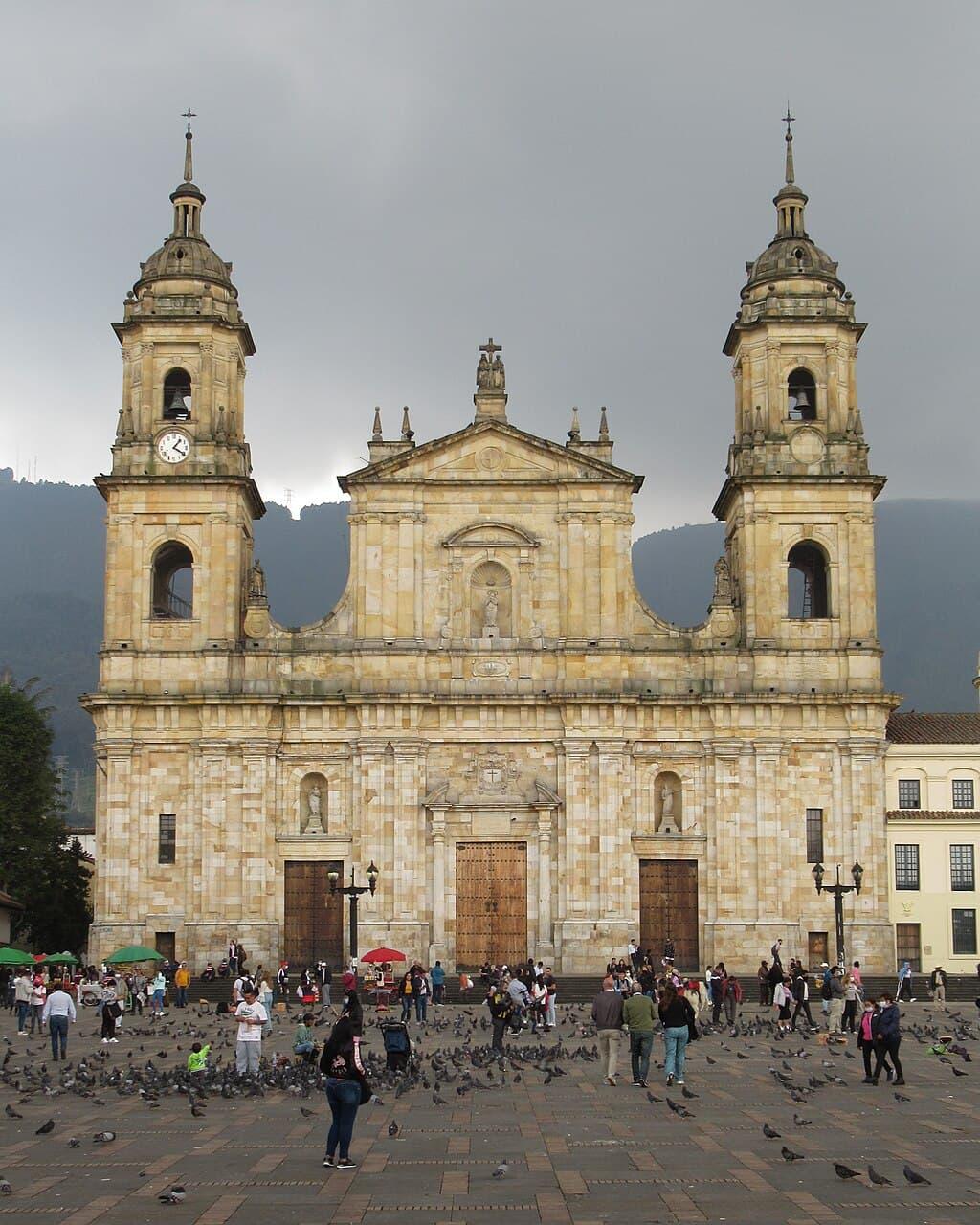
Act IV marked the arrival of the current building. Beginning in 1807, Spanish Capuchin friar Domingo de Petrés broke away from the Viceroyalty of New Granada's colonial baroque traditions, introducing disciplined Neoclassical architecture to the capital.
Bogotá self guided walking tour by Ciceru
1.5 hours9 stopsAudio guideStart any day, at your own paceTicket on your phone · 30-day refundNeoclassical Architecture and Civic Presence
Following the death of Domingo de Petrés in 1811, construction continued under master builder Nicolás León until the cathedral was finished in 1823. Spanning roughly 5,300 square meters, the Latin-cross basilica features five naves and two symmetrical 52-meter bell towers. Between 1943 and 1948, architect Alfredo Rodríguez Orgaz remodeled the twin towers to align with Petrés's original architectural plans.
Each of the 52-meter towers carries a dedication to a protective saint. The south tower honors Saint Barbara, while the north clock tower is dedicated to Saint Emygdius, venerated as a protector against earthquakes. Entering through the building's thick wooden doors leaves the noise of Plaza de Bolívar behind, opening into a vast, whitewashed interior defined by stone floor echoes and quiet acoustics.
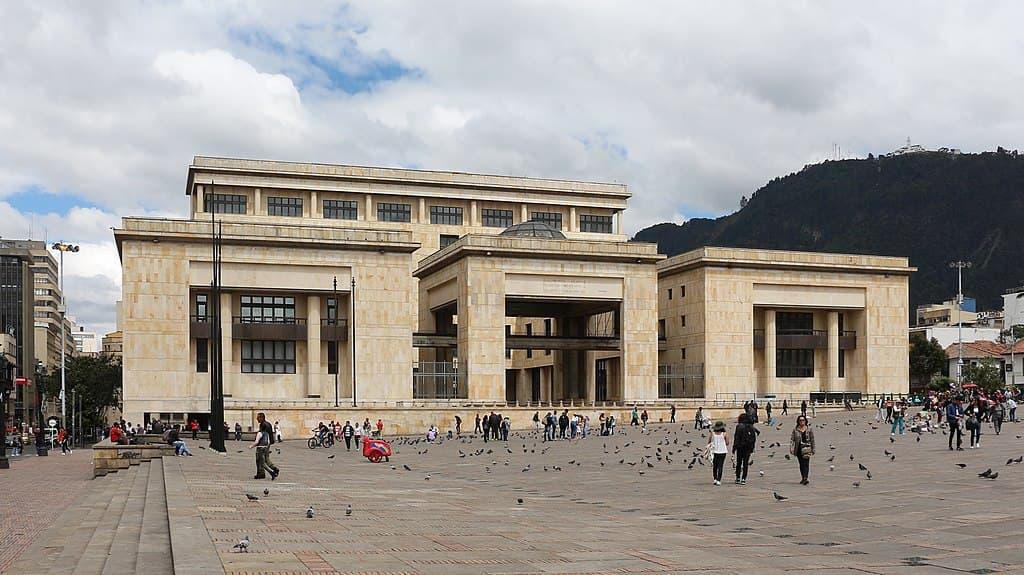
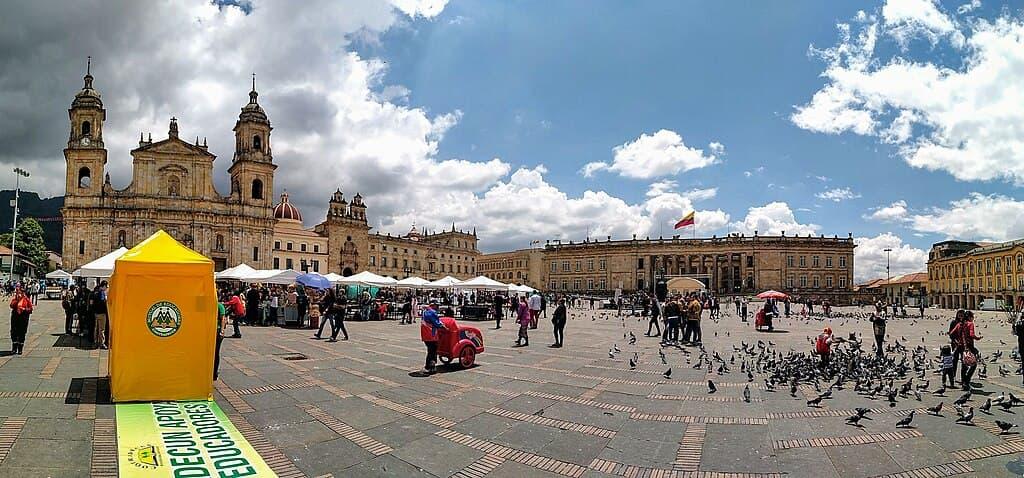
The cathedral commands the eastern boundary of Plaza de Bolívar, positioning religious authority alongside the National Capitol, the Liévano Palace, and the Palace of Justice. It also acts as an orienting landmark between the colonial grid of La Candelaria and the central axis of Carrera Séptima.
Interior Art and Historic Relics
The cathedral serves as a resting place for key historical figures. Bogotá's founder, Gonzalo Jiménez de Quesada, died of illness in Mariquita in 1579. After his remains were moved multiple times over centuries, they were permanently entombed in 1938 inside the cathedral's Chapel of Saint Elizabeth of Hungary, resting within a sculpted marble sarcophagus by Luis Alberto Acuña.
Musical history is preserved in the main sanctuary, which houses Colombia's largest historic tubular pipe organ, installed in 1890. Directly adjoining the cathedral's southern flank is the Capilla del Sagrario. Constructed between 1660 and 1689, this independent 17th-century stone chapel houses an extensive collection of paintings by colonial artist Gregorio Vásquez de Arce y Ceballos.
Ecclesiastical Status and Visitor Access
Pope Leo XIII granted the building the honorary title of Primate of Colombia in 1902. It was elevated to a minor basilica in 1907 and officially designated a National Monument of Colombia on August 11, 1975.
Today, the cathedral continues to serve as an active Catholic house of worship, hosting major national ecclesiastical rites, episcopal installations, state memorial services, and Holy Week assemblies. Daily Mass is celebrated Monday through Saturday at 12:00 PM, and on Sundays at 10:30 AM and 12:00 PM. The cathedral is open daily to the public for prayer, architectural viewing, and tourism free of charge, with modest dress and silence required inside.
FAQ
Why is the cathedral known for 'faith in four acts'?
Four successive temples have stood on the same physical plot: an initial 1538 thatch chapel, a 1553 rammed-earth structure whose roof collapsed, a 1572 stone church dismantled after an earthquake, and the present 1807 Neoclassical cathedral.
Who is buried in the Catedral Primada de Colombia?
Bogotá founder Gonzalo Jiménez de Quesada is entombed inside the cathedral's Chapel of Saint Elizabeth of Hungary within a marble sarcophagus sculpted by Luis Alberto Acuña.
What are the mass schedules and admission fees?
Admission to the cathedral is free of charge for prayer and tourism under guidelines requiring silence and modest dress. Daily Mass is held Monday through Saturday at 12:00 PM and Sundays at 10:30 AM and 12:00 PM.
More places in Bogota
bogota, colombia
Plaza de Bolívar: the republic’s front porch.
Plaza de Bolívar: the republic’s front porch.
bogota, colombia
Palacio de Justicia: a building rebuilt, a story remembered
Palacio de Justicia: a building rebuilt, a story remembered
bogota, colombia
Santuario Nacional del Carmen: striped faith