Plaza de Bolívar: Bogotá's Historic Civic Square
The Civic Heart of Colombia
Situated in Bogotá's historic La Candelaria district, Plaza de Bolívar functions as the symbolic and physical center of Colombia’s constitutional republic. Established in 1539, the square occupies 13,903 square meters at an elevation of 2,640 meters above sea level. Bounded by Calles 10 and 11 and Carreras 7 and 8, the plaza connects the colonial urban grid directly with the major pedestrian artery of Carrera Séptima. In October 1995, Decree 1802 designated the square a National Monument of Colombia.
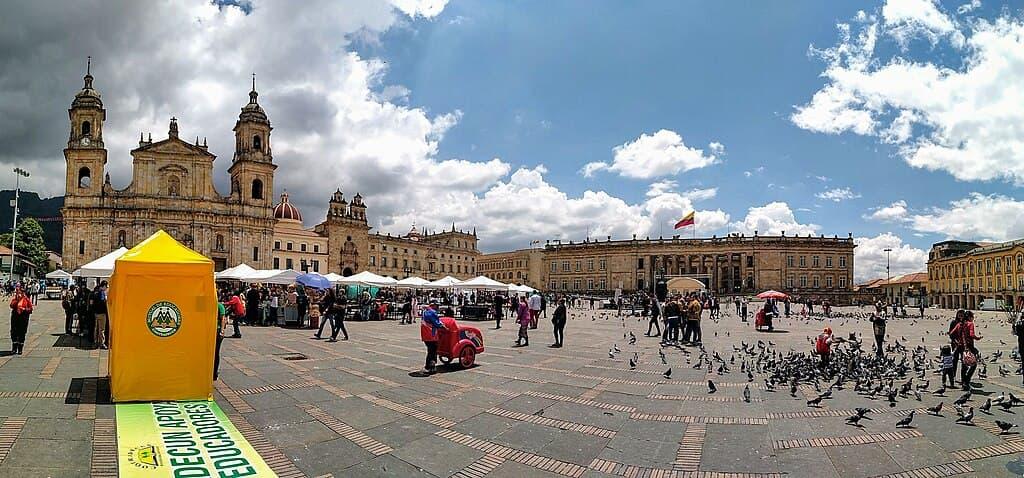
Unlike traditional public parks, the plaza is a vast, unshaded stone esplanade. High-altitude Andean winds sweep unobstructed across the flagstones, framed by institutional structures that physically embody the constitutional separation of powers alongside the nation's primary religious seat.
Bogotá self guided walking tour by Ciceru
1.5 hours9 stopsAudio guideStart any day, at your own paceTicket on your phone · 30-day refundFour Facades of Power and Faith
Each of the plaza's four sides is anchored by an essential civic or religious institution, creating a rare spatial concentration of authority:
- South: The Neoclassical Capitolio Nacional houses Colombia's bicameral Congress. Designed in 1847 by architect Thomas Reed, the building underwent decades of construction before its official completion in 1926.
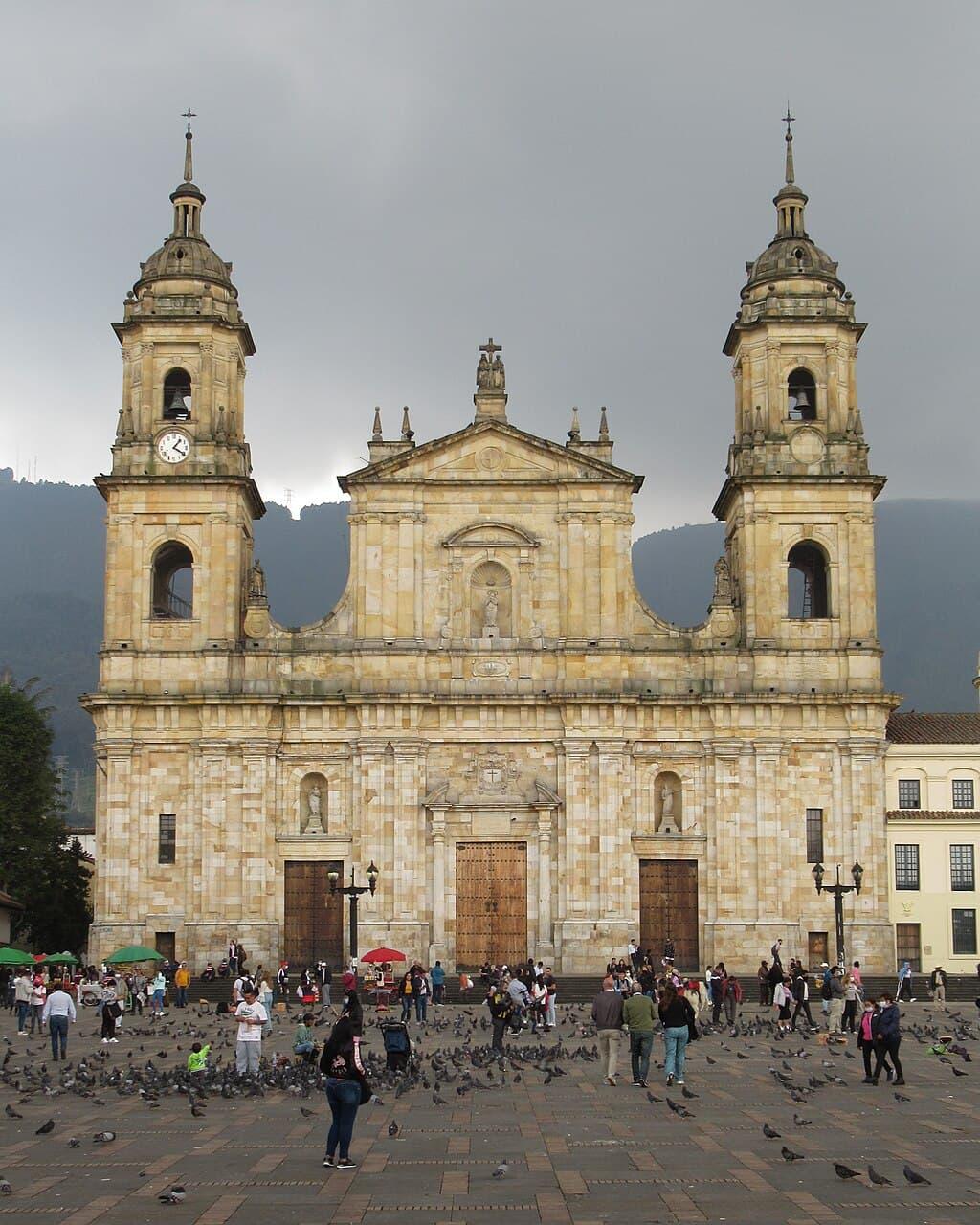
- East: The Neoclassical Catedral Primada de Colombia, designed by Capuchin friar Domingo de Petrés and constructed between 1807 and 1823, stands beside the Baroque Capilla del Sagrario, which dates back to 1700.
- West: The Palacio Liévano, designed in the French Renaissance style by architect Gastón Lelarge and constructed between 1902 and 1905, serves as Bogotá's City Hall (Alcaldía Mayor de Bogotá).
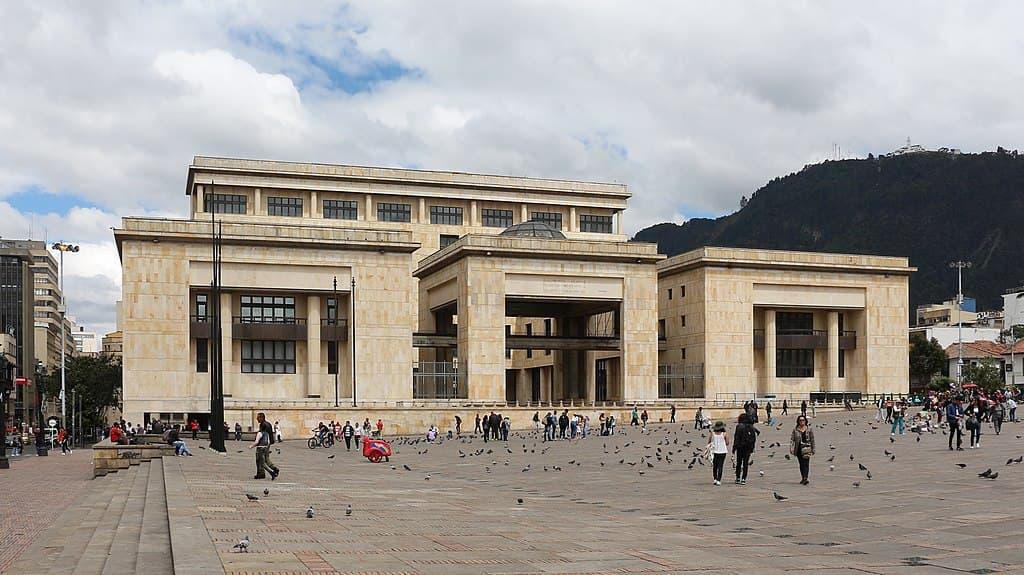
- North: The late-20th-century modernist Palacio de Justicia serves as the seat of Colombia's Supreme Court and Constitutional Court. The building was reconstructed following the destruction of the previous courthouse in 1985.
From Colonial Marketplace to Monumental Esplanade
Spanish conquistador Gonzalo Jiménez de Quesada established the plaza in 1539 atop ancestral Muisca lands. Originally named Plaza Mayor, it functioned throughout the colonial period as an open-air market, a staging ground for bullfights, and the site of the civic pillory (picota). During the struggle for independence from Spain, the square witnessed the execution of prominent revolutionary leaders, including Camilo Torres Tenorio in 1816.
The space was renamed Plaza de la Constitución in 1821 and assumed its current name, Plaza de Bolívar, in 1846. Across the 20th century, the plaza served as the flashpoint for modern political crises, notably sustaining fires during the 1948 Bogotazo riots following the assassination of Jorge Eliécer Gaitán, as well as the armed siege of the Palace of Justice in November 1985.
The square's current architectural form dates to 1960. For the sesquicentennial of Colombian independence, architects Fernando Martínez Sanabria and Jacques Mosseri redesigned the layout. Their modernist plan eliminated ornamental garden beds, perimeter vehicle roads, and corner fountains, consolidating the space into a unified, open stone expanse.
Central Monuments and Local Lore
At the center of the esplanade stands Bogotá’s first public bronze monument: a statue of Simón Bolívar sculpted by Italian artist Pietro Tenerani, unveiled on July 20, 1846.
Before the installation of Bolívar's likeness, the square’s center was occupied from 1583 to 1846 by a public stone fountain topped with a carved figure of St. John the Baptist. Residents colloquially referred to the statue as El Mono de la Pila (the monkey of the fountain). The site gave rise to the enduring local idiom "A quejarse al Mono de la Pila" ("Go complain to the fountain monkey"), a retort originally used by parents to dismiss children who grumbled about having to haul heavy water jugs across the plaza.
Daily Life and Civic Gathering
Today, Plaza de Bolívar functions as Colombia's premier stage for mass political rallies, union marches, and civic ceremonies, while simultaneously serving as a daily thoroughfare for students, government personnel, and travelers.
The open stones host informal street vendors selling grain to crowds feeding thousands of resident pigeons, a practice that municipal authorities have addressed through mitigation campaigns to protect historical stone facades and public health. Alongside local snack stalls and street photographers, commercial handlers offer photos with decorative Andean llamas—animals not native to the savanna of Bogotá, but introduced in recent decades to cater to popular regional imagery.
FAQ
What institutions surround Plaza de Bolívar?
The plaza is surrounded by Colombia's primary seats of power: the Capitolio Nacional (Congress) to the south, the Catedral Primada and Capilla del Sagrario to the east, the Palacio Liévano (Bogotá City Hall) to the west, and the Palacio de Justicia (Supreme and Constitutional Courts) to the north.
What monument occupied the center of the plaza before Simón Bolívar's statue?
From 1583 to 1846, the center held a public stone water fountain topped with a figure of St. John the Baptist, popularly called El Mono de la Pila. It gave rise to the popular Bogotá phrase 'A quejarse al Mono de la Pila.'
When did the plaza take on its modern open stone design?
In 1960, architects Fernando Martínez Sanabria and Jacques Mosseri redesigned the plaza for the sesquicentennial of Colombian independence, removing ornamental gardens, fountains, and traffic routes to create the vast paved esplanade seen today.
Are the llamas found on Plaza de Bolívar native to Bogotá?
No. Llamas are not native to the high savanna of Bogotá. They were brought to the plaza by commercial vendors in recent decades as photo props catering to Andean visitor tropes.
More places in Bogota
bogota, colombia
Catedral Primada de Colombia: faith in four acts
Catedral Primada de Colombia: faith in four acts
bogota, colombia
Palacio de Justicia: a building rebuilt, a story remembered
Palacio de Justicia: a building rebuilt, a story remembered
bogota, colombia
Santuario Nacional del Carmen: striped faith