Palacio de Justicia: Bogotá's Rebuilt High Court
A Monument of Resilience on Plaza de Bolívar
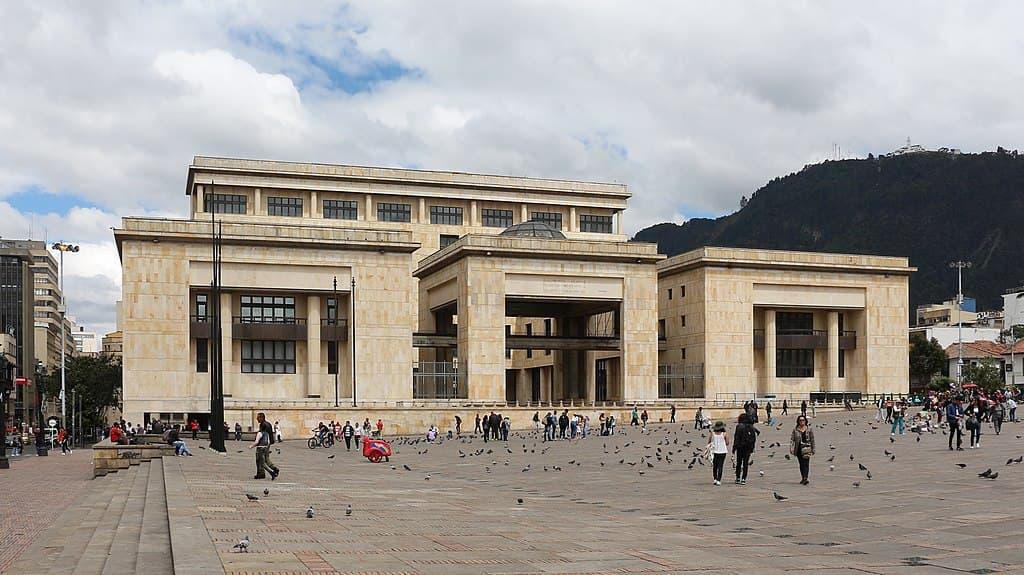
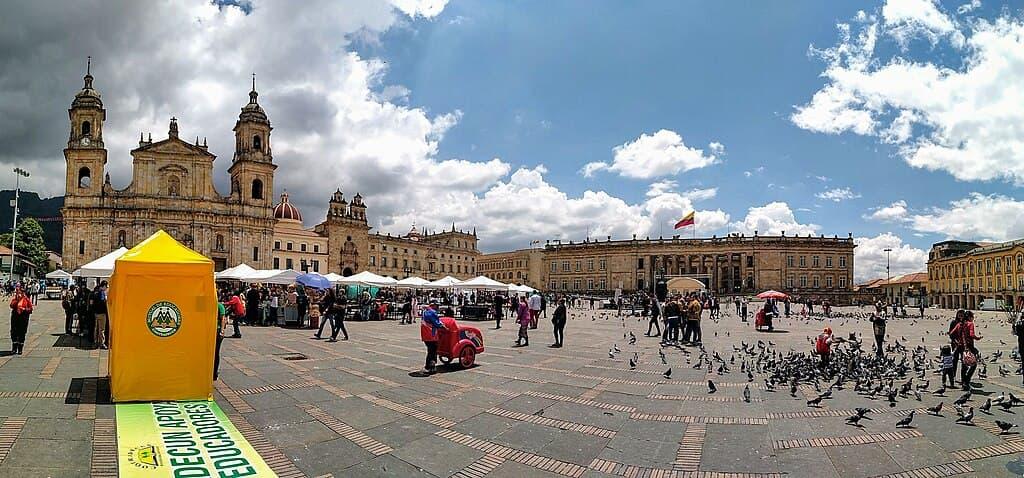
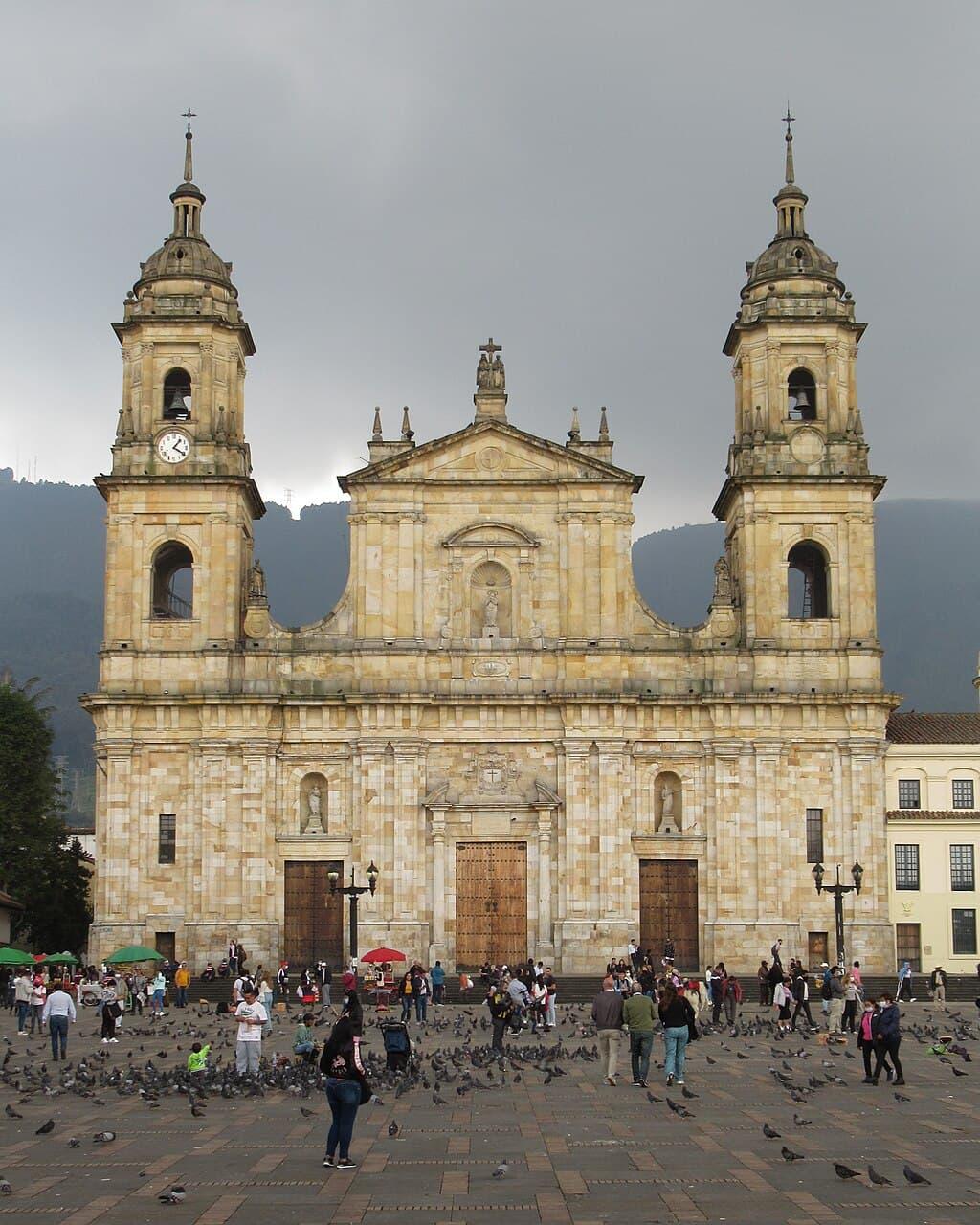
The Palacio de Justicia Alfonso Reyes Echandía occupies the northern edge of Plaza de Bolívar at Calle 12 No. 7-65 in Bogotá. Characterized by postmodern and modern institutional architecture with stone cladding, reinforced concrete, and tinted windows, it stands in stark visual contrast to the surrounding historical square. While the plaza is framed by the neoclassical Capitolio Nacional to the south, the French-neoclassical Palacio Liévano to the west, and the colonial-era Primary Cathedral to the east, the Palace of Justice represents a modern civic presence.
Mounted prominently above the entrance is an inscribed stone tablet quoting General Francisco de Paula Santander: "Colombianos, las armas os han dado independencia, las leyes os darán libertad" ("Colombians, arms have given you independence; laws will give you freedom"). The building is named in memory of Supreme Court President Dr. Alfonso Reyes Echandía, who perished inside during the 1985 siege.
Bogotá self guided walking tour by Ciceru
1.5 hours9 stopsAudio guideStart any day, at your own paceTicket on your phone · 30-day refundThe Destructions of 1948 and 1985
The current structure is the product of repeated cycles of political violence and reconstruction. Bogotá’s original Palace of Justice, designed in the 1920s by Pablo de la Cruz at Calle 11 and Carrera 6, was destroyed by fire on April 9, 1948, during the Bogotazo riots sparked by the assassination of political leader Jorge Eliécer Gaitán. The original plot no longer houses the court; it is now the location of the Centro Cultural Gabriel García Márquez.
A replacement modernist stone palace, designed by Colombian architect Roberto Londoño Domínguez, was subsequently constructed on the north side of Plaza de Bolívar. However, on November 6–7, 1985, guerrillas from the M-19 movement seized the complex. The retaking of the building by the military led to widespread structural fires, the destruction of legal archives, the forced disappearances of cafeteria staff and visitors, and the deaths of more than 100 people, including 11 Supreme Court magistrates. Directly across the plaza's northeast corner, the Casa del Florero served as the military identification holding point for survivors escorted from the building, forever linking both sites in human-rights documentation.
Rebuilding After Tragedy
Following the 1985 destruction, authorities chose to demolish the charred remains rather than repair them. In a rare architectural occurrence, Roberto Londoño Domínguez was commissioned a second time to design the replacement building on the very same site.
Londoño adapted his earlier design to include reinforced concrete, blast-resistant glazing, and heightened security standards while preserving the building's alignment with the statue of Simón Bolívar and the Capitolio Nacional across the square. Construction began in the late 1980s, phased occupancy commenced in 1998, and full formal operations resumed by 2004. As a deliberate symbol of continuity, the surviving Santander stone plaque was recovered from the ruins of the pre-1985 portal and set directly into the new façade.
Modern High Courts and Enduring Memory
Today, the Palacio de Justicia serves as the operational headquarters for the highest branches of the Colombian judiciary: the Supreme Court of Justice, the Constitutional Court, the Council of State, and the Superior Council of the Judiciary.
Because the building is a heavily secured, working government facility, public access to the interior is restricted. It is experienced from the open expanse of Plaza de Bolívar, where historians and civic observers often describe it as both a working institutional center and an architectural scar commemorating 20th-century national history.
FAQ
Can the public tour the interior of the Palacio de Justicia?
No. The Palacio de Justicia is a high-security operational facility housing Colombia's highest courts, meaning interior public access is restricted. It is viewed from the exterior perimeter on Plaza de Bolívar.
What is the history behind the stone inscription above the entrance?
The stone tablet features a quote from General Francisco de Paula Santander about independence and law. It was salvaged from the ruins of the previous modernist palace after the 1985 fire and deliberately set into the reconstructed façade as a physical link between the past and present.
Who designed the current Palacio de Justicia building?
The building was designed by Colombian architect Roberto Londoño Domínguez, who was commissioned to design both the building destroyed in 1985 and its modern replacement.
More places in Bogota
bogota, colombia
Plaza de Bolívar: the republic’s front porch.
Plaza de Bolívar: the republic’s front porch.
bogota, colombia
Catedral Primada de Colombia: faith in four acts
Catedral Primada de Colombia: faith in four acts
bogota, colombia
Santuario Nacional del Carmen: striped faith