Fort Lovrijenac: Dubrovnik's Western Sea Fortress
Strategic Architecture on the Western Cliff
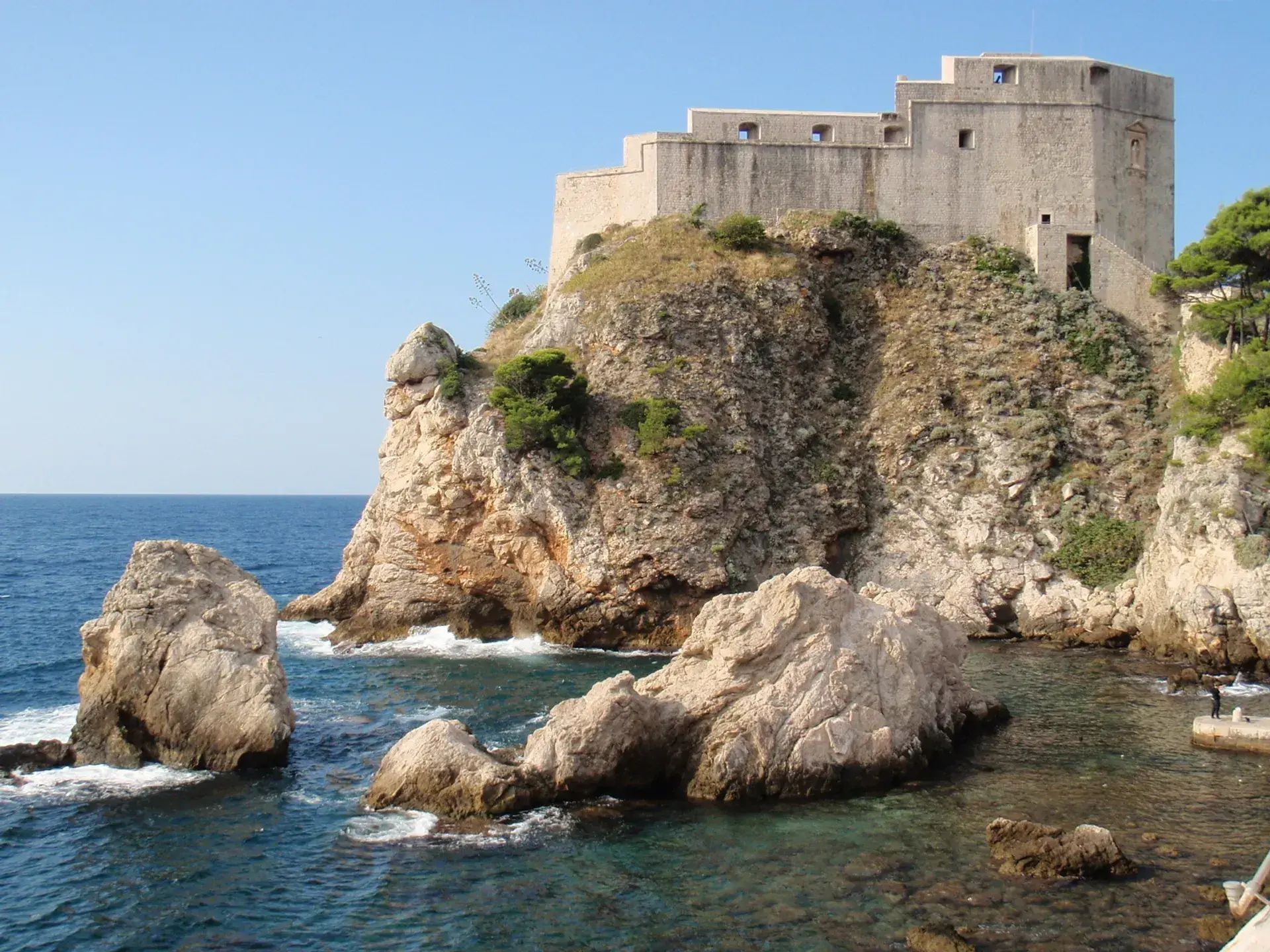
Perched atop a sheer 37-meter limestone cliff outside Dubrovnik's western ramparts, Fort Lovrijenac stands as a detached coastal stronghold west of the Pile Gate. Designed with a triangular footprint tailored to the contours of the rock, the fortress is organized around an inner courtyard across three stepped terrace levels. At the base of the precipice, heavy sea winds and waves crash and echo against the stone, underscoring the natural isolation of the position.
The most notable architectural feature of Fort Lovrijenac is the stark contrast in the thickness of its defenses. The seaward-facing walls, constructed to resist artillery fire from naval invaders, measure up to 12 meters thick. Conversely, the rear wall facing the city of Dubrovnik measures roughly 60 centimeters thick. This disparity served as an intentional defensive fail-safe: if an occupying force or a rebellious garrison seized the outpost, cannons mounted across Kolorina bay on the city's Fort Bokar could readily breach the thin inner wall to neutralize the threat.
Historical Evolution and Garrison Governance
The earliest surviving official record concerning the fortress dates to 1301, documenting the city council's election of a castellan, or fortress commander. The structure underwent comprehensive rebuilding and expansion during the 15th and 16th centuries to mount heavy artillery, incorporating designs by master builder I. K. Zanchi of Pesaro. The fortress sustained severe structural damage during the catastrophic earthquake of 1667, leading to continuous reinforcement and repair efforts that lasted through the close of the 17th century.
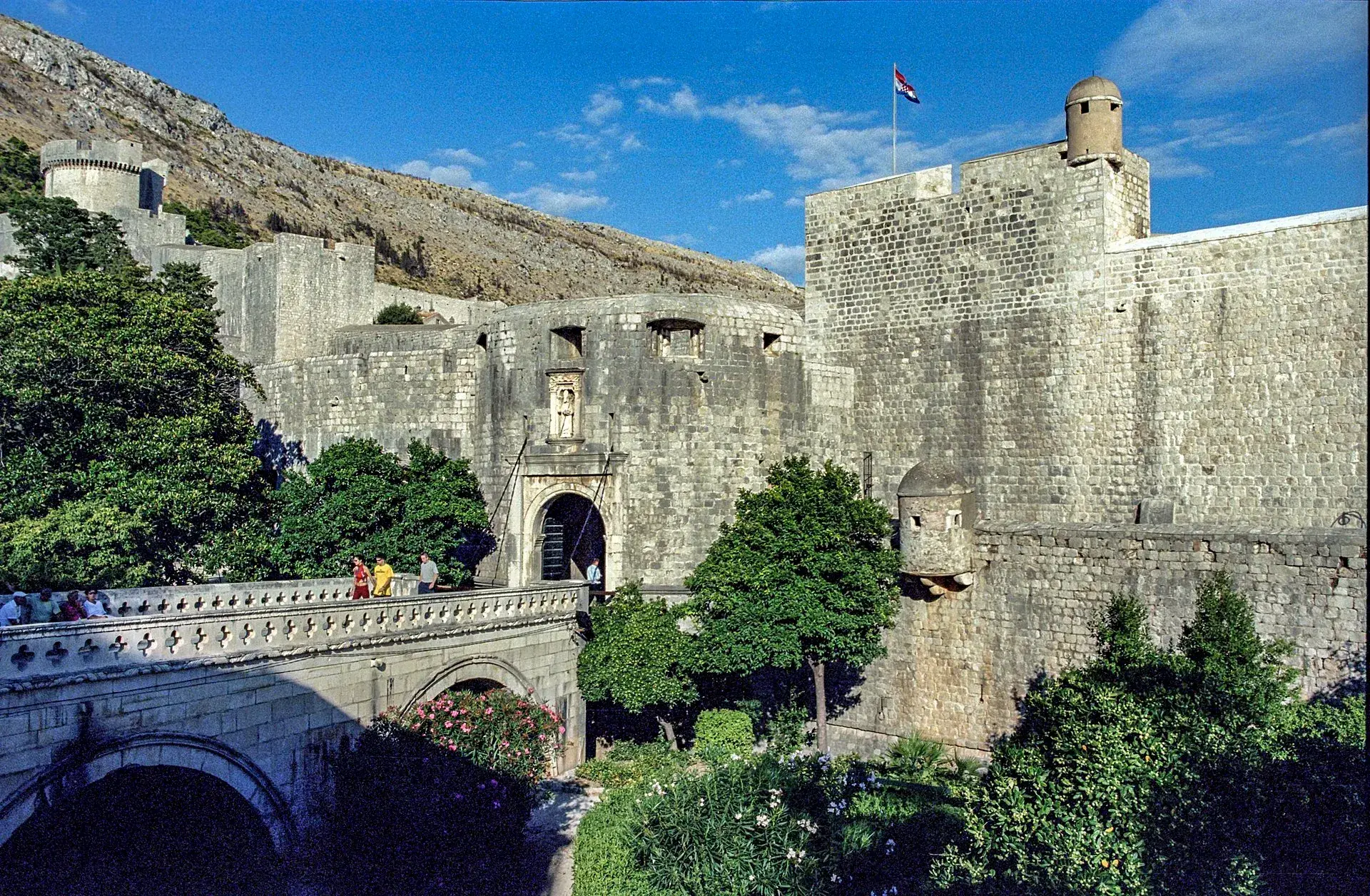
To safeguard against potential treason or domestic coups, the Republic of Ragusa enforced strict regulations on the fort's command. The commanding officer was selected exclusively from the local nobility, rotated out every single month, and forbidden from leaving the fortress complex for the entire duration of his term. Working in tandem with Fort Bokar, Fort Lovrijenac maintained an overlapping field of fire over the waters of Kolorina bay, anchoring the primary protective barrier for the Pile Gate entrance.
Relics, Inscriptions, and Cultural Heritage
Carved into the stone lintel above the main entrance is the Latin motto Non bene pro toto libertas venditur auro ("Freedom is not sold for all the gold in the world"). The phrase traces its lineage to Aesop's fable of the dog and the wolf, celebrating the wolf's choice of hardship and freedom over a chained animal's fed comfort. Within a northwestern wall niche sits a stone statue of Dubrovnik's patron saint, Saint Blaise, sculpted in 1559 by Jacob de Spinis and Vicko Lujov.
Historically, the fortress hosted heavy ordnance, including a renowned 1537 bronze cannon nicknamed Gušter ("The Lizard"), cast by the founder Ivan Rabljanin. The weapon never fired a hostile shot in combat. During disarmament efforts by Austrian forces in the 19th century, the transport ropes snapped while lowering the massive cannon, sending it into the seabed below where it remains unrecovered.
Modern Access and Public Use
Today, Fort Lovrijenac is integrated into Dubrovnik's cultural and historical network. The fortress acts as an open-air stage during the annual Dubrovnik Summer Festival, hosting classical theater productions, most notably William Shakespeare's Hamlet. It also functions as a location for international film and television productions.
Visitors can observe the fortress from the cove below or from the external approach. Entry to the interior courtyards and upper terraces requires an admission ticket; the standard Dubrovnik City Walls ticket includes access to Fort Lovrijenac.
FAQ
Does a Dubrovnik City Walls ticket include entry to Fort Lovrijenac?
Yes, standard ticketing for the Dubrovnik City Walls also covers admission to Fort Lovrijenac.
Why was the inner wall of Fort Lovrijenac built so thin?
The city-facing wall was intentionally constructed to be only 60 centimeters thick as a defensive fail-safe. If the fortress was captured by enemies or taken over by a mutinous garrison, Dubrovnik's defenders could easily penetrate it with artillery fire from Fort Bokar.
What is the meaning of the Latin inscription above the entrance?
The inscription reads 'Non bene pro toto libertas venditur auro', which translates to 'Freedom is not sold for all the gold in the world.' It derives from Aesop's fable of the dog and the wolf.