Sponza Palace: Dubrovnik's Surviving Customs House
Architectural Splendor on Luža Square
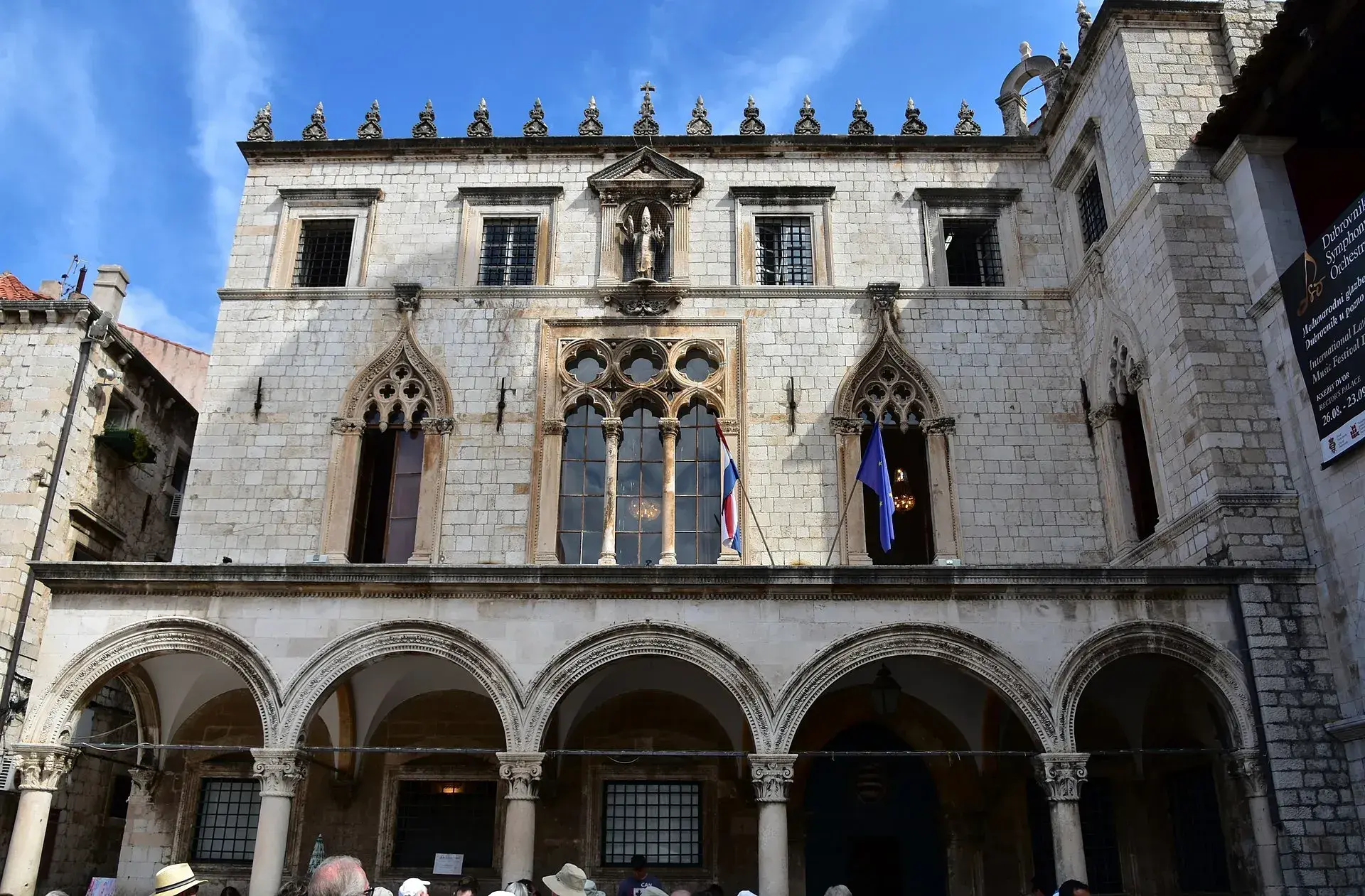
Standing at the eastern terminus of the Stradun on Luža Square, Sponza Palace serves as an enduring architectural monument of the Republic of Ragusa. Constructed between 1516 and 1522, the building was designed by chief Republic architect Paskoje Miličević Mihov, with sculptural stonework crafted by Nikola and Josip Andrijić of Korčula.
The palace showcases a distinct blend of late Gothic and Renaissance styles. Its ground level features an open Renaissance portico resting on Corinthian columns, leading from the bright limestone pavement of the main street into a shaded, cool interior atrium. The first floor displays late Gothic bifora windows, while the second floor is defined by Renaissance window frames. Within the arcaded central courtyard, a stone relief medallion crafted by French Renaissance sculptor Bertrandus Gallicus depicts the Christ monogram flanked by two angels.
From Rainwater Cistern to Commercial Engine
The name Sponza originates from the Latin word spongia (sponge), referencing a former rainwater catchment and cistern that previously occupied the grounds. Historically, the building was also known as Divona, derived from the Italian and Venetian term dogana, meaning customs house.
Erected primarily as a bonded warehouse and customs headquarters, the complex was where Mediterranean goods arriving in Dubrovnik were inspected, taxed, and weighed. Ground-floor warehouse bays were identified by inscriptions of patron saints carved above the stone arches. Over time, the facility expanded into a central civic engine, housing the state treasury, the mint for coining Ragusan currency, an armory, a public bank, and the city's first state school. In the late 16th century, the building also accommodated the Academia dei Concordi, a literary academy where scholars gathered to debate art, literature, and science.
A Latin inscription on the wall above the former public scales explicitly framed honest trade as a spiritual mandate: FALLERE NOSTRA VETANT; ET FALLI PONDERA: MEQUE PONDERO CUM MERCES, PONDERAT IPSE DEUS ("Our weights forbid us to cheat or be cheated; when I weigh the goods, God himself weighs them with me").
Surviving the Great Earthquake of 1667
Dubrovnik suffered catastrophic devastation during the earthquake of 1667, which destroyed the majority of public and private structures across the city and prompted widespread reconstruction in the Baroque style. Sponza Palace survived the disaster virtually undamaged.
Its structural preservation provided the Republic's administration with an operational base to coordinate disaster recovery. Today, the palace remains a vital benchmark illustrating the Gothic-Renaissance secular architecture of pre-earthquake Dubrovnik.
The State Archives and Modern Use
Since 1952, Sponza Palace has housed the State Archives in Dubrovnik (Državni arhiv u Dubrovniku). The collection preserves municipal records dating back to 1022, containing more than 7,000 bound manuscript volumes and roughly 100,000 separate documents detailing centuries of Mediterranean diplomacy, maritime trade, and notary activity.
On the ground floor, the building hosts the Memorial Room of the Defenders of Dubrovnik, which displays photographs, documents, and artifacts dedicated to the defenders and civilians who died during the 1991–1992 siege in the Croatian Homeland War. The central courtyard is also utilized as a cultural stage for art exhibitions, classical concerts, and the ceremonial opening performance of the annual Dubrovnik Summer Festival.
FAQ
Is Sponza Palace open to the public?
The ground-floor atrium and the Memorial Room of the Dubrovnik Defenders are open and free to visit. The State Archives located on the upper floors are not open to general visitors.
What does the Latin inscription inside Sponza Palace mean?
The inscription above the former public scales reads: 'FALLERE NOSTRA VETANT; ET FALLI PONDERA: MEQUE PONDERO CUM MERCES, PONDERAT IPSE DEUS', translating to 'Our weights forbid us to cheat or be cheated; when I weigh the goods, God himself weighs them with me.'
Why is Sponza Palace historically significant in Dubrovnik?
Built between 1516 and 1522, it is one of the few secular Gothic-Renaissance buildings to survive the 1667 earthquake virtually intact, offering a rare view of Dubrovnik before the city was rebuilt in the Baroque style.