Jesuit Stairs: Dubrovnik's Baroque Landmark
Baroque Design Inspired by Rome
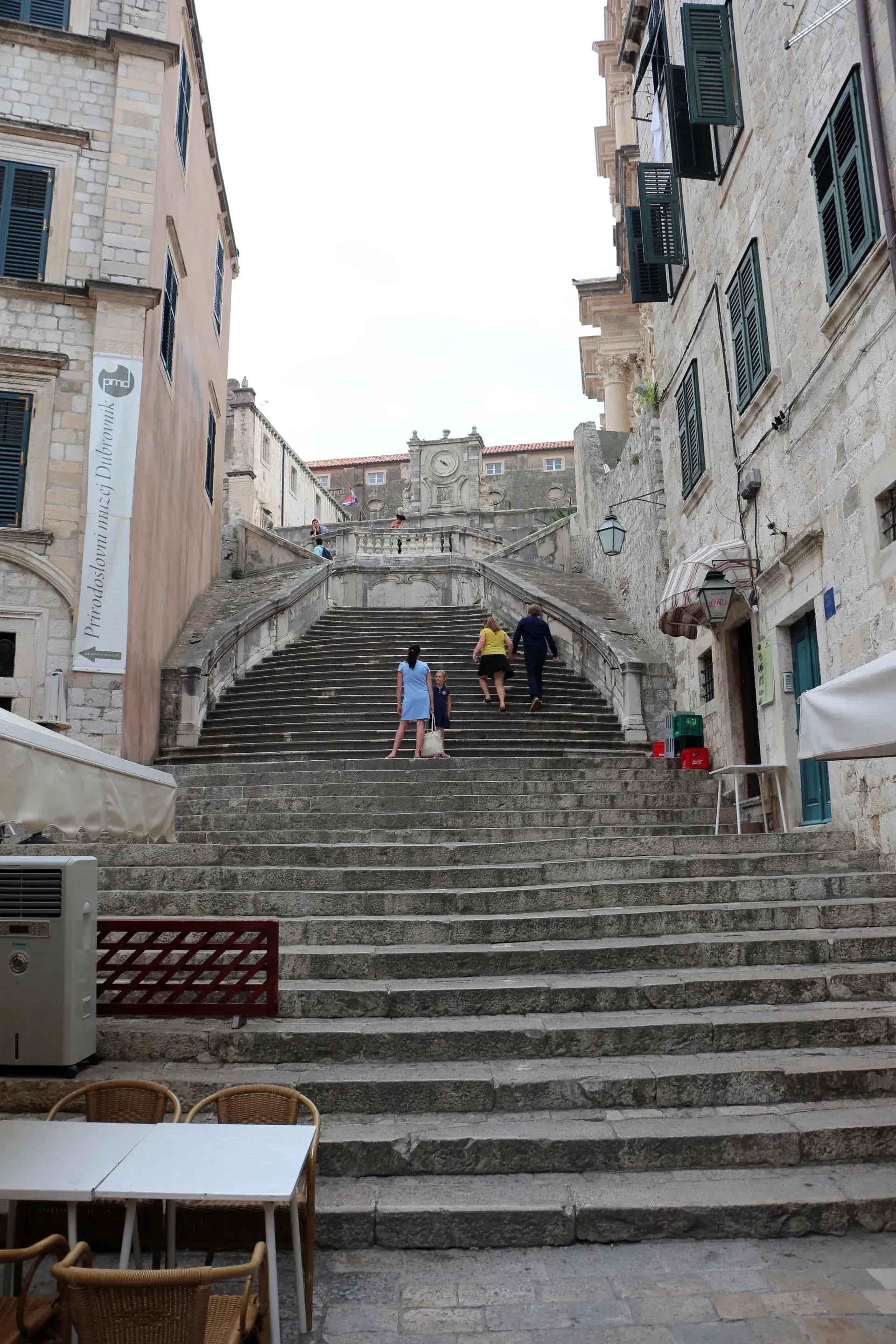
The Jesuit Stairs (skale od jezuita or skaline) are an 18th-century Late Baroque monumental outdoor staircase located in the southern section of Dubrovnik's Old Town. Designed in 1738 by the Roman architect Pietro Passalacqua, who was of Sicilian origin, the staircase deliberately emulates the architectural composition of the Spanish Steps in Rome. The structure features dynamic, convex-concave curving stone flights separated by intermediate landings. Centuries of continuous foot traffic have polished the broad limestone steps, creating a smooth and reflective surface.
The staircase functions as an architectural link bridging two elevations within the urban landscape. It connects Gundulić Square (Gundulićeva poljana) at the base with Bošković Square (Poljana Ruđera Boškovića) at the top. At the stair summit stands the Church of St. Ignatius of Loyola and the former Collegium Ragusinum. While the urban corridors along the Stradun reflect Gothic and Renaissance restraint, the Jesuit Stairs introduce a theatrical Late Baroque perspective to the city's street layout.
Origins and Urban Transformation
Efforts to establish a Jesuit academic complex in Ragusa began in 1555 when Bishop Ludovico Beccadelli invited the order to the city. Securing necessary land and funding required nearly a century of negotiations. In 1653, Rector Gianbattista Canauli developed redevelopment plans to clear a footprint within the densely populated medieval quarter.
The catastrophic 1667 earthquake leveled many existing structures in the area, providing space for the project to move forward with the financial backing of nobleman Marin Gundulić's bequest. Prominent Jesuit architect and painter Andrea Pozzo designed the Church of St. Ignatius, which was constructed between 1699 and 1725. In 1738, Passalacqua completed the grand staircase across parcels of cleared domestic land, formally connecting the elevated religious complex to the lower civic street grid. To accomplish this, city authorities systematically expropriated and demolished entire medieval residential blocks and alleys in one of Dubrovnik's oldest districts.
Cultural Role and Modern Public Use
Like other major Old Town landmarks including the Stradun, Pile Gate, and Luza Square, the Jesuit Stairs are a free and open public thoroughfare accessible at all hours. The staircase serves as a daily corridor for residents and visitors traveling between the morning open-air market on Gundulić Square and the upper residential lanes, schools, and churches near the southern city walls.
The staircase and Bošković Square also host cultural events, channeling audiences into the plaza for open-air theater and musical performances during the annual Dubrovnik Summer Festival. In popular culture, the stairs achieved global visibility as the real-world filming location for Cersei Lannister's "Walk of Shame" in Season 5 of HBO's television drama Game of Thrones.
Historical Relics of Bošković Square
Several historic artifacts remain preserved around the perimeter of the staircase. At the base of the college steps, a stone relief plaque dated 1481 depicts angels holding the YHS christogram. This element is believed to have survived from the medieval Church of Saint Lucia, which was destroyed on the site during the 1667 earthquake.
Just above the staircase, the belfry of the Church of St. Ignatius houses the oldest functioning bell in Dubrovnik, cast in 1355 by the bellfounders Viventius and his son Viator. In 1930, the terrace at the top of the stairs was officially named Poljana Ruđera Boškovića in honor of the physicist, astronomer, and polymath Ruđer Bošković, who was educated at the adjacent Jesuit college.
FAQ
Who designed the Jesuit Stairs in Dubrovnik?
The stairs were designed in 1738 by Roman architect Pietro Passalacqua, who modeled the sweeping convex-concave curves on the Spanish Steps in Rome.
What sites do the Jesuit Stairs connect?
The staircase connects Gundulić Square below to Bošković Square above, where the Church of St. Ignatius of Loyola and the former Collegium Ragusinum stand.
Are the Jesuit Stairs free to access?
Yes, the Jesuit Stairs operate as a free, open public thoroughfare accessible 24 hours a day.
Which television series filmed at the Jesuit Stairs?
The staircase served as the filming site for Cersei Lannister's 'Walk of Shame' scene in Season 5 of HBO's Game of Thrones.