Orlando's Column: Dubrovnik's Historic Stone Knight
The Stone Guardian of Luža Square
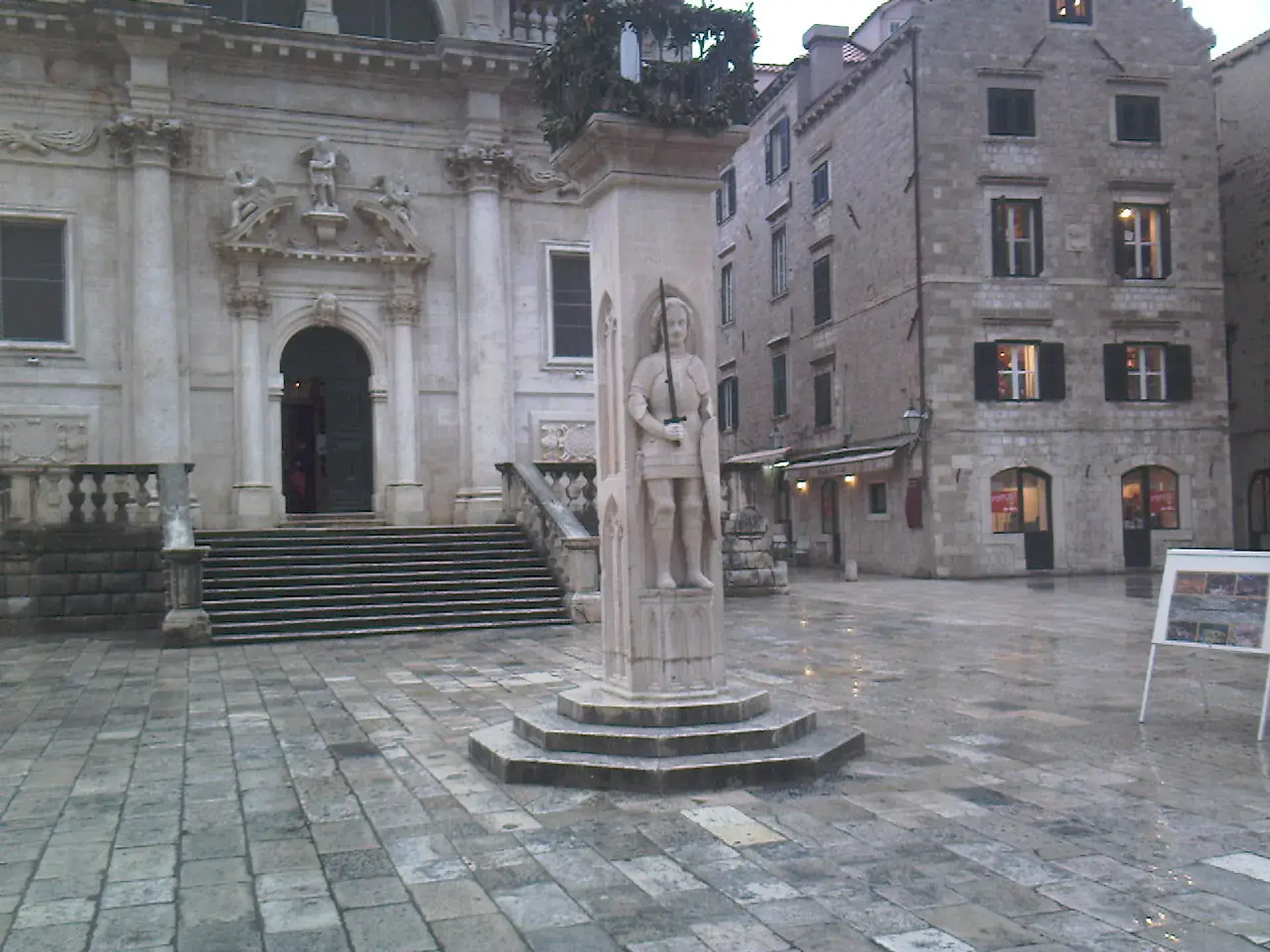
Erected in 1418, Orlando's Column is the oldest surviving public secular stone monument in Dubrovnik. The five-meter freestanding limestone pillar stands in Luža Square, an open, free public space situated at the eastern terminus of the Stradun. Positioned between Sponza Palace, the Church of Saint Blaise, and the City Bell Tower, the Late Gothic monument was carved by Italian sculptor Bonino da Milano alongside local master Antun Dubrovčanin. It depicts the medieval knight Orlando (Roland) clad in armor, holding a raised sword and shield.
Unlike monuments dedicated to local aristocrats or purely religious figures, the statue adopted the Central European medieval custom of Roland monuments. Erected in the wake of the 1358 Treaty of Zadar, the pillar symbolized civic autonomy, free-trade rights, and royal protection under the Hungarian-Croatian crown. Located at the convergence of Dubrovnik's administrative, religious, and economic life, the weathered limestone carving stands at eye level against the baroque facade of the Church of Saint Blaise.
The Ragusan Cubit and Commercial Integrity
Beyond its political symbolism, Orlando's Column functioned as an essential instrument of daily trade in the Republic of Ragusa. The knight's right forearm was designated as the official municipal standard of linear measurement, known as the Ragusan cubit, or lakat. Measuring precisely 51.25 centimeters, this length was also engraved directly into the stone base of the monument.
Merchants dealing in textiles and raw fabrics across Luža Square were required to measure their goods against this carved standard. By anchoring commercial transactions to a fixed public marker, the Republic sought to prevent commercial fraud and uphold an orderly marketplace at the intersection of the Stradun and the customs house at Sponza Palace.
Center of Justice and Municipal Decrees
Orlando's Column served multiple legal and punitive functions for the city government. Atop the pillar, an enclosed platform operated as a municipal rostrum. From this elevated post, official heralds proclaimed newly enacted state laws, court sentences, treaties, and public notices to the gathered populace.
Conversely, the base of the pillar served as the city's pillory. Documented by scholar Philippus de Diversis in 1440, convicted criminals were bound to the stone base to endure public ridicule, flogging, or corporal punishment. However, civic tradition also granted temporary reprieves; during the annual February festivities of Saint Blaise, debtors received legal safe conduct past the pillar, allowing them to enter Luža Square and negotiate obligations without the threat of detention at the pillory.
Legend, Ceremony, and Modern Preservation
Although the historical Orlando was an eighth-century Frankish march warden under Charlemagne who never visited the Adriatic, local folklore established a different narrative. A persistent legend claimed Orlando commanded a fleet in the ninth century to liberate Dubrovnik from a 15-month Saracen siege near Lokrum Island, providing a localized heroic context for the Germanic civic statue.
Today, the column remains central to Dubrovnik's civic ceremonies. It functions as the city's primary ceremonial flagpole, where the "Libertas" banner is hoisted to inaugurate the Dubrovnik Summer Festival, and the flag of Saint Blaise is raised during the winter patronal feast. Following extensive structural assessments and interventions by the Croatian Conservation Institute to repair vertical stone fissures, the pillar remains in Luža Square behind a low protective barrier, standing beneath the hourly metallic chime of the bronze jacks striking the City Bell Tower above.
FAQ
What is the Ragusan cubit associated with Orlando's Column?
The Ragusan cubit, or lakat, was the Republic of Ragusa's official commercial measurement for textiles. Measuring exactly 51.25 centimeters, it corresponded to the length of Orlando's right forearm, and an identical reference line was carved into the pillar's stone base to prevent trade fraud.
When was Orlando's Column built and by whom?
The column was commissioned and erected in 1418. It was crafted in the Late Gothic style by Italian sculptor Bonino da Milano and local master Antun Dubrovčanin.
How was the column used for legal matters in Dubrovnik?
The elevated platform atop the column served as a rostrum where heralds announced state laws, treaties, and verdicts. The base functioned as a pillory where convicted offenders were bound for public ridicule and corporal punishment.
What ceremonial role does the column maintain today?
Orlando's Column serves as the city's ceremonial flagpole, hoisting the Libertas banner for the opening of the Dubrovnik Summer Festival and the flag of Saint Blaise during the patron saint's feast day in February.