Castle Tower: Karlovy Vary's Oldest Landmark
Origins and the Royal Hunt of Charles IV
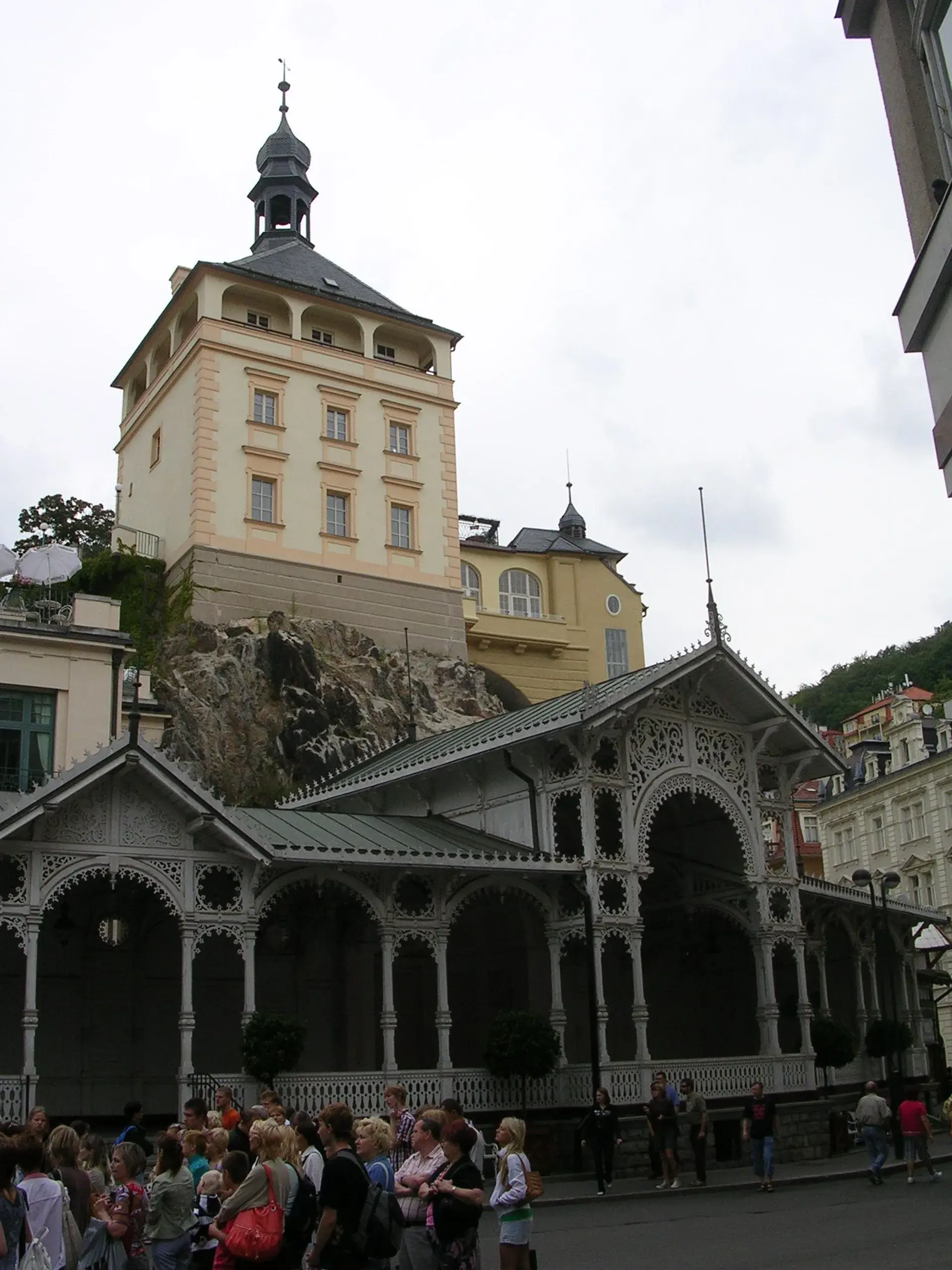
Perched atop a granite promontory at Zámecký vrch 2, the Castle Tower (Zámecká věž) overlooks Tržiště (Market Square) and the Market Colonnade. Built around 1358 under the orders of Holy Roman Emperor and Czech King Charles IV, the tower originally formed part of a small Gothic castle and royal hunting seat. Standing today as Karlovy Vary's oldest preserved architectural structure, it has held cultural monument status since 1964.
Local tradition links the founding of the town directly to this vantage point. First recorded in print in 1571 by the physician Fabian Summer, legend states that Charles IV discovered the thermal waters while hunting deer. When a pursuing hound tumbled into a boiling spring, its cries led the emperor to the scalding water. After bathing his ailing leg and experiencing relief, Charles IV ordered the construction of a settlement and hunting seat around the springs. The emperor subsequently stayed at the castle repeatedly between 1370 and 1376, using it as an administrative seat to grant Karlovy Vary its royal town privileges in 1370.
From Medieval Stronghold to Municipal Watchtower
During the 15th and 16th centuries, the Bohemian Crown frequently pledged the property to local noble families, most notably the Schlicks. Over time, the fortress fell into neglect. In 1567, Emperor Maximilian II officially transferred the decaying site to the municipality; records from the era describe it as little more than ruins used to store local firefighting equipment.
A catastrophic town fire in 1604 destroyed the surrounding settlement and leveled the remaining castle fortifications. In 1608, the town repurposed the surviving medieval tower into a municipal watchtower (hláska). Following another urban fire in the 18th century, the structure underwent significant remodeling in 1766, which introduced an arcaded observation gallery and a Baroque roof.
From 1766 well into the 19th century, watchmen stationed on the upper gallery held a ceremonial and practical role. They blew fanfare horns across the valley to formally inaugurate the annual spa season and to herald the arrival of monarchs, aristocrats, and notable spa patrons entering the resort.
Modern Engineering and Present-Day Heritage
While Karlovy Vary is celebrated primarily for its 19th-century Belle Époque, neo-Renaissance, and Art Nouveau colonnades, the Castle Tower remains virtually the only above-ground medieval masonry surviving from the town's founding era. In 1911, Viennese architect Friedrich Ohmann, who also designed the nearby Castle Colonnade, engineered a public elevator shaft directly into the granite cliff face beneath the tower, facilitating pedestrian access between the river valley and the upper residential quarter.
Following a comprehensive interior restoration, the tower reopened in 2022 as a visitor center and cultural venue. It now hosts the Great Spa Towns of Europe exhibition, exploring the 11 transnational spa towns inscribed on the UNESCO World Heritage List in 2021. Today, the complex includes an interactive historical installation, access to underground spaces, and the Castle Tower Café. From its high open gallery, situated directly above the narrowest constriction of the Teplá valley, visitors can look over the spa core while rising drafts of steam from the thermal springs below ascend the cliff face.
FAQ
What is the oldest surviving building in Karlovy Vary?
The Castle Tower (Zámecká věž) is Karlovy Vary's oldest standing architectural structure, built around 1358 on the orders of Holy Roman Emperor Charles IV.
What exhibition is housed inside the Castle Tower?
Since reopening in 2022, the tower houses the 'Great Spa Towns of Europe' exhibition, which highlights the 11 transnational spa towns inscribed on the UNESCO World Heritage List in 2021.
What role did the tower watchmen play in the 18th and 19th centuries?
Stationed on the arcaded gallery added in 1766, watchmen blew fanfare horns to officially mark the opening of the spa season and to announce the arrival of prominent nobles, monarchs, and wealthy visitors.