Hot Spring Colonnade: Karlovy Vary's Vřídlo Geyser
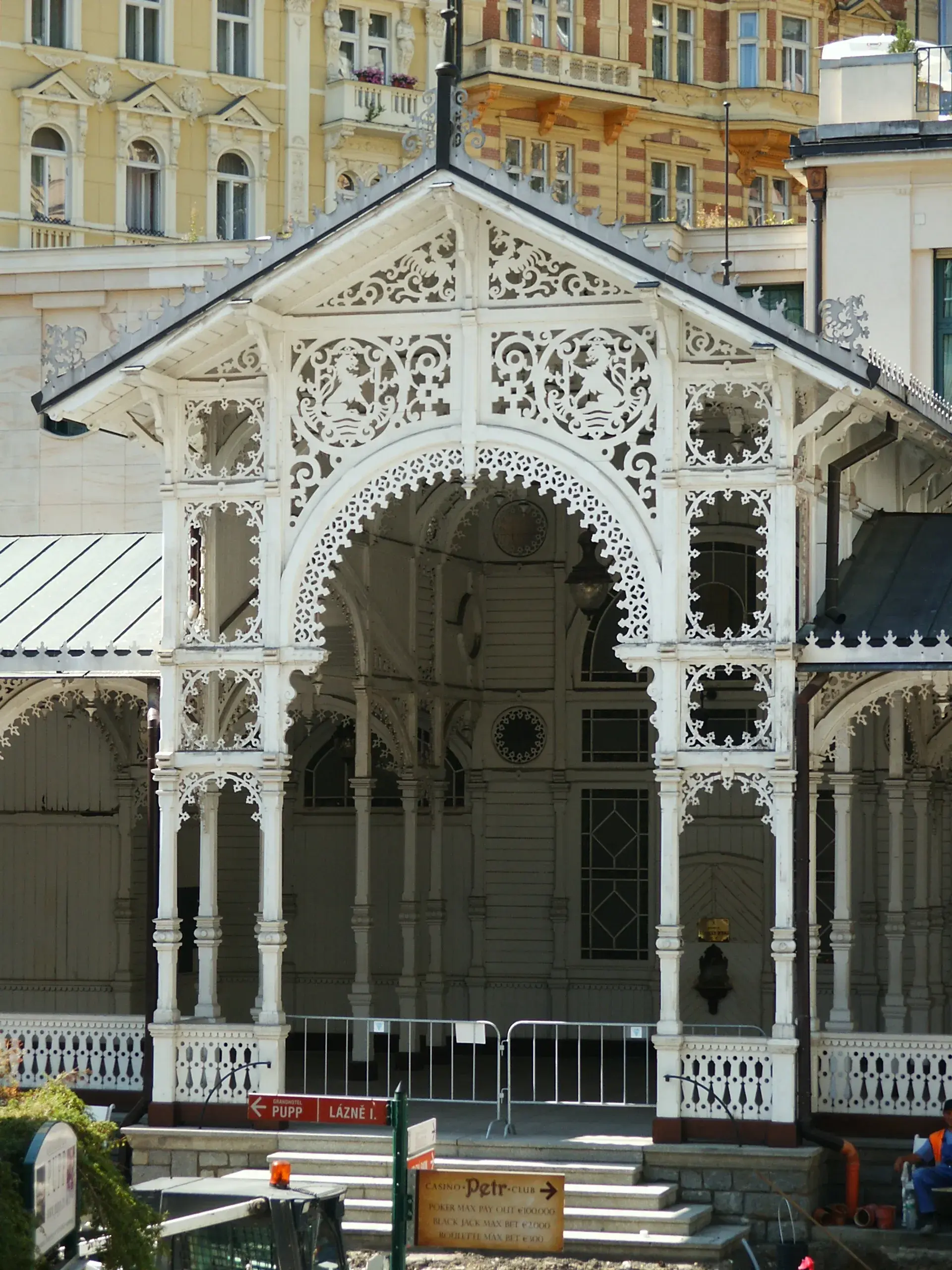
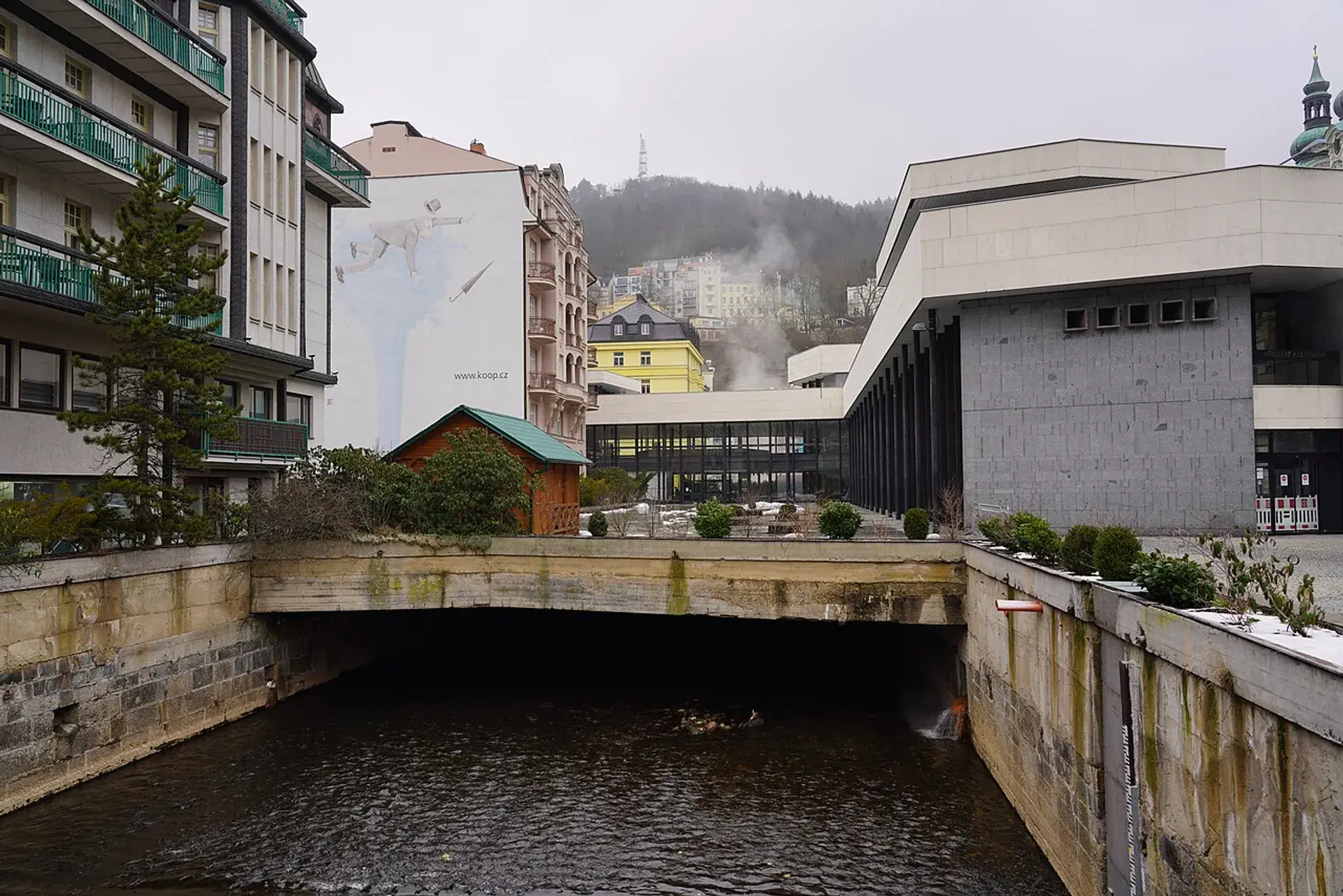
Located on Divadelní náměstí along the banks of the Teplá River, the Hot Spring Colonnade encloses Vřídlo (Spring No. 1), the hottest and most voluminous natural spring in the Czech Republic. Serving as the central axis of Karlovy Vary's historic spa district, the colonnade connects upstream landmarks such as Grandhotel Pupp with downstream promenades, forming the hydrological foundation of the city's inclusion in the UNESCO Great Spa Towns of Europe.
The Power of the Vřídlo Geyser
At the core of the colonnade is the Vřídlo geyser, a natural thermal phenomenon fed by deep subterranean reservoirs. Hydrogeological testing shows that the water began as rainwater infiltrating bedrock fractures approximately 35,000 years ago during the Pleistocene epoch. Driven upward by natural carbon dioxide pressure from depths between 2,000 and 2,500 meters, the water erupts at temperatures reaching 72°C to 73.4°C.
The geyser produces roughly 2,000 liters of mineral water every minute, reaching heights of up to 12 meters beneath an octagonal glass prism lantern. This massive discharge brings between 18 and 20 metric tons of dissolved mineral salts to the surface each day. The hall itself is filled with intense radiant heat, dense humidity, and a heavy mineral aroma, all backdropped by the continuous roar of the ascending thermal column.
Architectural Evolution and Modern Design
Thermal activity at this site has been sheltered by a succession of structures since the city was chartered around 1370 under Holy Roman Emperor Charles IV. After centuries of primitive timber shelters, a late-Baroque hall, and an 1826 Empire-style building designed by Josef Esch, Viennese architects Ferdinand Fellner and Hermann Helmer constructed a cast-iron pseudo-Renaissance colonnade in 1878–1879. However, the aggressive mineral vapors corroded the ironwork, leading to its dismantling in 1939 under Nazi administration, when the metal was repurposed for wartime production.
Following decades under a temporary wooden shelter, the current functionalist colonnade was built between 1969 and 1975 according to designs by Czech architect Jaroslav Otruba. Constructed from reinforced concrete and expansive glass panels, the building remains a distinct modernist presence among the town's Historicist architecture. Severe vapor damage forced the interior geyser hall to close in 2016, during which time the geyser was temporarily diverted into an outdoor forecourt basin. Following comprehensive technical repairs, indoor geyser operations officially resumed in May 2022. While a civic petition sought to demolish the structure in favor of a replica of the 1879 cast-iron colonnade, the municipal referendum ultimately failed due to low voter turnout.
Balneological Distribution and Underground Tours
Beyond serving as a sightseeing pavilion, the colonnade functions as Karlovy Vary's primary balneological distribution station. The facility regulates and pumps thermal mineral water directly to sanatoria and medical spas across the valley for therapeutic bathing treatments. Inside the public hall, dispensers allow visitors to sample the water, which carries a salty, alkaline, and metallic taste from its high concentrations of sodium, bicarbonate, and sulfate.
Visitors can also join guided tours of the facility's technical underground, known as Podzemí Vřídla. These subterranean routes expose historical piping chambers, water-regulation infrastructure, and massive sinter deposits formed by mineral accumulation.
The Petrification of 'Stone Roses'
Because the thermal water contains approximately 6.5 grams of dissolved minerals per liter, it precipitates aragonite (often referred to as "Carlsbad stone") onto any surface it contacts. Underground plumbing requires constant descaling and regular replacement to keep channels clear.
The municipal spring administration harnesses this rapid crystallization to craft the spa town's signature "stone roses" (kamenné růže). Handcrafted paper roses are suspended in spraying mineral runoff beneath the colonnade for one to two weeks. As aragonite and iron oxides coat the paper, the delicate petals transform into heavy, reddish-brown stone keepsakes sold in the colonnade's retail shops alongside traditional ribbed porcelain spa cups.
FAQ
How hot is the water inside the Hot Spring Colonnade?
The Vřídlo spring emerges at scalding temperatures ranging between 72°C and 73.4°C, making it the hottest natural spring in the Czech Republic.
How old is the water feeding the geyser?
Hydrogeological tests indicate that the water erupting from the spring fell as rainwater and seeped underground roughly 35,000 years ago during the Pleistocene epoch.
What are the stone roses made at the colonnade?
Stone roses are traditional souvenirs created by hanging paper flowers in mineral-rich spring runoff beneath the colonnade for one to two weeks until they are encrusted in aragonite and iron oxides.
Why was the previous 19th-century colonnade taken down?
The 1879 cast-iron colonnade designed by Fellner and Helmer suffered extreme corrosion from hot mineral steam and was dismantled in 1939 to salvage scrap metal for war production.
Discover Karlovy-vary-1 like never before
Dive into Karlovy-vary-1 hidden stories and secret spots with Ciceru interactive tours.
Explore tour
Audioguide
Quizzes
Maps
Solo
Couples
Groups & families

© Ray Swi-hymn from Sijhih-Taipei, Taiwan | CC BY-SA 2.0