Market Colonnade: Karlovy Vary's Wooden Landmark
Architecture and "Wooden Lace" Design
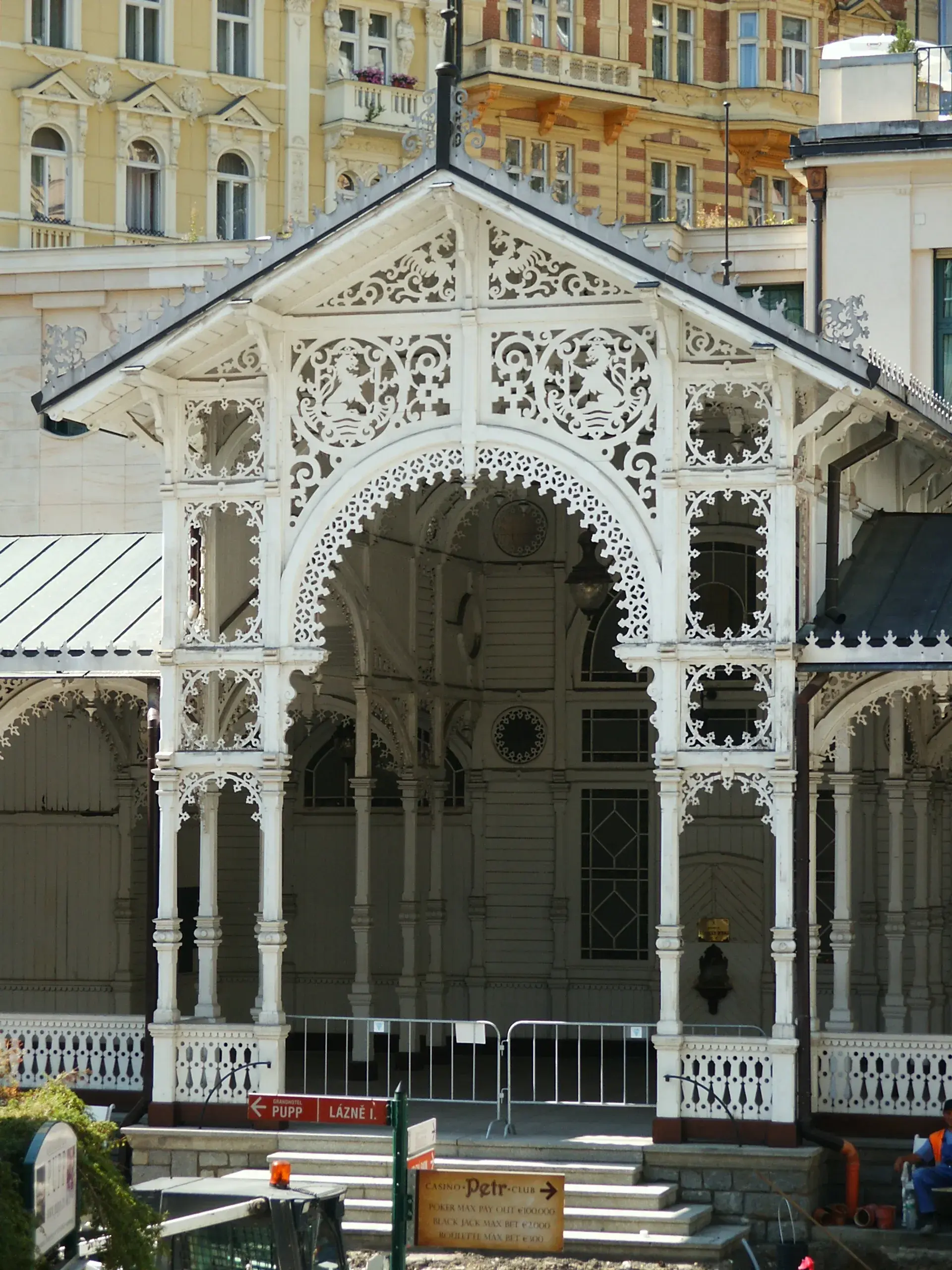
The Market Colonnade (Tržní kolonáda) is situated on Market Square (Tržiště) along the banks of the Teplá River, directly beneath the historic Castle Tower in Karlovy Vary. Designed in 1882–1883 by the renowned Viennese architectural duo Ferdinand Fellner and Hermann Helmer, the pavilion was erected by Viennese master carpenter Franz Oesterreicher.
Constructed from white-painted timber in the Swiss chalet style, the structure features open arcade galleries covered by a gabled metal roof. The colonnade is celebrated for its elaborate, pierced ornamentation—often described locally as "wooden lace" (dřevěná krajka). Sunlight filtering through this intricate woodwork projects shifting geometric shadow patterns across the promenade floor, contrasting with the warm mineral steam rising continuously from the thermal basins.
From Temporary Shelter to Lasting Monument
Built on the former site of Karlovy Vary’s Town Hall following its demolition in the 1870s, the colonnade was not originally planned as a permanent fixture. In 1883, the municipality erected the wooden arcade as an inexpensive, provisional roof intended to shelter spa guests for just a few years until a permanent stone colonnade could be constructed.
However, the airy design proved exceptionally popular with visitors and town officials, prompting the city to preserve it indefinitely and expand it slightly in 1904–1905. Over the subsequent century, continuous exposure to moisture, outdoor weather, and rising mineral steam caused irreparable timber rot. Between 1991 and 1993, the city dismantled the decaying original and constructed an exact wooden replica at a cost exceeding 22 million CZK, ensuring the preservation of the beloved "provisional" shed.
Sheltered Springs and the Charles IV Legend
The colonnade shelters three distinct mineral springs:
- Charles IV Spring (Pramen Karla IV.): Emerging at approximately 64 °C, this spring was historically known as Žrout ("The Devourer"). Mounted above its fountain basin is a bronze relief plaque created in 1939 by sculptor Adolf Zörkel. The relief illustrates the town's founding legend, where Emperor Charles IV discovers the valley's thermal waters after his hunting dog falls into a spring while pursuing a stag.
- Market Spring (Tržní pramen): Discharging mineral water at roughly 62 °C, this spring is sheltered within an apsidal niche.
- Lower Castle Spring (Dolní zámecký pramen): Supplying thermal water at temperatures ranging between 55 °C and 64 °C.
Spa Traditions and Civic Role
The Market Colonnade continues to operate as an active public drinking pavilion. Guests and patients take part in the traditional thermal cure by collecting hot spring water directly from the fountains using porcelain spa cups. In addition to daily drinking cures, the apsidal niche encircling the Market Spring provides natural acoustic amplification, serving as a venue for seasonal promenade performances, chamber concerts, and cultural gatherings.
As an architectural link, the colonnade occupies a prominent place on the town's pedestrian axis, connecting the modernist Hot Spring Colonnade (Vřídelní) with the stone Mill Colonnade (Mlýnská). It remains one of the notable surviving examples of Fellner and Helmer's prolific influence during the late-19th-century Habsburg spa construction boom.
FAQ
Which mineral springs are inside the Market Colonnade?
The Market Colonnade shelters three springs: Charles IV Spring (approximately 64 °C), Market Spring (approximately 62 °C), and Lower Castle Spring (approximately 55–64 °C).
Is the current structure the original 19th-century building?
No. Severe timber rot caused by weather and mineral steam led the city to dismantle the original 1883 structure and build an exact wooden replica between 1991 and 1993.
Who designed the Market Colonnade?
It was designed in 1882–1883 by the Viennese architects Ferdinand Fellner and Hermann Helmer, and constructed by master carpenter Franz Oesterreicher.
What does the bronze relief inside depict?
Sculpted by Adolf Zörkel in 1939, the bronze relief above the Charles IV Spring depicts the legend of Emperor Charles IV discovering the thermal waters after a hound fell into a hot spring while chasing a stag.