Kaiserbad Spa: Karlovy Vary's Imperial Baths
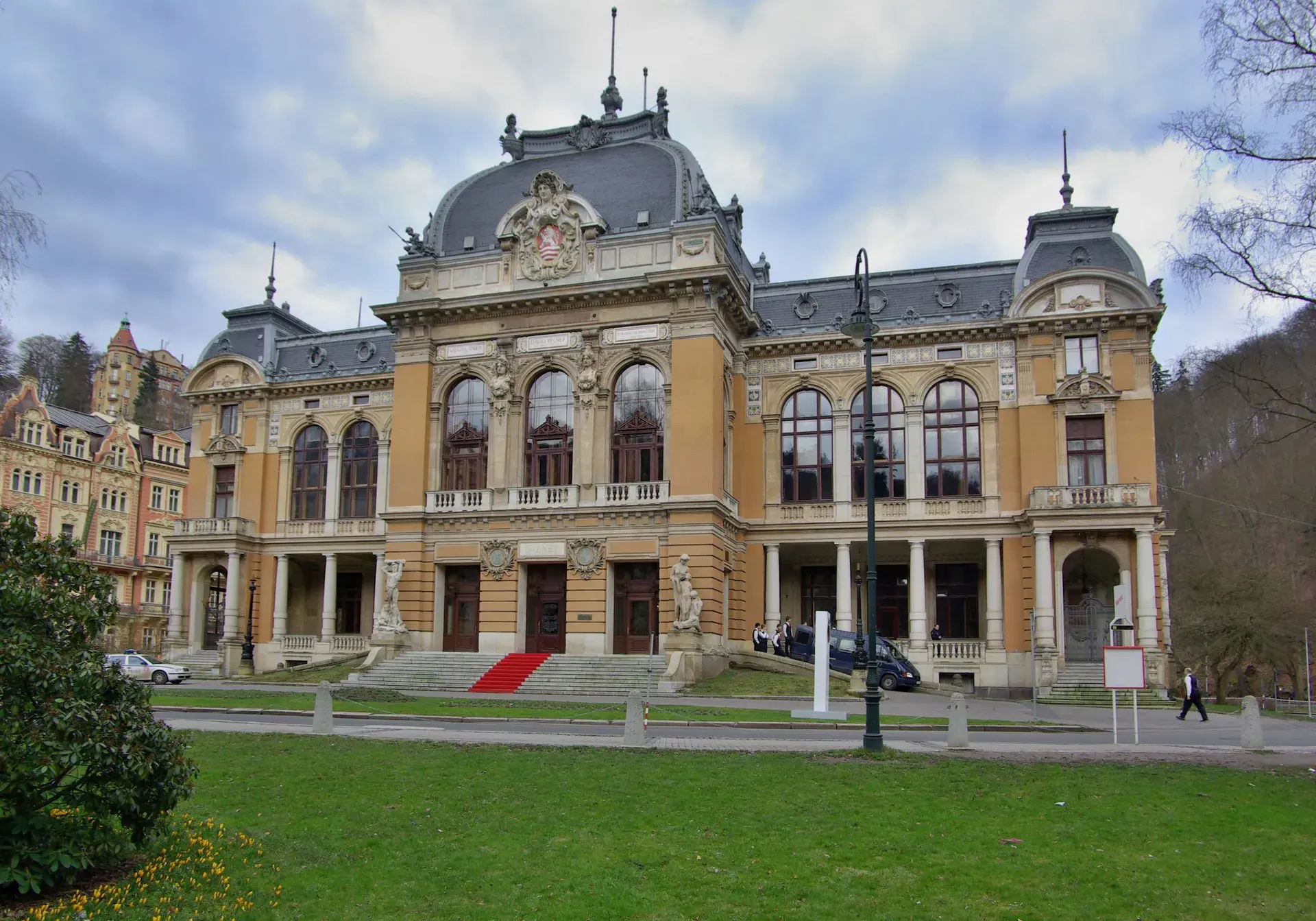
Located at Mariánskolázeňská 2 along the Teplá River, the Imperial Baths (historically known as Kaiserbad and later Lázně I) stands at the southern edge of Karlovy Vary's historic promenade. Positioned across from Sady Karla IV and adjacent to Grandhotel Pupp, the site marks the geographic threshold where the town's riverbank architecture gives way to forested valley walking paths. Designed by the renowned Viennese theater architects Ferdinand Fellner and Hermann Helmer, the building was constructed between 1893 and 1895 on the grounds of a former municipal brewery, opening on May 5, 1895. Today, it is recognized as a Czech National Cultural Monument and forms an integral part of Karlovy Vary's UNESCO World Heritage designation under The Great Spa Towns of Europe.
Belle Époque Architecture and Industrial Engineering
Initiated in 1891 by balneologist Dr. Karel Becher, the U-shaped complex was created as the most technologically advanced balneotherapy center in the Austro-Hungarian Empire. The exterior combines French Neo-Renaissance architecture with Neo-Baroque elements and early Art Nouveau details, featuring grand symmetrical staircases, carriage portals, stone sculptures, and the municipal coat of arms. Inside, luxurious spaces appointed with marble paneling, gilded stucco, and painted ceilings welcomed up to 2,000 visitors per day across 100 to 120 treatment chambers offering mineral, carbonic, steam, hot-air, electrotherapy, and peat treatments.
Behind this lavish display lay an automated industrial system engineered to keep heavy physical labor hidden from guests. Peat was prepared in a separate external pavilion and transported through subterranean corridors on internal tracks. From there, hydraulic elevators lifted wooden tubs through discrete hatches in the floorboards directly into private treatment rooms, concealing the mechanical operation entirely from visitors.
The Mechanized Gym and the Imperial Suite
The technological focus of Kaiserbad extended to physical therapy. On the first floor, the Zander Hall was outfitted with 64 mechanized exercise machines designed by Swedish physician Gustav Zander. The machines were powered by a central transmission driveshaft concealed beneath the wooden floorboards, providing automated resistance training for therapy patients.
For high-profile visitors, the building housed the Fürstenbad (Princely Bath), later known as the Imperial Bathroom. This opulent private suite featured dedicated salons, resting chambers, and an inlaid sunken bathtub intended for Emperor Franz Joseph I. However, imperial records show that while the emperor toured and inspected the baths during his visit to Karlsbad in August 1904, he stayed at the adjacent Grandhotel Pupp and never actually used the royal bath suite.
Evolution and Shifting Uses
Following the collapse of the empire and the foundation of Czechoslovakia in 1918, the complex was renamed Lázně I. To allow for year-round operation, the central open courtyard was enclosed under a roof between 1948 and 1953. Balneological treatments continued for decades but finally ceased in the late 1980s. During the early 1990s, the Zander Hall briefly operated as a private casino before the entire complex fell into disrepair and closed in 1994.
During its period of vacancy, Kaiserbad attracted international filmmakers. The exterior facade and main entrance doubled as the casino entrance in the 2006 James Bond film Casino Royale, while the building's revolving doors were also featured in the 2003 action-comedy Shanghai Knights.
Modern Restoration and Cultural Revival
Between December 2019 and June 2023, regional authorities funded a comprehensive public restoration costing between 1.4 and 1.5 billion CZK. Reopening to the public in June 2023, the facility now functions as a visitor center, museum of balneology, café, and research library.
A central feature of the restoration is a geometric, red multifunctional auditorium inserted into the enclosed courtyard. Designed by Petr Hájek Architekti, this reversible structure rests on six steel legs without touching the historic perimeter walls. The auditorium functions as a flexible concert venue and the permanent home of the Karlovy Vary Symphony Orchestra. Its ceiling is equipped with motorized, rotating triangular modules that adjust acoustically to absorb, disperse, or reflect sound depending on the requirements of each performance.
FAQ
Did Emperor Franz Joseph I ever use the Imperial Bathroom?
Although an opulent private suite with an inlaid sunken bath was designed specifically for Emperor Franz Joseph I, historical records indicate that he only toured and inspected the Imperial Baths during his August 1904 visit and never actually bathed there.
What movies were filmed at Kaiserbad?
The exterior and main entryway of Kaiserbad served as the Montenegro casino in the 2006 James Bond film Casino Royale. The building's revolving doors were also featured in the 2003 film Shanghai Knights.
What is the purpose of the red steel structure inside the courtyard?
Designed by Petr Hájek Architekti, the red freestanding structure is a modern multifunctional concert hall supported on six steel legs. It does not contact the historic walls and serves as the primary venue and home for the Karlovy Vary Symphony Orchestra.