Mill Colonnade in Karlovy Vary: Guide & History
Monumental Neo-Renaissance Architecture
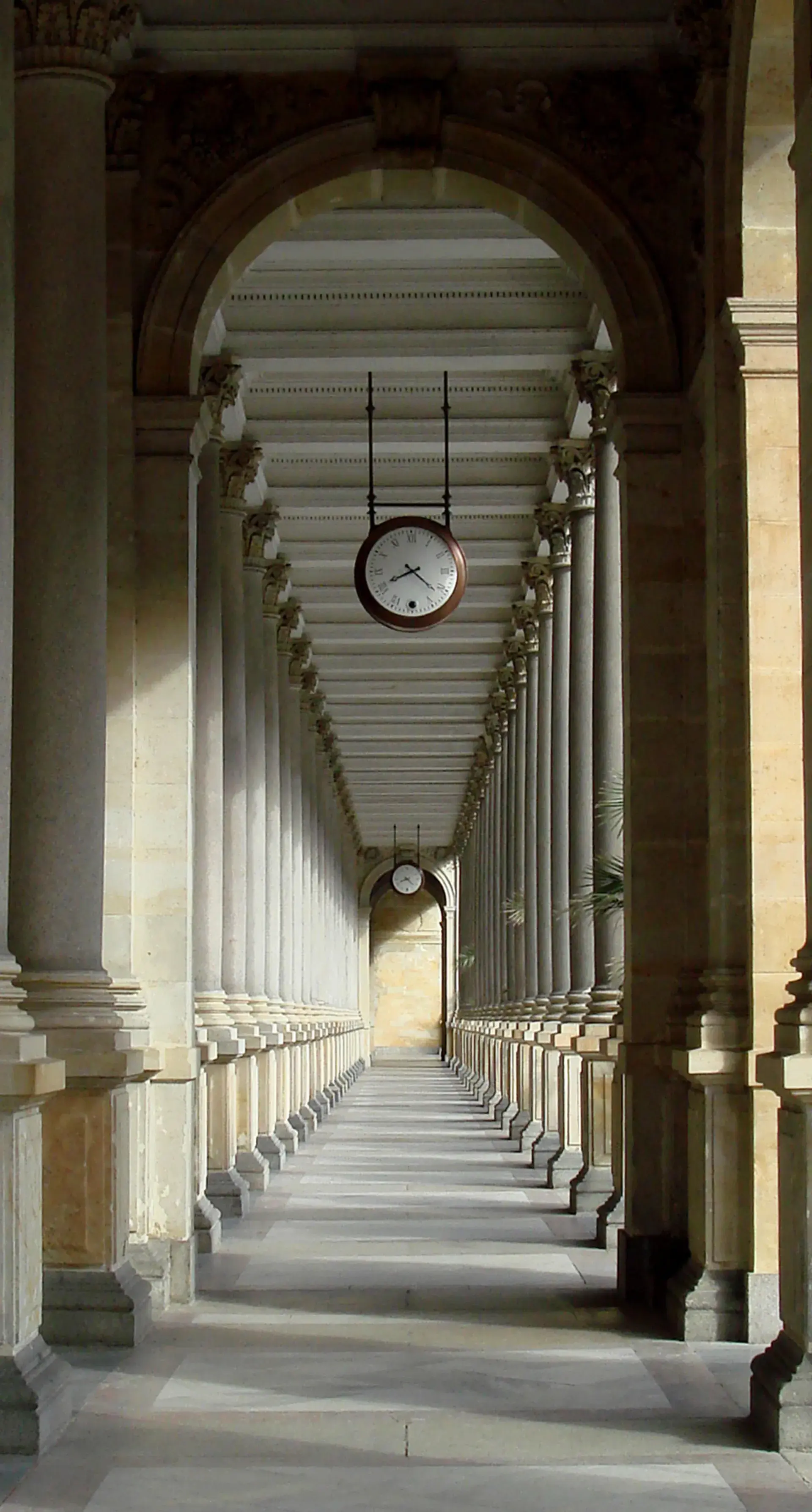
The Mill Colonnade (Mlýnská kolonáda) is the largest colonnade in the Czech spa town of Karlovy Vary. Measuring 132 meters in length and 13 meters in width, the structure was designed in the Neo-Renaissance style by Czech architect Josef Zítek, renowned for his work on Prague's National Theatre and Rudolfinum.
Built between 1871 and 1881, the open three-aisled hall is supported by 124 Corinthian columns. Along the roof balustrade stand 12 sandstone allegorical statues representing the months of the year, crafted by sculptors Alfred Schreiber and Karl Wilfert. The pediments are adorned with reliefs created by Bohuslav Schnirch. Within the interior, hollow acoustic reverberations of footsteps on stone flagstones blend with the sound of thermal water trickling into distribution vases and the faint, warm mineral vapor rising from the fountains.
From Wooden Sheds to the "Bed of Carrots"
Prior to the construction of the stone colonnade, the site on the Teplá River accommodated wooden bathing sheds and an old watermill. In 1811, Václav Skalník replaced these structures with the wooden Empire-style New Spring Colonnade. By the late 1860s, the municipal council commissioned Zítek to develop a grand stone replacement.
Zítek originally proposed an ambitious two-storey complex. However, municipal budget constraints forced the city to scale the design back to a single level covered by a flat promenade terrace. The project took a decade to complete and faced severe budget overruns. When the colonnade debuted for the 1881 spa season, it faced sharp local criticism. Critics and residents derided the dense grid of columns as an oversized "bowling alley" or a "bed of carrots" that crowded the river valley, lamenting the loss of the river walk's former intimacy.
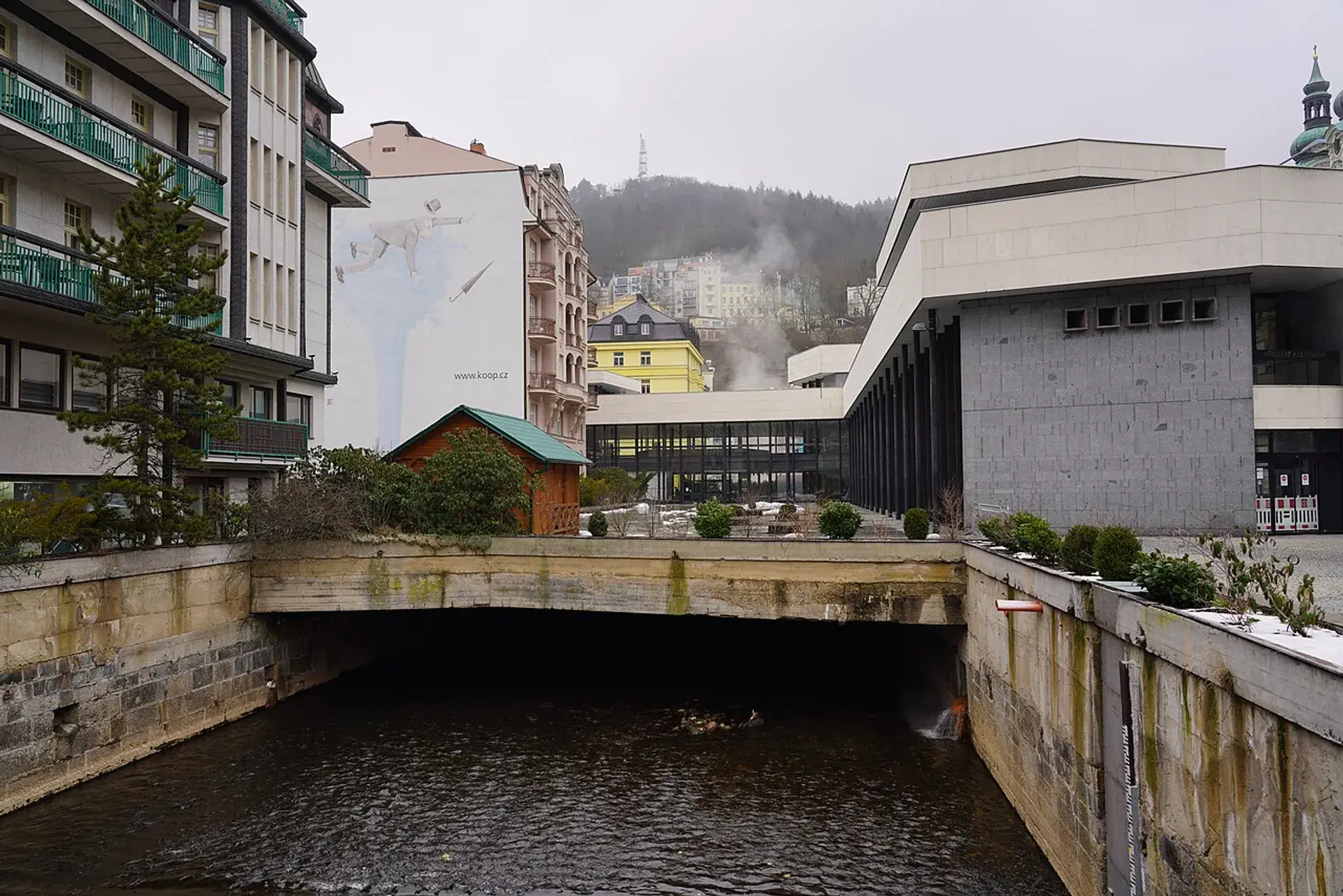
Over the subsequent decades, the structure underwent further adjustments. Between 1891 and 1892, workers excavated rock from the adjacent hillside to construct a northern pavilion enclosing the Rock Spring. Later, in 1949, the riverbed fronting the hall was vaulted over to create an expansive civic esplanade.
Thermal Mineral Springs and Spa Traditions
The Mill Colonnade houses distribution taps for five designated thermal mineral springs, cataloged as numbers 6 through 10 in the city’s spa system:
- Mill Spring (Mlýnský pramen): Discharges at approximately 56°C.
- Rusalka Spring (Rusalčin pramen): Discharges at approximately 60°C.
- Prince Wenceslas Spring (Pramen knížete Václava I and II): Discharges at approximately 65°C.
- Libuše Spring: Discharges at approximately 62°C.
- Rock Spring (Skalní pramen): Discharges at approximately 53°C.
The extensive scale of the colonnade reflects 19th-century medical doctrines. Spa physicians instructed patients to sip the mineral waters slowly from porcelain cups while pacing measured distances to aid digestion and mineral absorption. Positioned along the pedestrian corridor of the Teplá River, the colonnade serves as a central spine linking the lower Park Colonnade with the upper Market and Hot Spring Colonnades.
Curiosities and Current Use
The colonnade remains open 24 hours a day with free public admission. A raised orchestra shell within the hall regularly hosts open-air promenade concerts by the Karlovy Vary Symphony Orchestra during the spring and summer spa season. The flat stone roof functions as an open viewing terrace overlooking the river valley, while the vaulted esplanade outside hosts public gatherings, including seasonal sand-sculpture exhibitions.
Several historical details reward close observation. The 12 allegorical statues on the parapet face outward toward the town and river, meaning visitors walking across the roof terrace view the backs of the sculptures. Near the Mill Spring niche, an 1828 marble plaque preserves the Latin text of the Ode to the Hot Spring, authored by Renaissance humanist Bohuslav Hasištejnský of Lobkovic. During Czechoslovakia's post-war socialist era, the monument was temporarily renamed the Colonnade of Czechoslovak-Soviet Friendship before later reclaiming its historic designation.
FAQ
Which thermal springs can be found inside the Mill Colonnade?
The colonnade houses five designated mineral springs: the Mill Spring (~56°C), Rusalka Spring (~60°C), Prince Wenceslas Spring (~65°C), Libuše Spring (~62°C), and Rock Spring (~53°C).
Why was the Mill Colonnade initially unpopular?
At its opening in 1881, locals and critics mocked Josef Zítek's design as an oversized 'bowling alley' or a 'bed of carrots,' arguing that its dense row of columns ruined the river valley's intimate setting.
What are the opening hours and admission fees for the Mill Colonnade?
The Mill Colonnade is open to the public 24 hours a day, year-round, with free admission.
What decorative features are on the roof of the colonnade?
The roof balustrade features 12 sandstone allegorical statues representing the months of the year, sculpted by Alfred Schreiber and Karl Wilfert, facing outward toward the town.