Helsinki Cathedral: Senate Square's Neoclassical Icon
Neoclassical Vision on Senate Square
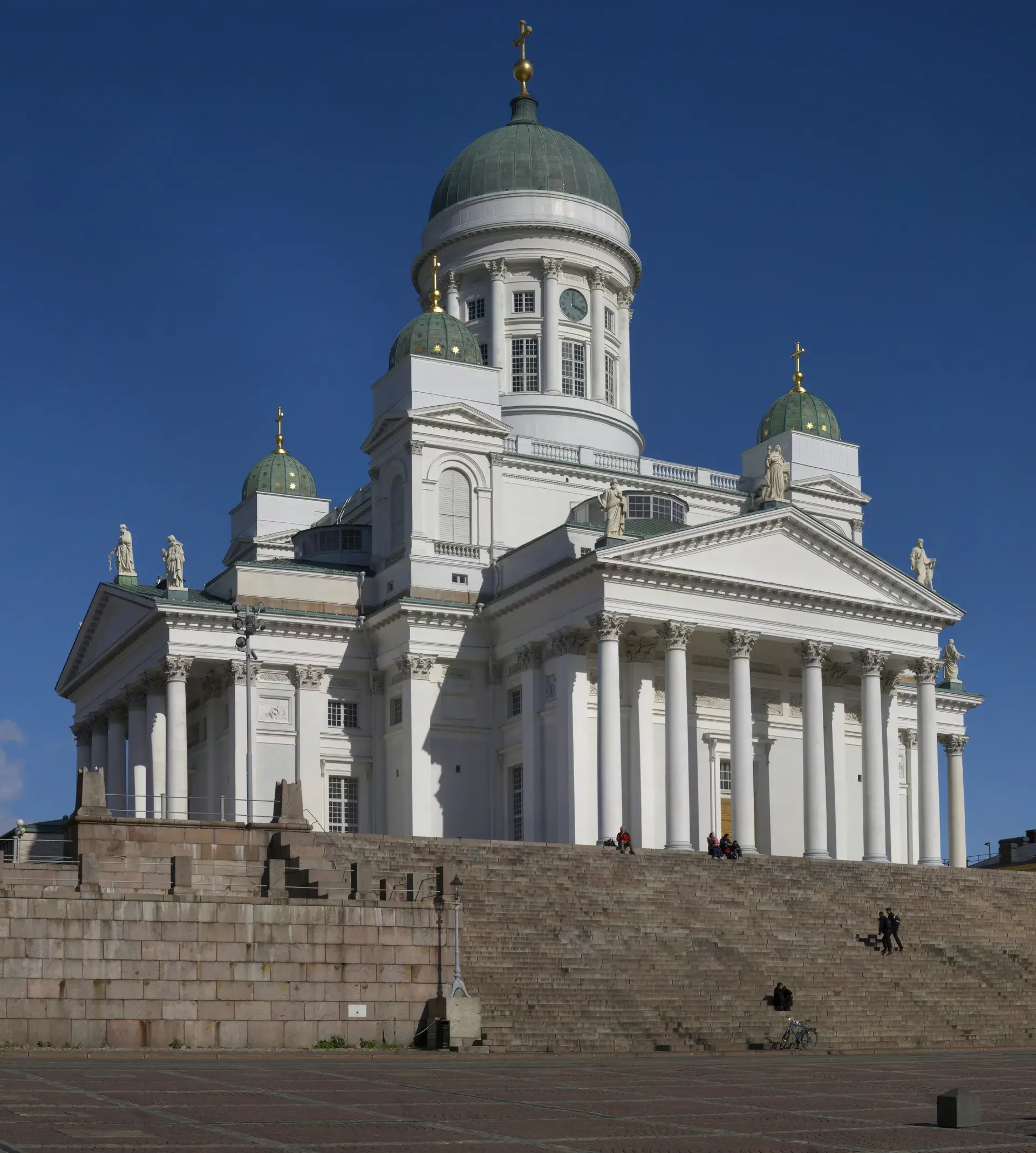
Helsinki Cathedral (Helsingin tuomiokirkko / Helsingfors domkyrka) rises from the northern edge of Senate Square in the central Kruununhaka district. The cathedral serves as the seat of the Evangelical Lutheran Diocese of Helsinki and represents the focal point of the city's 19th-century administrative center. After Helsinki was declared the capital of the Grand Duchy of Finland under the Russian Empire in 1812, town planner Johan Albrecht Ehrenström and German-born architect Carl Ludvig Engel laid out Senate Square to reflect an imperial civic triad: the cathedral represented the church, the Government Palace to the east represented state authority, and the main building of the University of Helsinki to the west stood for academic science.
To make way for this new Empire-style center, the wooden Ulrika Eleonora Church, which had been consecrated on the square in 1727, was dismantled. However, its memory was preserved within the new structure; its original 18th-century church bell was salvaged and installed in the cathedral's central tower.
Imperial Interventions and Architectural Revisions
Engel completed initial drawings for the neoclassical cathedral around 1818, and construction began in 1830. When Engel died in 1840, architect Ernst Bernhard Lohrmann took charge of completing the project, introducing notable modifications. Drawing inspiration from Saint Isaac's Cathedral in Saint Petersburg, Lohrmann added two side pavilions and four smaller cupolas to flank the towering central dome, providing both structural reinforcement and visual balance.
Tsar Nicholas I also intervened directly in the cathedral's exterior design. Engel had envisioned a lower colonnade and a main guard post directly beneath the church facing the plaza. The Tsar overruled this concept, decreeing instead that the guardhouse be replaced with a monumental, 60-metre-wide cascade of granite stairs. This broad staircase elevates the cathedral high above the cobblestones and street traffic below, establishing the building's imposing presence and creating an enduring civic gathering point.
Neoclassical Form and the Zinc Apostles
Completed and consecrated in 1852, the cathedral rests on an equal-armed Greek-cross ground plan framed by Corinthian pediments. Its exterior is finished in stark white and pale grey, topped with five green patinated copper domes. The central dome extends more than 80 metres above sea level, making it a prominent landmark visible from the city's street grid and from ships navigating the South Harbour.
Adorning the pediment rooflines are three-metre-tall zinc statues depicting the Twelve Apostles. Cast in Berlin by sculptors Hermann Schievelbein and August Wredow, the figures form one of the largest uniform collections of zinc sculptures anywhere in the world. Directly above the entrance pediment on the exterior frieze, the Hebrew tetragrammaton for God (יהוה / Jahve) is carved into the stone.
Lutheran Austerity Within
In contrast to the gilded interiors typical of imperial Orthodox and Catholic churches of the era, the interior of Helsinki Cathedral embraces Lutheran simplicity. The high-ceilinged cross plan is defined by whitewashed walls, large windows providing expansive natural daylight, simple wooden pews, and polished brass chandeliers arranged to emphasize clarity of sound from the pulpit.
The cathedral's focal point is an altarpiece illustrating the entombment of Christ, painted by Baltic-German court artist Carl Timoleon von Neff and presented as a personal gift by Tsar Nicholas I. Standing in the interior corners are monumental statues commemorating key figures of the Protestant Reformation: Martin Luther and Philipp Melanchthon—both based on Ernst Rietschel’s monument in Worms—alongside Mikael Agricola, the leader of the Finnish Reformation and pioneer of the written Finnish language.
Historical Evolution and Modern Role
Originally dedicated at its 1852 consecration as St. Nicholas Church in honor of Tsar Nicholas I, the building underwent significant symbolic shifts in the 20th century. Following Finland's independence in 1917, it was commonly referred to as Suurkirkko ("The Great Church"). It officially became Helsinki Cathedral in 1959 when the Diocese of Helsinki was formally established.
Today, the cathedral remains an active place of worship hosting regular Lutheran services, baptisms, and weddings, alongside state ceremonies, parliamentary opening services, and University of Helsinki academic festivities. The structure welcomes visitors year-round, operating with seasonal visitor ticketing during the summer and autumn months. Beneath the main hall, the cathedral crypt functions as a public venue for exhibitions, cultural events, and a seasonal café.
FAQ
Who designed Helsinki Cathedral?
German-born architect Carl Ludvig Engel designed the cathedral in the neoclassical Empire style. After Engel's death in 1840, Ernst Bernhard Lohrmann completed construction in 1852, adding four corner cupolas and two side pavilions.
Why were the cathedral's front stairs built?
Carl Ludvig Engel originally planned a lower colonnade and guardhouse facing Senate Square, but Tsar Nicholas I personally ordered that these be replaced by a 60-metre-wide granite staircase.
What sculptures can be seen on the exterior of Helsinki Cathedral?
The roofline features three-metre-tall zinc statues of the Twelve Apostles sculpted by Hermann Schievelbein and August Wredow, representing one of the world's largest uniform collections of zinc statues.
What names has Helsinki Cathedral held throughout its history?
Consecrated as St. Nicholas Church in 1852 in honor of Tsar Nicholas I, it was renamed Suurkirkko (The Great Church) after Finnish independence in 1917, and became Helsinki Cathedral in 1959.