Lantern Carriers: Helsinki's Iconic Stone Men
The Guardians of Helsinki Central Station
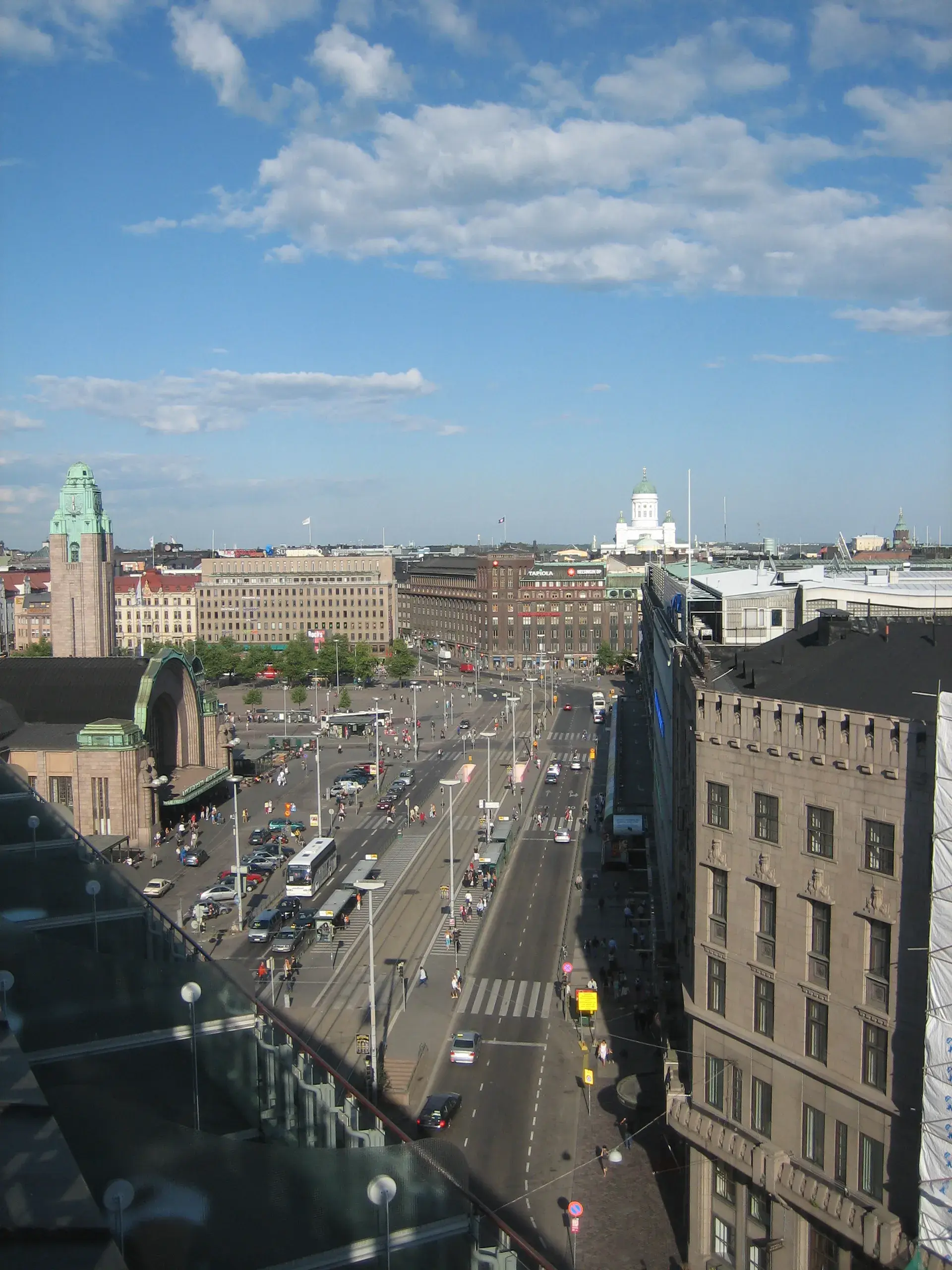
Standing watch over the main portal of Helsinki Central Station at Rautatientori (Railway Square), four colossal granite figures flank the terminal's massive barrel-vaulted archway. Known in Finnish as Lyhdynkantajat ("The Lantern Carriers") and affectionately called Kivimiehet ("The Stone Men"), these monumental sculptures are among the most recognizable public landmarks in Helsinki. Each figure holds a spherical lantern that illuminates at dusk, casting a soft glow across the station's pink-red granite facade and the commuter traffic below.
Emil Wikström and the Model Behind the Figures
The statues were sculpted by Emil Wikström and completed in 1914. Rather than inventing an idealized face, Wikström drew inspiration from everyday life, modeling the figures after Jalmari Lehtinen, a local gardener and crofter employed at Wikström’s Visavuori studio.
Carved from Finnish pink-red granite quarried by Ab Granit Oy in southern Finland, the muscular stone figures reflect a transition between late Art Nouveau (Jugendstil) and early rationalism. Their severe, upright posture and geometric styling complement the clean vertical lines of the terminal's entrance and adjacent 48.5-meter clock tower.
Architectural Context and Saarinen's Redesign
The Lantern Carriers are integrated into the grand facade designed by architect Eliel Saarinen. Saarinen initially won the station's design competition in 1904 with a National Romantic concept adorned with medieval turrets and carved bears. However, critics Sigurd Frosterus and Gustaf Strengell published a fierce 1904 polemic arguing that a modern transportation terminal demanded rational function, steam, and steel instead of historic romanticism.
Taking the critique seriously, Saarinen traveled across Germany and Great Britain to inspect contemporary railway architecture. By 1909, he completely redesigned the station, replacing historicist ornaments with streamlined granite planes. Construction began that same year, and the station officially opened on March 5, 1919, replacing an 1862 terminal by Carl Albert Edelfelt. Wikström’s stone carriers, installed during this transformative era, embody the transition away from romantic historicism toward architectural rationalism.
Cultural Icons and Modern Presence
Over the decades, the Lantern Carriers have transcended their role as structural decoration to become fixtures of Finnish popular culture. They frequently participate in civic moments; for instance, the figures were fitted with oversized protective face masks during the COVID-19 pandemic and painted in KISS rock band makeup to celebrate a Helsinki concert.
Today, the Lantern Carriers welcome between 200,000 and 240,000 daily passengers at Finland's busiest transport hub. Serving as an architectural anchor, they bridge the neoclassical landmarks of Railway Square with the modern civic center of the city.
FAQ
Who created the Lantern Carriers?
The sculptures were designed by Finnish artist Emil Wikström and completed in 1914.
Who served as the model for the statues?
Emil Wikström modeled the four figures on Jalmari Lehtinen, a crofter and gardener who worked at his Visavuori studio.
What are the statues called locally?
In Finnish, they are known officially as Lyhdynkantajat ("The Lantern Carriers") and commonly referred to as Kivimiehet ("The Stone Men").
What type of stone was used for the statues?
The figures are carved from Finnish pink-red granite quarried by Ab Granit Oy in southern Finland.